
12-Lead EKG Practice Exam
$69.00
- Buy to unlock unlimited access to all Quiz questions and Answers in this Quiz.
- After purchase you can print a PDF of the whole quiz at any point. The PDF will contain the questions and the correct answers.
About this Exam
Prepare to excel in advanced cardiac assessment with our
comprehensive study guide for the 12-Lead Electrocardiogram (EKG) Practice
Test. A 12-lead EKG is a vital diagnostic tool that provides a
multi-dimensional view of the heart's electrical activity, going far beyond the
basic information from a standard rhythm strip. This certification or exam is
designed for healthcare professionals who need to develop or validate their
expertise in complex EKG interpretation. This includes nurses (especially in critical
care, emergency, or cardiology units), paramedics, emergency medical
technicians (EMTs), EKG technicians, respiratory therapists, and even some
physicians. Mastering the ability to read and interpret these intricate
tracings is essential for accurate patient assessment, rapid diagnosis, and
effective treatment planning. This practice test is your stepping stone to
confidence and proficiency in this crucial clinical skill.
Ready to test your knowledge?
Buy Now to Access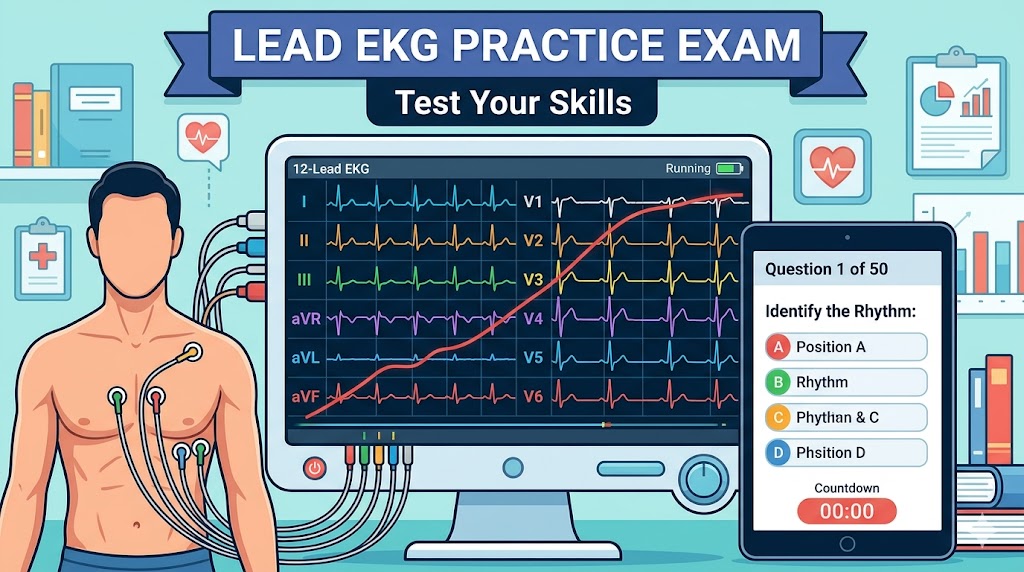
Additional Information
2 What the Course Entails and Exam Details
The course and subsequent exam are designed to deeply
immerse you in the art and science of 12-lead EKG interpretation. It’s not just
about identifying a rate and rhythm; it's about synthesizing multiple
viewpoints of the heart to diagnose complex conditions. The core curriculum
typically covers:
- EKG
Fundamentals: A solid review of cardiac anatomy, physiology, and the
electrical conduction system. This includes understanding waveforms,
intervals, and segments.
- 12-Lead
EKG Lead System: Master the precise placement of electrodes and
understand the unique perspective each lead (bipolar limb leads, augmented
limb leads, and precordial chest leads) provides.
- Systematic
Interpretation Approach: Learn a structured, step-by-step method for
analyzing a 12-lead tracing, from calculating axis to evaluating intervals
and ST-T changes.
- Arrhythmia
Diagnosis: Expand your knowledge beyond basic rhythms to identify a
wide range of complex arrhythmias, including advanced heart blocks,
ventricular tachycardias, and atrial fibrillation/flutter.
- Myocardial
Ischemia and Infarction: Develop the critical skill of recognizing
ST-segment changes, T-wave abnormalities, and pathologic Q waves
indicative of myocardial ischemia, injury, and infarction (STEMI vs.
NSTEMI).
- Hypertrophy
and Bundle Branch Blocks: Learn to diagnose ventricular and atrial
hypertrophy and differentiate between left and right bundle branch blocks.
- Other
Conditions: Understand how electrolyte imbalances, drug toxicities,
and various other cardiac and pulmonary conditions can manifest on a
12-lead EKG.
3 What to Expect in the Final Exam
While the exact format can vary, the final comprehensive
exam for 12-Lead EKG certification generally involves a mix of theory and
practical interpretation. You can typically expect:
- Format:
A computer-based or written test dominated by multiple-choice questions. A
critical component will be interpreting actual 12-lead EKG strips. You
might be asked to diagnose a condition, identify specific lead findings,
or determine the appropriate clinical response based on the EKG. Some
tests may include scenario-based questions.
- Passing
Score Requirements: This varies by certifying body or institution.
Often, a high level of proficiency is required, with passing scores
ranging from 70% to 80% or higher.
- Time
Limits: Expect a timed exam, usually between 1 to 2 hours. This
requires you to be not only accurate but also efficient in your analysis.
- Specific
Rules: Most professional certification exams are proctored. You'll
likely be required to present identification, and the use of aids like
smartphones, calculators (unless specific ones are allowed), or textbooks
is strictly prohibited. Understanding the specific rules of your chosen
exam provider is essential.
4 How to Study and Exam Centers
Preparation is the key to success. Here’s a strategic
approach:
- Practice,
Practice, Practice: Use comprehensive practice tests like this one
repeatedly. It familiarizes you with the question style and helps you
gauge your understanding of complex concepts.
- Study
Real Strips: Don't just read about EKG findings; look at hundreds of
actual 12-lead tracings. Online repositories, flashcards, and textbook
figures are invaluable resources.
- Focus
on the "Why": Understand the underlying reasons for specific
EKG changes (e.g., why a STEMI shows ST elevation in specific leads).
- Master
the Criteria: Commit the diagnostic criteria for key conditions (STEMI
criteria, heart block criteria, bundle branch block criteria) to memory.
- Review
Systematic Approaches: Practice a consistent routine for every strip
you analyze (Rate, Rhythm, Axis, Intervals, ST-T changes).
- Use
Study Guides: Leverage textbooks and study guides designed for
advanced EKG interpretation or ACLS preparation, as these often cover
12-lead topics.
Where to Take the Exam: The final certification exam
is often administered through various channels:
- Online
Portals: Many educational companies and professional organizations
offer online courses with integrated final exams.
- Authorized
Training Centers: Institutions like the American Heart Association
(AHA) or Red Cross may offer relevant certifications, often as part of
advanced courses like ACLS.
- Specialized
Certification Bodies: Technical organizations for EKG technicians or
allied health professionals may have their own certification exams,
sometimes held at physical testing centers or authorized schools.
- Pearson
VUE or Prometric: For some national certifications, the exam may be
proctored at a Pearson VUE or Prometric testing center. Always check with
your specific certifying body for details.
5 Job Opportunities from the Course
A strong proficiency in 12-lead EKG interpretation
significantly enhances your professional credentials and opens doors to various
rewarding career paths. It is often a required or highly desired skill for the
following positions:
- Certified
Electrocardiograph (EKG) Technician: Specializes in performing and
interpreting EKGs in hospitals, clinics, or private practices.
- Monitor
Technician: Responsibly observes and interprets continuous cardiac
monitoring in telemetry units, ICUs, or EDs.
- Cardiovascular
Technician: A broader role that can involve assisting with EKGs,
stress tests, and catheterizations.
- Certified
Nurse Aide (CNA) / Patient Care Technician (PCT): Advanced EKG
training can lead to specialized roles within cardiac units.
- Paramedic
/ Emergency Medical Technician (EMT): Mastery is crucial for field
diagnosis and triage of cardiac emergencies.
- Registered
Nurse (RN): Especially in high-acuity areas like the Emergency
Department, ICU, or Cardiology Unit, where rapid and accurate EKG
interpretation is essential for patient care.
- Respiratory
Therapist: Uses EKG findings to assess a patient's cardiac function
alongside respiratory status.
This specialized skill not only makes you more competitive
in the job market but also enables you to provide a higher level of care to
your cardiac patients.
Frequently Asked Questions
Reviews
5.0
Based on 0 reviews
Leave a Review
No reviews yet. Be the first to review!