
17X Mission Assurance Day 1 Practice Exam
$69.00
- Buy to unlock unlimited access to all Quiz questions and Answers in this Quiz.
- After purchase you can print a PDF of the whole quiz at any point. The PDF will contain the questions and the correct answers.
About this Exam
Welcome to your comprehensive study guide for the 17X Mission Assurance Day
1 qualification process. This introductory certification is strategically
designed for cyberspace operations professionals, systems engineers, risk
managers, and defense contractors tasked with ensuring the success and
resilience of critical defense missions. It provides a foundational
understanding of how to identify vulnerabilities and mitigate threats to ensure
essential functions continue under any condition. This practice exam is the
crucial first step in mastering the required mindset and core principles,
enabling candidates to proceed confidently toward full certification.
Ready to test your knowledge?
Buy Now to Access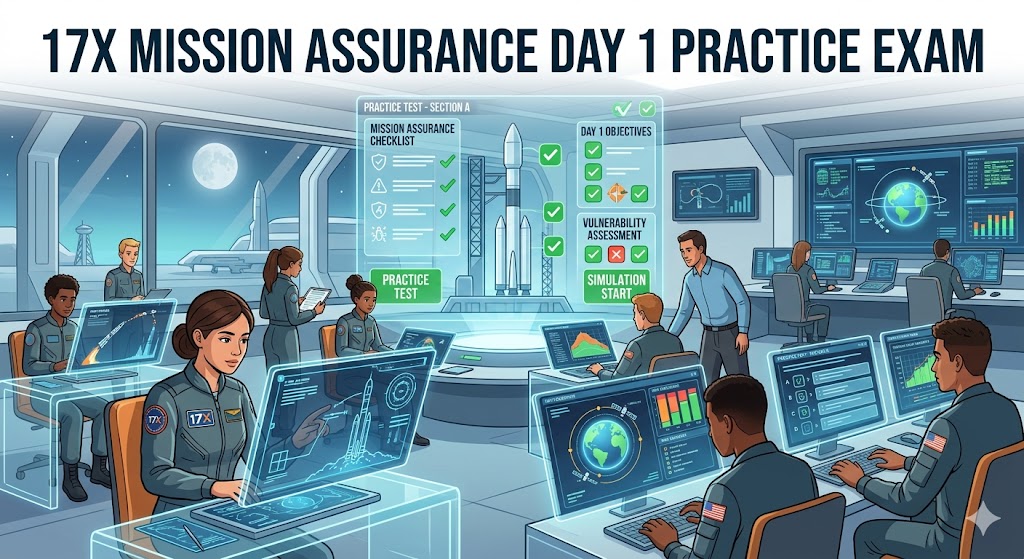
Additional Information
What the Course Entails and Exam Details
The foundation of the 17X Mission Assurance Day 1
curriculum focuses heavily on the integration of risk management, quality
assurance, and engineering disciplines across the entire life cycle of a
mission. It moves beyond simple compliance to prioritize mission success
against a spectrum of hazards.
Students preparing for this exam must master the
following core competencies:
<!--[if !supportLists]-->·
<!--[endif]-->Mission Assurance Constructs: Understanding the
foundational DoD and military-specific pillars of Mission Assurance and how
they differ from standard quality control.
<!--[if !supportLists]-->·
<!--[endif]-->Asset Categorization and Dependency Analysis: Learning
how to identify Mission-Essential Functions (MEFs) and the critical assets
(personnel, facilities, infrastructure, networks) that support them.
<!--[if !supportLists]-->·
<!--[endif]-->Risk Management Framework (RMF): Mastering the stages
of identifying, assessing, mitigating, and monitoring risks to strategic
missions.
<!--[if !supportLists]-->·
<!--[endif]-->Vulnerability Assessment and Mitigation: Developing
skills to analyze weaknesses in technical and operational systems and
implementing effective mitigation strategies.
<!--[if !supportLists]-->·
<!--[endif]-->Continuity of Operations (COOP): Grasping the
principles of resilient design and contingency planning to ensure mission
continuation during a disruption.
The exam itself serves as a foundational assessment,
ensuring that candidates possess the prerequisite theoretical knowledge before
advancing to practical, scenario-based training phases.
What to Expect in the Final Exam
The final 17X Mission Assurance Day 1 exam is a
rigorous assessment of theoretical knowledge and basic scenario application.
While exact formats can update periodically, candidates should expect a timed,
proctored computer-based test consisting primarily of multiple-choice
questions.
Here is what you need to know about the current format:
<!--[if !supportLists]-->·
<!--[endif]-->Total Number of Questions: You can expect
approximately 50 to 70 multiple-choice and scenario-based questions.
<!--[if !supportLists]-->·
<!--[endif]-->Time Limit: You will typically be allocated 90 minutes
to complete the exam.
<!--[if !supportLists]-->·
<!--[endif]-->Passing Score: The passing threshold is generally set
at 70%, emphasizing a solid grasp of core principles.
<!--[if !supportLists]-->·
<!--[endif]-->Exam Type: This is usually a closed-book, proctored
exam. Mobile devices, study notes, or external aids are not permitted during
the session.
Focus your study on defined terms, regulatory
hierarchies, the sequential steps of established risk frameworks, and standard
vulnerability mitigation protocols.
How to Study and Exam Centers
Effective preparation for the 17X Mission Assurance Day
1 exam requires a dedicated study plan that combines rote memorization of
definitions with conceptual understanding. We recommend beginning your journey
by thoroughly reviewing the official candidate handbook and all authorized
course slides provided during your initial training phase.
Implement these high-impact study strategies to
maximize your score:
<!--[if !supportLists]-->·
<!--[endif]-->Focus on Acronyms and Definitions: Mission Assurance
uses specialized terminology. Create flashcards for key terms, regulatory
bodies, and framework steps.
<!--[if !supportLists]-->·
<!--[endif]-->Master the Frameworks: Understand the flow of the Risk
Management Framework (RMF) and dependency mapping sequences. You should be able
to identify which step occurs next in a hypothetical scenario.
<!--[if !supportLists]-->·
<!--[endif]-->Take Multiple Practice Exams: Use authorized practice
tests repeatedly. This not only builds familiarity with the question phrasing
but also helps you manage your time effectively under pressure.
<!--[if !supportLists]-->·
<!--[endif]-->Form Study Groups: Collaborating with peers is highly
effective for clarifying complex concepts and discussing hypothetical mission
scenarios.
Regarding Exam Centers, this specific qualification is
primarily managed within authorized military training environments or through
specific secure, authorized government portals. Candidates should verify the
exact testing location with their command, training coordinator, or authorized
schoolhouse, as these exams are usually administered in physical, proctored
testing nodes rather than open public centers like Pearson VUE.
Job Opportunities from the Course
Earning a qualification in Mission Assurance opens
significant career paths within the Department of Defense, aerospace
organizations, and the broader defense industrial base. These roles are
critical, high-visibility positions focused on high-level strategic success.
Following full certification, individuals are qualified
for specialized roles such as:
<!--[if !supportLists]-->·
<!--[endif]-->Mission Assurance Engineer
<!--[if !supportLists]-->·
<!--[endif]-->Quality Assurance Specialist (Defense Sector)
<!--[if !supportLists]-->·
<!--[endif]-->Risk Management Analyst (DoD Systems)
<!--[if !supportLists]-->·
<!--[endif]-->Cyberspace Operations Security Specialist
<!--[if !supportLists]-->·
<!--[endif]-->Operations Security (OPSEC) Planner
<!--[if !supportLists]-->·
<!--[endif]-->Continuity of Operations (COOP) Coordinator
<!--[if !supportLists]-->·
<!--[endif]-->Systems Security Engineer
Frequently Asked Questions
Reviews
5.0
Based on 0 reviews
Leave a Review
No reviews yet. Be the first to review!