
18B Mortar Employment & 81mm Practice Test
$69.00
- Buy to unlock unlimited access to all Quiz questions and Answers in this Quiz.
- After purchase you can print a PDF of the whole quiz at any point. The PDF will contain the questions and the correct answers.
About this Exam
The 18B Mortar Employment & 81mm qualification is a critical certification for US Army Special Forces Weapons Sergeants (MOS 18B) and select indirect fire personnel. This specialized training validates a soldier's ability to tactically employ, operate, and maintain the 81mm mortar system, a potent indirect fire weapon essential for supporting small-unit operations, providing illuminating fire, and obscuring enemy vision. Mastering the 81mm mortar is a key indicator of a weapons specialist's competence in delivering accurate, timely, and lethal fire support in both conventional and unconventional environments.
Ready to test your knowledge?
Buy Now to Access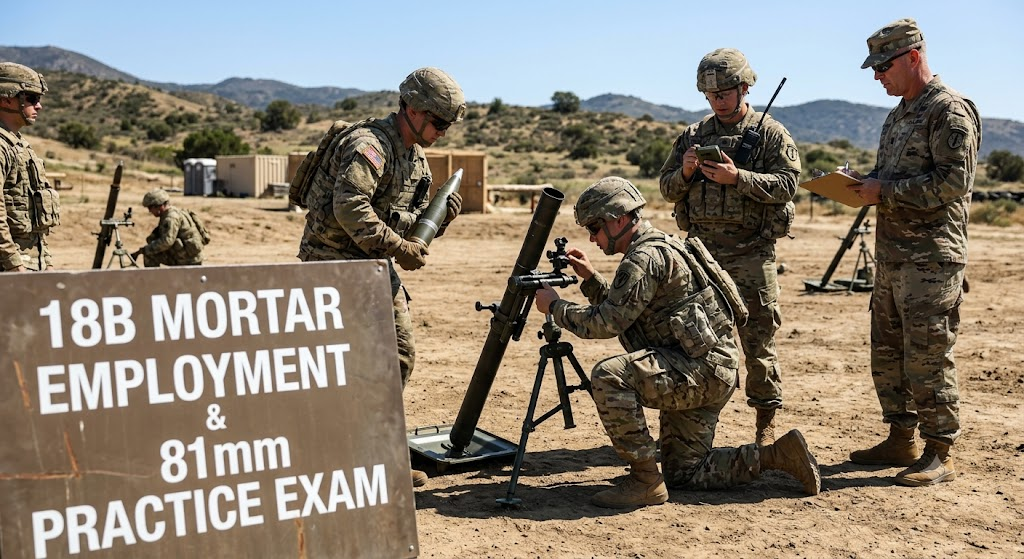
Additional Information
What the Course Entails and Exam Details
The course and final qualification cover a comprehensive syllabus designed to build expert proficiency. Key areas include:
81mm Mortar System: Comprehensive knowledge of the M252A1 (or L16A2) 81mm mortar, its components (cannon, bipod, baseplate, and sights), capabilities, and technical specifications.
Ammunition and Fuzes: In-depth understanding of current ammunition types, including High Explosive (HE), Smoke (RP and WP), and Illumination (IR and visible), alongside various fuze settings like multi-option and point detonating, ensuring effective target engagement.
Mortar Gunnery and Fire Direction: Advanced proficiency in fire direction center (FDC) procedures, manual and automated gunnery calculations, and direct, indirect, and reciprocal lay methods.
Employment Tactics and RSOP: Mastering Reconnaissance, Selection, and Occupation of Mortar Positions (RSOP), considering defilade, overhead and mask clearance, and survivability in dynamic tactical scenarios.
Forward Observer Procedures: Seamless coordination with forward observers for calls for fire and adjustments.
Maintenance and Troubleshooting: Expert skills in user maintenance and rapid troubleshooting to keep the weapon system operational under stress.
Safety Procedures: Uncompromising adherence to critical safety checks and operational protocols to prevent accidents.
What to Expect in the Final Exam
The final qualification exam is a multi-phased evaluation designed to test both theoretical knowledge and practical application under realistic conditions. Candidates must be prepared for:
Written Knowledge Test: A rigorous examination, often multiple-choice, covering the entire spectrum of mortar gunnery, ammunition, safety, and employment doctrine. This tests a soldier's foundational understanding of the "why" and "how" of 81mm operations.
Practical Performance Evaluations: The core of the qualification. Candidates must demonstrate proficiency in hands-on tasks, including rapid set-up and direct/indirect lay of the 81mm mortar, boresighting, FDC calculations, and firing drills. Evaluations often place a strong emphasis on speed, accuracy, and safety.
Scenarios and Simulated Missions: Evaluation might include a simulated field problem requiring the soldier to plan, position, and control fires for a specific scenario.
Time Limits and Accuracy Standards: Many practical tasks are strictly timed and have zero-tolerance for safety violations, reflecting the urgency and precision required in combat. The passing score is high, often requiring 100% on safety checks and significant accuracy on all technical and tactical tasks.
How to Study and Exam Centers
Effective preparation requires a blend of classroom study, personal review, and intensive practical application.
Actionable Study Strategies:
Master the Manuals: Thoroughly study ATP 3-22.90 (Mortars) and applicable Technical Manuals (TMs). These are your definitive references.
Utilize Practice Tests: Leverage practice exams like this one to identify knowledge gaps and get accustomed to the question format.
Form Study Groups: Collaborating with peers, especially those with mortar experience, is highly beneficial for discussing complex gunnery problems and practical drills.
Conduct Practical Drills: Repeatedly practice set-up, aiming, and fire command response until actions become muscle memory.
FDC Simulation: If possible, use automated FDC simulation tools or practice manual FDC calculations extensively.
Exam Centers: The 18B Mortar Employment & 81mm qualification does not take place at civilian testing centers. It is conducted as a formal unit evaluation, at specified training ranges, or within a military school environment, such as the US Army John F. Kennedy Special Warfare Center and School (USAJFKSWCS) for Special Forces personnel. Candidates are evaluated by certified instructors and senior mortar leaders.
Job Opportunities from the Course
Successfully achieving the 18B Mortar Employment & 81mm qualification opens direct career paths and enhances advancement opportunities within specialized military roles, including:
US Army Special Forces Weapons Sergeant (MOS 18B)
Mortar Section Leader (in specialized infantry or reconnaissance units)
Mortar Platoon Sergeant
Forward Observer / Joint Fire Support Specialist (highly valuable additional skill)
Instructor at military training centers focused on crew-served weapons and indirect fire tactics.
Frequently Asked Questions
Reviews
5.0
Based on 0 reviews
Leave a Review
No reviews yet. Be the first to review!