
18B Mortars Practice Exam
$69.00
- Buy to unlock unlimited access to all Quiz questions and Answers in this Quiz.
- After purchase you can print a PDF of the whole quiz at any point. The PDF will contain the questions and the correct answers.
About this Exam
The 18B Mortars qualification is a specialized certification designed for military personnel, particularly within special operations forces, who are training as weapons sergeants (18B). This exam is a critical step for individuals seeking to become experts in the operation, tactical employment, and technical management of various mortar systems used by light infantry and special operations units. It is designed for soldiers who have completed their initial specialized weapons training and are moving toward advanced certifications.
Ready to test your knowledge?
Buy Now to Access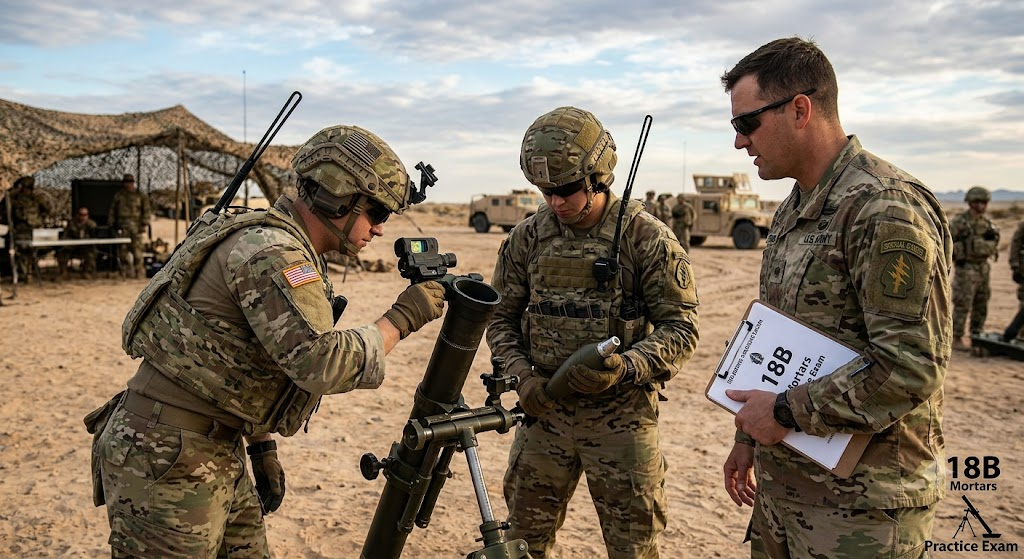
Additional Information
What the Course Entails and Exam Details
The course and subsequent exam cover a broad range of skills and knowledge essential for the 18B MOS. Candidates are required to demonstrate proficiency in:
Mortar System Identification and Operation: Comprehensive knowledge of various mortar platforms (e.g., 60mm, 81mm, and 120mm systems), their characteristics, capabilities, and detailed disassembly/assembly procedures.
Fire Direction Control (FDC): Advanced mastery of FDC procedures, including manual and automated calculations for fire missions, applying ballistic data, and coordinating fire support with ground units and forward observers.
Tactical Employment: Principles of planning, selecting, and occupying mortar firing positions in diverse operational environments, supporting offensive and defensive operations.
Ammunition and Fuzes: In-depth understanding of mortar rounds, propellants, fuzes, and proper handling, storage, and safety procedures.
Maintenance and Troubleshooting: Field maintenance procedures, recognizing common malfunctions, and performing necessary repairs.
The 18B Mortars qualification is typically part of a comprehensive Advanced Weapons Course (AWC) or Special Forces Qualification Course (SFQC) for 18B sergeants.
What to Expect in the Final Exam
The final assessment is comprehensive and demanding, requiring both theoretical knowledge and practical application under pressure. Candidates can expect:
Written Examination: A rigorous multiple-choice test covering all technical and tactical aspects of mortar operations and fire direction control.
Practical Examinations (Performance Tests): Candidates must successfully complete hands-on tests that involve:
Operating and setting up various mortar systems quickly and accurately.
Processing fire missions under time constraints and simulated combat stress.
Demonstrating FDC procedures for complex scenarios.
Performing malfunction corrections and field maintenance.
Passing Score: The passing standard is typically extremely high, reflecting the specialized and high-stakes nature of Special Operations weapons sergeants. Candidates must demonstrate proficiency in all aspects to receive a passing grade.
Time Limits: Both written and practical sections are timed to simulate operational pressure and demand rapid, accurate decision-making.
Specific Rules: Candidates are often limited in the use of reference materials during the exam, especially during practical applications where split-second recall is essential.
How to Study and Exam Centers
Preparation for the 18B Mortars Practice Exam requires dedicated study and significant practical application. Successful candidates employ several strategies:
Hands-On Practice: The single most crucial study method is extensive repetition of all practical tasks, including mortar assembly/disassembly, gun drills, and FDC calculations. This must be done with speed and precision, ideally under peer supervision and stressful conditions.
Review of Field Manuals: Mastery of all relevant Army Field Manuals (FMs) and Technical Manuals (TMs) is required for the written exam.
Study Groups: Collaborating with fellow candidates to review doctrine, process practice fire missions, and test each other on technical knowledge and procedures is highly effective.
AWC/SFQC Instruction: The instruction provided during the formal course is paramount, and candidates must utilize all available training time to refine their skills.
Exam Centers: The final exams are administered at specialized military training centers, specifically at the home of US Army Special Operations Command (USASOC) at Fort Bragg, NC, or in conjunction with relevant Advanced Weapons Courses in tactical training areas.
Job Opportunities from the Course
Upon completion of the 18B weapons sergeant course, which includes the 18B Mortars qualification, soldiers are qualified to hold key roles within Special Forces and other specialized units:
Special Forces Weapons Sergeant (18B): Operating as the primary weapons expert on a Special Forces Operational Detachment Alpha (ODA).
Mortar Section Leader (Special Operations): Leading and supervising mortar teams in specialized light infantry or ranger units.
Fire Support Sergeant (NCO): Coordinating indirect fire assets and advising unit commanders on the tactical employment of mortars.
AWC Instructor: Training future 18B sergeants in advanced weapons and mortar operations.
Mortar Platoon Sergeant: Providing operational leadership and technical expertise for an infantry mortar platoon.
Frequently Asked Questions
Reviews
5.0
Based on 0 reviews
Leave a Review
No reviews yet. Be the first to review!