
19D Cavalry Scout Practice Exam
$69.00
- Buy to unlock unlimited access to all Quiz questions and Answers in this Quiz.
- After purchase you can print a PDF of the whole quiz at any point. The PDF will contain the questions and the correct answers.
About this Exam
Battlefield. This position is
designed for individuals who possess exceptional observational skills, physical
stamina, and a quick tactical mind. The 19D Cavalry Scout Practice Exam serves
as an essential preparatory resource for recruits aiming to excel during their
One Station Unit Training (OSUT) and secure this vital Military Occupational
Specialty (MOS). By utilizing this practice test, candidates can build confidence,
master core The 19D Cavalry Scout role represents the crucial "eyes and
ears" of the U.S. Army on the tactical concepts, and familiarize
themselves with the knowledge required to operate in high-stakes reconnaissance
environments. It is specifically tailored for future soldiers dedicated to
leading from the front in a challenging combat role.
Ready to test your knowledge?
Buy Now to Access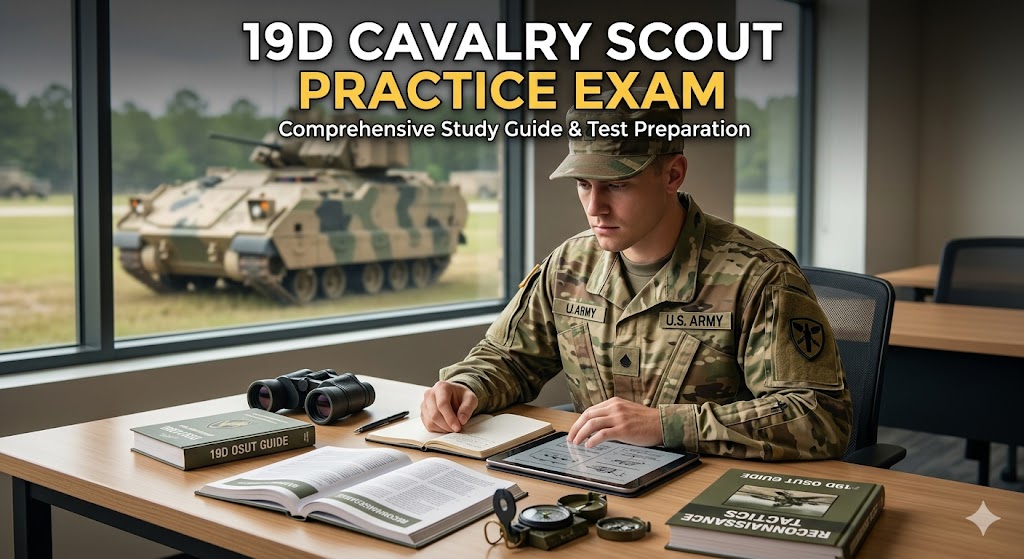
Additional Information
What the Course Entails and Exam Details
Preparing for the 19D role requires
comprehensive knowledge across diverse military disciplines. The underlying
training, which this practice test simulates, focuses heavily on mounted and
dismounted reconnaissance operations. Students must become proficient in
navigating complex terrain using advanced land navigation techniques, including
the use of maps, compasses, and GPS devices. A primary focus of the syllabus is
vehicle and aircraft identification, ensuring scouts can instantly distinguish
between friendly and enemy assets. Furthermore, the curriculum covers the
operation of crew-served weapons systems, communications security, tactical
reporting procedures, and the basics of forward observation for call-for-fire
missions. Practice tests designed for this specialty challenge your
understanding of these critical skills through multiple-choice scenarios.
What to Expect in the Final Exam
It is important to understand that
certification as a 19D Cavalry Scout is not achieved through a single written
exam, but through the rigorous completion of Army OSUT. However, written
assessments, which this practice material simulates, represent a critical
component of that training. In the actual OSUT environment at Fort Moore,
trainees face multiple-choice examinations covering theoretical knowledge,
vehicle recognition, and tactical procedures. These written tests contribute
significantly to your overall academic standing during training. Beyond the
classroom, candidates must pass practical hands-on evaluations, commonly known
as GO/NO-GO tests, which evaluate skills like weapons proficiency, radio
operation, and physical fitness through the Army Combat Fitness Test (ACFT).
Success requires a balance of sharp mental acuity and robust physical
endurance.
How to Study and Exam Centers
Effective preparation requires a
structured study approach. Utilize the 19D Cavalry Scout Practice Exam
repeatedly to simulate the testing environment and identify personal knowledge
gaps, particularly in complex areas like enemy vehicle identification. We
highly recommend complementing this practice test with official Army study
guides, physical training, and land navigation workshops. Many successful
candidates find value in studying with future peers to practice tactical
communication and scenario-based problem-solving. Regarding the physical exam
locations, official written and practical evaluations are conducted on-site at
U.S. Army training installations, most notably Fort Moore, Georgia (formerly
Fort Benning). While online practice portals provide indispensable prep, the
official MOS qualification occurs exclusively within regulated military
environments under the supervision of authorized instructors.
Job Opportunities from the Course
Successfully qualifying as a 19D
opens distinct career paths within the U.S. Army combat arms sector. The
intense training provides foundational skills highly prized for leadership
progression in tactical units. Graduates are immediately assigned to operational
cavalry units, where they apply their skills in real-world scenarios.
Specific job titles and roles
unlocked by this training include:
- U.S. Army Cavalry Scout (MOS 19D)
- Reconnaissance Platoon Sergeant
- Bradley Fighting Vehicle Commander
- Scout Section Leader
- Target Acquisition Specialist
- Selection candidate for elite assignments (such as U.S.
Army Ranger School or Special Forces)
- Tactical Advisor or Instructor in specialized recon
schools
Frequently Asked Questions
Reviews
5.0
Based on 0 reviews
Leave a Review
No reviews yet. Be the first to review!