
19D Cavalry Scout Practice Test
$69.00
- Buy to unlock unlimited access to all Quiz questions and Answers in this Quiz.
- After purchase you can print a PDF of the whole quiz at any point. The PDF will contain the questions and the correct answers.
About this Exam
The 19D Cavalry Scout (MOS 19D) is a critical role within the U.S. Army, serving as the "eyes and ears" of the commander. These specialized Soldiers are responsible for conducting reconnaissance, surveillance, and security missions, operating both in front of and alongside the main force to gather intelligence on enemy activities, terrain, and weather. This MOS requires individuals who are mentally and physically resilient, detail-oriented, and capable of operating independently and as part of a highly coordinated team. A "19D Cavalry Scout Practice Test" isn't a single standardized "certification" exam like in the civilian sector. Instead, it typically helps prospective recruits prepare for the key areas of the Armed Services Vocational Aptitude Battery (ASVAB) required to qualify for this Military Occupational Specialty, or assists enrollees in mastering the knowledge and practical skills assessed during their rigorous One Station Unit Training (OSUT).
Ready to test your knowledge?
Buy Now to Access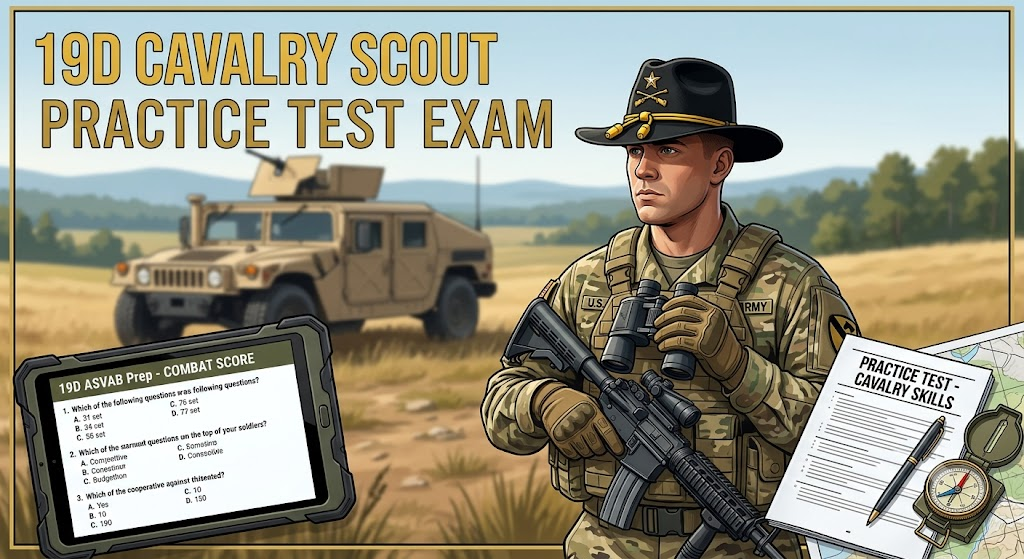
Additional Information
What the Course Entails and Exam Details
To become a 19D Cavalry Scout, you must first qualify and complete comprehensive training. The process entails:
Initial Qualification (The Exam Prep): Preparation involves targeting the key subtests of the ASVAB that calculate the Combat (CO) line score, a primary entry requirement. Core topics typically covered in practice materials for this score include:
General Science (GS)
Arithmetic Reasoning (AR)
Word Knowledge (WK)
Paragraph Comprehension (PC)
Auto & Shop Information (AS)
Mechanical Comprehension (MC)
Cavalry Scout Training (The Real Course): Successful enlistment leads to One Station Unit Training (OSUT), which combines Basic Combat Training (BCT) and Advanced Individual Training (AIT) in one location, usually Fort Moore, GA (formerly Fort Benning) or Fort Leonard Wood, MO. This 22-week course is a combination of classroom instruction and intense field exercises. The curriculum entails:
Reconnaissance and Surveillance: Mastering techniques to observe, report, and secure.
Land Navigation: Becoming proficient in the use of maps, compasses, and GPS systems in all terrain and light conditions.
Weapon Systems: Training to operate and maintain various individual and crew-served weapons, including the M4 carbine, M240 machine gun, M2 .50 caliber machine gun, and specialized anti-tank missile systems.
Tactical Operations: Learning squad maneuvers, convoy security, listening post/observation post (LP/OP) operations, and how to execute intelligence collection plans.
Vehicle Operations: Training on modern cavalry fighting vehicles and light-armored vehicles.
What to Expect in the Final Exam
As there is no single "final exam" for the 19D role, you must succeed at different stages. Here is what to expect for the two primary assessment areas:
The ASVAB (Qualification Test):
Format: The computer-based ASVAB is an adaptive multiple-choice test, meaning the questions adjust in difficulty based on your previous answers. The paper version is also multiple-choice but static.
Score Requirements: You must meet a minimum overall Armed Forces Qualification Test (AFQT) score to enlist. Crucially, for 19D, you must achieve a specific minimum Combat (CO) line score (e.g., typically a CO score of 87 or higher, though requirements can change).
Time Limit: The entire test lasts several hours, with specific time limits for each subtest section.
Rules: The ASVAB is administered under strict proctored conditions with no external aids allowed.
OSUT Graduation Assessments (Training Completion):
Format: Assessments during and at the end of OSUT are a combination of practical hands-on evaluations and performance-based tests.
Requirements: You must pass individual and collective tasks, physical fitness assessments (like the Army Combat Fitness Test - ACFT), weapon qualification ranges, and large-scale culminating field training exercises.
Rules: You must demonstrate proficiency in all essential skills and adhere to all Army standards and the core Army values throughout training to graduate.
How to Study and Exam Centers
Preparation for the 19D path is multi-faceted.
How to Study for the ASVAB (Initial Step):
Diagnostic Practice Tests: Take free or paid full-length practice ASVABs to identify your weak areas in the CO score subtests.
Targeted Review: Use ASVAB study guides (digital or physical) to focus on learning the specific concepts you struggled with, particularly in math, mechanics, and science.
Simulation: Take multiple full practice tests under timed conditions to get used to the format and manage your time effectively. Use official tools like the free "U.S. Army ASVAB Challenge" app.
Work with a Recruiter: Your Army Recruiter can provide study materials and schedule a practice test (EST) to gauge your readiness.
How to Prepare for OSUT (Secondary Step):
Physical Fitness: Start a training program that targets strength, endurance, and cardiovascular health to excel at the Army Combat Fitness Test (ACFT) before arrival.
Mental Preparation: Read about Army history, customs, and courtesies. Brush up on basic military knowledge to reduce stress during reception.
Skill Fundamentals: If possible, practice basic navigation and survival skills.
Exam Centers:
ASVAB: The official ASVAB is taken at Military Entrance Processing Stations (MEPS) or mobile testing sites across the country, organized by your recruiter.
OSUT: All 19D Cavalry Scout training and graduation practical testing take place at authorized Army training centers, primarily Fort Moore, GA, and Fort Leonard Wood, MO.
Job Opportunities from the Course
Graduation from 19D Cavalry Scout training unlocks specific career paths within the U.S. Army. It is essential to note that while direct civilian equivalents are limited, the skills gained are highly sought after by employers.
Army Career Path:
Cavalry Scout (MOS 19D)
Squad Leader (NCO)
Platoon Sergeant (NCO)
First Sergeant (NCO)
Warrant Officer (Cavalry/Armor)
Special Operations Opportunities (e.g., Ranger, Special Forces)
Skills Transferable to Civilian Careers:
The following job areas often value the training and experience of a Cavalry Scout:
Law Enforcement: Local, State, and Federal Agencies (e.g., Police Officer, State Trooper, FBI, DEA, DHS).
Private Security and Intelligence: Security Consultant, Intelligence Analyst, Surveillance Specialist.
Logistics and Supply Chain Management.
Emergency Management and First Response.
Heavy Equipment and Vehicle Operations.
Team Leadership and Operations Management.
Frequently Asked Questions
Reviews
5.0
Based on 0 reviews
Leave a Review
No reviews yet. Be the first to review!