
2391-52 Inspection and Testing Qualification Practice Test
$69.00
- Buy to unlock unlimited access to all Quiz questions and Answers in this Quiz.
- After purchase you can print a PDF of the whole quiz at any point. The PDF will contain the questions and the correct answers.
About this Exam
The City & Guilds 2391-52 Level 3 Award is a combined qualification, rigorously designed for practicing electricians who wish to take the next step in their careers. This comprehensive course equips you with the advanced skills and knowledge required to perform both Initial Verification on new electrical installations and Periodic Inspection & Testing on existing ones, resulting in the production of Electrical Installation Certificates (EICs) and Electrical Installation Condition Reports (EICRs). It's a definitive mark of competence and safety awareness, widely respected across the UK electrical industry. If you are a qualified electrician with appropriate foundational knowledge (such as 18th Edition wiring regulations), this qualification is the ideal progression pathway to become a fully recognized electrical inspector.
Ready to test your knowledge?
Buy Now to Access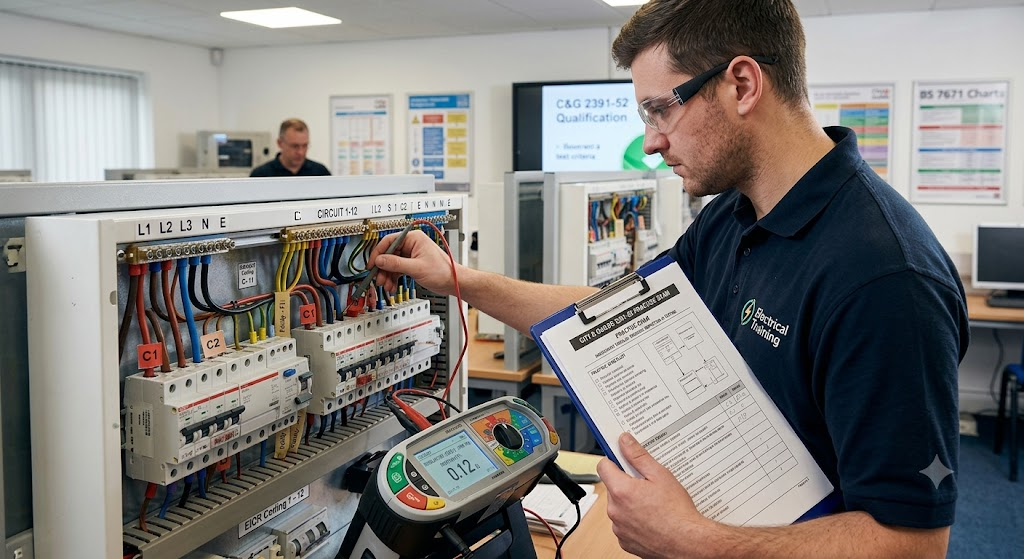
Additional Information
What the Course Entails and Exam Details
This intensive course blends theoretical understanding with practical application, ensuring you can competently and safely inspect and test electrical installations of various scales. The syllabus and practice material will cover:
Comprehensive understanding of relevant statutory and non-statutory regulations, primarily BS 7671 (the IET Wiring Regulations) and the requirements of Part P for domestic works.
Detailed procedures for initial verification of new installations, ensuring they meet design specifications and are safe for initial power-up.
Advanced techniques for the systematic periodic inspection of existing installations to identify deterioration, defects, and dangerous conditions, resulting in an accurate EICR.
Expert instruction and practice on using a wide range of electrical test instruments safely and correctly (e.g., multifunction testers, loop impedance testers, RCD testers, multimeters).
Correct sequencing and methodologies for key electrical tests, including continuity of protective conductors and ring final circuit conductors, insulation resistance, polarity, earth electrode resistance, earth fault loop impedance, and RCD functional and time testing.
The essential skill of interpreting test results accurately to ensure compliance and identify potential issues or non-conformities.
Meticulous guidance on completing industry-standard forms, including Electrical Installation Certificates, Schedule of Inspections, Schedule of Test Results, and the comprehensive Electrical Installation Condition Reports, complete with correct observation coding.
The exam details reflect the rigor of the qualification. Typically, the final assessment consists of two distinct components that must both be passed to achieve the qualification:
A written (often multiple-choice, online) exam, testing theoretical knowledge. This exam is typically around 60 questions and is open-book, allowing use of approved regulations and guidance material.
A practical assessment, where you must demonstrate your ability to correctly identify safety and non-compliance issues on a realistic installation, use test equipment properly and in the correct sequence, interpret results, and accurately complete the associated certification under strict assessment conditions.
What to Expect in the Final Exam
Prepare for a challenging, two-part assessment that aims to confirm your genuine competency, not just memorized facts. In the written component (often taken as a timed, online multiple-choice exam at an accredited center), you will face varied questions that assess your in-depth understanding of the wiring regulations, testing principles, safety protocols, and result interpretation. Time management is crucial for this portion.
The practical assessment is often the most nerve-wracking part and requires extensive practical experience and calm methodical application. Expect to:
Perform full safe isolation procedures on a realistic installation/rig under observation.
Identify a series of simulated visual non-compliances and defects.
Conduct a specified sequence of initial verification and/or periodic tests on that rig using calibrated instruments. The assessor will be watching for correct technique, instrument selection, data recording, and safety adherence throughout.
Accurately complete the correct certification for your work, ensuring all data is consistent, observations are properly noted and coded (C1, C2, C3, FI on an EICR), and the overall condition of the installation is clearly reported and documented.
The pass mark requirements are strict for both elements, and failure in either typically requires a retake. Practical competence, methodical execution, and calm nerves are key to success.
How to Study and Exam Centers
Preparation for the 2391-52 should be exhaustive, combining theoretical revision with intensive practical practice. Consider these strategies:
Master the Regulations: BS 7671 is your primary resource. Ensure you have the latest edition and have studied it, the associated guidance notes, and recommended practical handbooks extensively. Use the index to quickly locate specific information during open-book exams.
Mock Exams & Question Banks: Utilize all available practice materials, past papers (where official or representative and permissible), and quality online mock exam platforms. Practice under timed conditions to improve your speed and confidence with the written format. Study the detailed feedback on incorrect answers.
Intensive Practical Practice: This is critical. Rehearse the full testing sequence, safe isolation, visual inspection, instrument operation, result interpretation, and certificate completion on a training rig or real (supervised) installations repeatedly. Ensure you are familiar with the operation of different test instruments. Seek opportunities to perform inspections and testing under real-world scenarios before the assessment.
Time Management: Develop a structured study schedule that covers all topics. When practicing, simulate exam conditions for both components, focusing on speed and accuracy, especially with certificate completion.
Exam Centers: The 2391-52 qualification is delivered and assessed by numerous accredited City & Guilds training centers across the UK, including further education colleges, specialist private electrical training providers, and approved authorized schools. The written component (multiple-choice or otherwise) is typically taken under controlled conditions at the training center where you are enrolled, which will often handle your registration. The practical assessment will always take place at a dedicated, accredited center with the appropriate rigs and assessment facilities. When selecting a course, check that they include and are authorized to conduct the final C&G assessments and enquire about their pass rates and available practice facilities. Some providers may offer online study components, but the mandatory practical assessment will require a physical visit to an accredited center.
Job Opportunities from the Course
Successfully gaining the 2391-52 qualification unlocks significant and rewarding career paths within the electrical industry and beyond. It is a defining credential that separates a qualified installer from a recognized inspector, leading to roles and opportunities including:
Electrical Inspector
Approved Electrician / Electrical Qualifying Supervisor (QS)
Electrical Surveyor / Condition Report Specialist
Maintenance Electrician (with specialized testing responsibilities)
Site Manager / Project Manager (in electrical installations)
Compliance Manager / Health & Safety Officer (with electrical focus)
Electrical Technical Author / Trainer
Private consultant offering specialized inspection and testing services
Landlord Electrical Compliance Officer / Housing Association Electrical Lead
Utility Company / Distribution Network Operator roles focused on safety and verification.
These roles often command higher salaries, greater responsibility, and increased job security due to the essential nature of compliant and safe electrical installations. This qualification is an excellent investment in your professional future.
Frequently Asked Questions
Reviews
5.0
Based on 0 reviews
Leave a Review
No reviews yet. Be the first to review!