
2nd Class Power Engineering 2A2 Practice Exam
$69.00
- Buy to unlock unlimited access to all Quiz questions and Answers in this Quiz.
- After purchase you can print a PDF of the whole quiz at any point. The PDF will contain the questions and the correct answers.
About this Exam
The 2nd Class Power Engineering certification is designed for experienced 3rd Class Power Engineers who demonstrate the potential to lead. It represents a transition from a primary focus on equipment operation to overseeing entire facility systems, teams, and regulatory compliance. Achieving your 2nd Class ticket marks you as a senior technical expert and opens the door to high-level supervisory and management positions. The [2nd Class Power Engineering 2A2 Practice Exam] specifically tests your advanced understanding of theoretical principles, preparing you for the rigor of the official SOPEEC (Standardization of Power Engineer Examinations Committee) 2A2 exam.
Ready to test your knowledge?
Buy Now to Access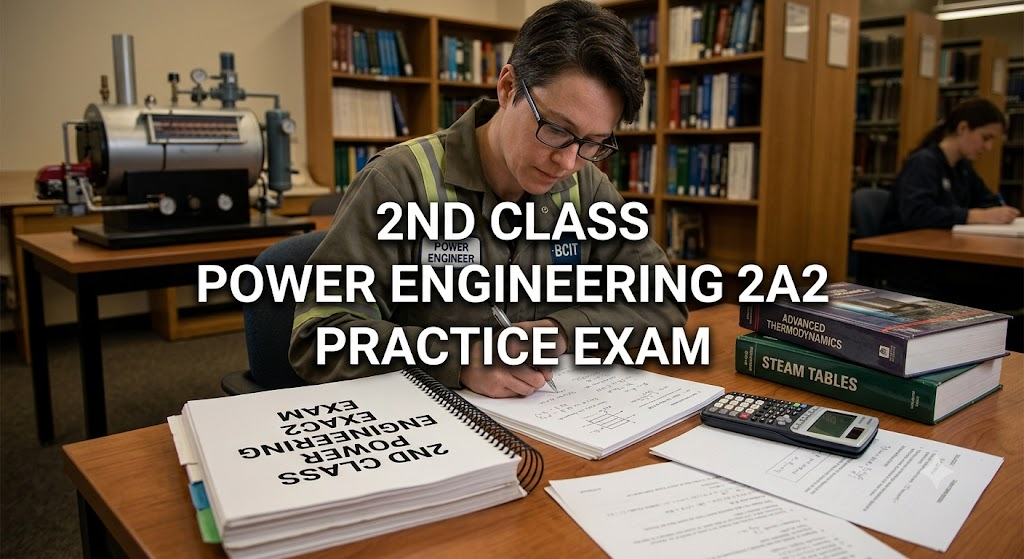
Additional Information
What the Course Entails and Exam Details
The core curriculum for the 2nd Class 2A2 paper is standardized across Canada and focuses on high-level theory. The major subject areas covered include:
Metallurgy: In-depth study of metals, their properties, crystalline structures, heat treatment processes, and the selection of materials for high-pressure, high-temperature power plant applications.
Non-Destructive Testing (NDT) and Corrosion: Understanding advanced inspection techniques, such as ultrasonic, radiographic, magnetic particle, and liquid penetrant testing, to assess equipment integrity without causing damage. It also covers the mechanisms, monitoring, and control of various forms of corrosion.
Welding: Advanced knowledge of welding processes, joint design, welding metallurgy, pre-heating and post-weld heat treatment, and the interpretation of welding symbols and procedure specifications (WPS).
Applied Thermodynamics: This is a heavy section, requiring mastery of advanced concepts. Topics include steam plant cycles (Rankine cycle with reheat and regeneration), internal combustion engine cycles (Otto, Diesel, Dual), gas turbine cycles (Brayton), compression refrigeration cycles, and the properties of steam (using steam tables and Mollier diagrams) for energy analysis. It also covers the principles of psychrometry (the study of moist air) relevant to HVAC and cooling tower applications.
What to Expect in the Final Exam
The official 2nd Class Power Engineering 2A2 examination is a rigorous assessment administered by your provincial boiler and pressure vessel safety authority (e.g., TSBC, ABSA, TSSA). Candidates should be prepared for the following:
Format: The standard format is a comprehensive multiple-choice exam, featuring 100 questions.
Time Limit: You will be given a maximum of 3.0 hours (180 minutes) to complete the entire exam.
Passing Score: A minimum grade of 65% is required to pass the 2A2 paper.
Rules: The exam is strictly timed, and candidates must adhere to all provincial safety authority regulations regarding the use of reference materials, calculators, and conduct.
Required Reference Material: Candidates are typically permitted and expected to use the official SOPEEC-approved reference material, which includes the ASME Code extracts, Handbook of Formulae and Physical Constants, and Steam Tables. Effective navigation of these documents is a critical skill tested by the exam.
How to Study and Exam Centers
Preparing for the 2nd Class 2A2 exam requires a structured and consistent study plan. It is not an exam that can be taken lightly. We recommend the following strategies:
Review the Official Syllabus: Start by downloading the complete, revised SOPEEC 2nd Class syllabus for Paper 2A2 from your provincial regulator's website. Use this as your primary checklist.
Utilize Authorized Textbooks: Study from the established industry standard textbooks, such as the PanGlobal 2nd Class material. These are specifically designed to cover the SOPEEC curriculum in detail.
Solve Practice Exams: Consistently working through realistic [2nd Class Power Engineering 2A2 Practice Exams] is perhaps the most effective way to identify your knowledge gaps, practice time management, and build confidence.
Master the Steam Tables and Formula Handbook: You must be able to quickly and accurately find data in the allowed reference material. Practice solving thermodynamics problems using only these documents.
Consider a Preparatory Course: Many technical institutes and colleges across Canada offer specific 2nd Class preparatory courses (online or in-person) that provide structured learning and instructor support.
Join Study Groups: Connecting with fellow 3rd Class engineers preparing for the 2nd Class exams can offer valuable peer support and diverse perspectives.
Exam Centers: The final, official exam is administered directly by the jurisdictional safety authorities. You must register to write the exam in the province where you are certified as a 3rd Class engineer. Examples of these authorities include:
ABSA (Alberta Boilers Safety Association)
TSBC (Technical Safety BC)
TSSA (Technical Standards and Safety Authority - Ontario)
TSASK (Technical Safety Authority of Saskatchewan)
Register on their respective online portals and choose a convenient location from their designated testing centers or authorized physical locations.
Job Opportunities from the Course
Successfully completing the [2nd Class Power Engineering 2A2 Practice Exam] and achieving your full 2nd Class certificate unlocks exceptional career opportunities in complex, high-pressure environments. With your 2nd Class ticket, you are qualified for senior, supervisory, and management roles, including:
Chief Power Engineer
Shift Engineer / Assistant Shift Engineer
Assistant Chief Engineer
Plant Manager
Maintenance Supervisor / Operations Manager
Operations Team Lead
Control Room Operator (in large utility or industrial plants)
Power System Operator
Industrial Facility Manager
Refrigeration Plant Manager (unlimited capacity)
These roles exist in a wide range of critical industries, including:
Power Generation: Utility-scale thermal, nuclear, or large cogeneration plants.
Oil and Gas: Refineries, upgraders, gas processing plants, and SAGD operations.
Manufacturing: Large chemical, pulp and paper, mining, and food processing facilities.
Large Institutions: Major hospitals, universities, and commercial complexes.
District Energy Systems.
Achieving your 2nd Class certification is a major accomplishment that guarantees both challenge and substantial reward throughout your power engineering career.
Frequently Asked Questions
Reviews
5.0
Based on 0 reviews
Leave a Review
No reviews yet. Be the first to review!