
2nd Class Power Engineering (2A3) Practice Exam
$69.00
- Buy to unlock unlimited access to all Quiz questions and Answers in this Quiz.
- After purchase you can print a PDF of the whole quiz at any point. The PDF will contain the questions and the correct answers.
About this Exam
The 2nd Class Power Engineering (2A3) certification is a crucial milestone for experienced power engineers seeking to advance their careers and assume higher levels of responsibility in large industrial, manufacturing, and utility plants.
This certification validates your deep, technical knowledge and practical understanding of advanced steam generation systems, emphasizing complex boiler design, operation, inspection, and maintenance.
It is designed for individuals who have already obtained their 3rd Class Power Engineering Certificate and have completed the required qualifying operating experience.
This exam specifically focuses on the core principles and operational nuances of the 'A3' paper, preparing candidates to manage, troubleshoot, and optimize high-pressure boiler systems and their associated components.
Ready to test your knowledge?
Buy Now to Access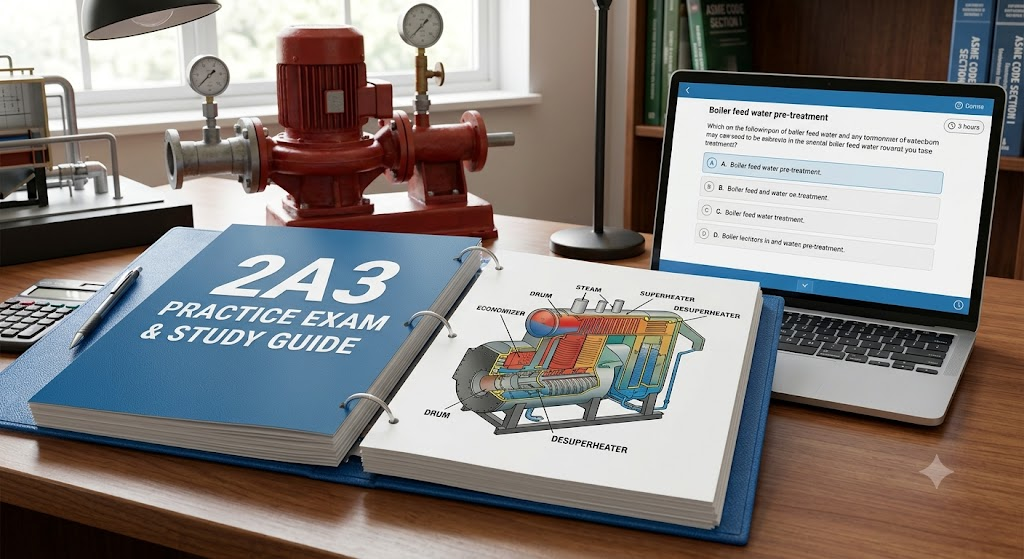
Additional Information
What the Course Entails and Exam Details
The course and subsequent 2A3 exam provide a thorough dive into the following advanced technical areas:
Steam Generator and Boiler Design: You will study the intricate details, configurations, and materials of specialized boilers, including multi-drum, once-through, and waste heat recovery units.
Boiler Operation: The material covers complex operational procedures, including start-up, shutdown, load management, and emergency response, with an emphasis on automation and control.
Boiler Inspection and Maintenance: You will learn advanced procedures for non-destructive testing (NDT), water-side and fire-side inspections, and specialized repair techniques, ensuring compliance with relevant codes (such as ASME and CSA).
Pumps: The syllabus covers the theory, application, performance curves, and maintenance of various high-pressure pump types used in power plants.
Water Chemistry and Treatment: A significant portion is dedicated to water pre-treatment, internal boiler water conditioning, and treatment for cooling and other non-boiler systems, ensuring system integrity and preventing corrosion and scale.
The 2nd Class 2A3 exam is one of six papers (2A1, 2A2, 2A3, 2B1, 2B2, 2B3) required to achieve the full 2nd Class Power Engineer Certificate of Competency.
What to Expect in the Final Exam
As of recent updates (starting in 2023/2024, varying by jurisdiction), the 2nd Class 2A3 exam is administered in a multiple-choice format.
This standardization is designed to provide a comprehensive, efficient, and consistent testing experience.
Format: The exam consists of 100 multiple-choice questions, each with one correct answer.
Time Limit: Candidates are typically allotted 3 or 3.5 hours to complete the exam.
Passing Score: To pass the exam and receive credit toward your 2nd Class certification, you must achieve a score of at least 65%.
Required Material: Candidates may be required to bring a calculator (non-programmable) and, in some cases, specific reference materials or code books, depending on the jurisdiction and testing center. Always confirm the specific list of allowed materials with your provincial regulator.
How to Study and Exam Centers
Effective study for the 2A3 exam combines theoretical knowledge with practical experience. We recommend the following strategies:
Utilize Official Syllabi: Start with the specific syllabus provided by your provincial safety authority (e.g., ABSA in Alberta, TSASK in Saskatchewan, TSSA in Ontario) or SOPEEC. This is your primary roadmap.
Study Official Textbooks: Invest in the recommended 2nd Class Part A3 textbooks. These are the foundation of your theoretical knowledge.
Take Practice Exams: This is critical. Regularly use comprehensive 2A3 practice exams to simulate test conditions, identify knowledge gaps, and become familiar with the multiple-choice structure.
Leverage Practical Experience: Relate your theoretical study to your daily work. Visualize the systems you read about and apply principles of maintenance and operation to your plant.
Join Study Groups and Review Courses: Collaborative learning and expert-led review sessions can clarify complex concepts and offer new perspectives.
The 2nd Class exams are generally administered through authorized provincial exam centers and selected post-secondary institutions. In most cases, these are physical proctored locations. Examples include:
Provincial Regulatory Offices: Many exams are taken directly at the offices of the safety authority.
College and University Testing Centers: Institutions that offer Power Engineering programs often serve as exam hubs.
Online Proctored Services (Select Jurisdictions): Some regions are moving toward or trialing online proctoring for certain written exams, but multiple-choice 2nd Class exams are predominantly taken at physical centers. Always verify your options with your local regulator.
Job Opportunities from the Course
Earning your 2nd Class Power Engineer certification, with the 2A3 paper as a key component, unlocks significant career advancement opportunities in various high-demand sectors:
Shift Engineer / Chief Engineer: In large industrial facilities (pulp and paper, chemical processing), a 2nd Class ticket is a common prerequisite for leadership roles, overseeing all shift operations and steam production.
Control Room Operator (Large Plant): You can manage the central control systems of complex power and process plants, optimizing efficiency and ensuring safety from a sophisticated panel.
Plant Supervisor / Manager: With further experience, this certification positions you for management positions, responsible for the entire power plant operations, maintenance, and budget.
Maintenance Supervisor: You can lead teams of mechanics, operators, and technicians, planning and executing advanced maintenance on critical high-pressure equipment.
Boiler Inspector / Surveyor: Transition into regulatory or insurance roles, ensuring public and industrial safety by inspecting pressure equipment and reviewing plant compliance.
Consulting Power Engineer: Use your advanced knowledge to provide expert advice on plant optimization, design, and code compliance to industrial clients.
Frequently Asked Questions
Reviews
5.0
Based on 0 reviews
Leave a Review
No reviews yet. Be the first to review!