
2nd Class Power Engineering (2B1) Practice Exam.
$69.00
- Buy to unlock unlimited access to all Quiz questions and Answers in this Quiz.
- After purchase you can print a PDF of the whole quiz at any point. The PDF will contain the questions and the correct answers.
About this Exam
The 2nd Class Power Engineering certification represents a major career milestone for experienced power engineers across Canada, unlocking mid-to-senior level roles with increased responsibility and compensation. Designed for individuals who have already earned their 3rd Class Certificate, this qualification enables engineers to supervise complex plant operations, manage maintenance teams, and serve as a Chief Engineer in many facilities. To achieve this, candidates must pass six standardized exams set by SOPEEC and meet specific hands-on experience requirements outlined by their provincial safety authority. The 2B1 exam is one of the key "Part B" papers, focusing on the practical knowledge and advanced understanding of essential prime movers and related plant systems. Passing this exam demonstrates an essential proficiency required to lead in high-stakes, large-scale industrial environments.
Ready to test your knowledge?
Buy Now to Access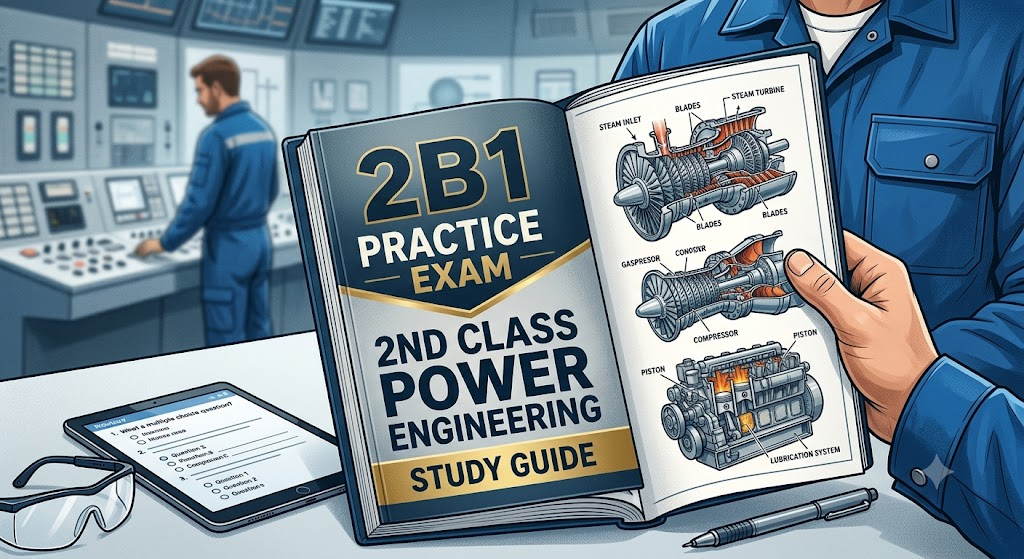
Additional Information
What the Course Entails and Exam Details
The 2B1 exam paper delves into the theory, construction, operation, and maintenance of critical prime movers and auxiliary systems used in modern power plants. While other exams cover thermal principles and boiler specifics, 2B1 is distinctly focused on power generation machinery.
The comprehensive SOPEEC syllabus for the 2B1 exam includes the following major topic areas:
Steam Turbines: Theoretical principles of impulse and reaction turbines, detailed construction features, auxiliary systems, control mechanisms, operation, maintenance procedures, and steam condensers.
Internal Combustion Engines: Comprehensive understanding of both large diesel and gas-fired engine components, auxiliary support systems, operation, and maintenance.
Gas Turbines: Detailed analysis of gas turbine design, cycle efficiency, essential auxiliaries, operation, and control systems.
Lubrication: Advanced principles of lubrication, including different types of lubricants, their properties, application methods, and the design of lubrication systems for large machinery.
Piping Systems: Understanding of piping codes, materials, design, installation, and inspection of industrial piping.
Mechanical Drawing: The ability to read, interpret, and produce basic engineering and mechanical drawings, including diagrams of complex systems.
This exam tests not just factual knowledge but also the candidate's ability to apply that knowledge to operational scenarios, troubleshooting, and plant-wide management.
What to Expect in the Final Exam
The 2nd Class Power Engineering 2B1 exam is a critical, single-paper examination.
Key details you need to be prepared for include:
Format: The exam consists of 100 multiple-choice questions, which is the now-standardized format for all 2nd Class papers.
Time Limit: Candidates are allotted 3 hours (180 minutes) to complete the entire examination.
Passing Score: A minimum grade of 65% is required to pass the 2B1 paper.
Prerequisite: Candidates must hold a valid 3rd Class Power Engineer's Certificate to be eligible to challenge any of the 2nd Class exams.
Structure: It is highly recommended to approach the exam with a strategy, as the questions cover a wide and detailed range of complex topics within the allotted time. All questions must be completed during a single session, making time management a vital skill. Provincial safety regulators administer the exam, ensuring adherence to national SOPEEC standards.
How to Study and Exam Centers
Effective preparation for the 2B1 exam requires a structured approach that combines theory with a deep understanding of practical operations.
Follow these proven study strategies:
Master the Syllabus: Obtain and thoroughly review the current official SOPEEC 2nd Class syllabus. Every question on the exam is derived directly from this document, so ensure you have no gaps in your understanding.
Enroll in an Approved Course: Consider taking a 2nd Class Power Engineering course from a recognized technical institute or college. These courses provide structured learning and often include valuable practical insights.
Utilize Practice Exams: Incorporating a 2nd Class Power Engineering 2B1 Practice Exam into your study routine is invaluable. It helps you become familiar with the multiple-choice format, identifies weak areas, and builds crucial time management skills.
Study Group and Peer Review: Collaborate with fellow 3rd Class engineers studying for the same level. Explaining complex concepts to others is an excellent way to solidify your own understanding.
Focus on Prime Movers: Given the high weighting of steam turbines, gas turbines, and internal combustion engines, dedicate additional time to understanding the nuances of their construction, control, and operational troubleshooting.
Exam Centers and Booking:
The 2B1 exam is administered provincially. You must book through your specific provincial safety authority (e.g., TSBC, ABSA, TSSA, etc.).
Exam options include:
Physical Testing Centers: Most provinces offer exams at dedicated testing centers or at the campuses of technical institutes.
Authorized Invigilation Centers: In some areas, approved third-party invigilators can administer the paper-based or computer-based exam.
Online Portals: Some jurisdictions are transitioning to online exam delivery through secure, proctored platforms, providing greater flexibility. Check with your local provincial authority for the most current information regarding available formats and booking procedures.
Job Opportunities from the Course
Earning your 2nd Class Power Engineering certification opens doors to a wide range of rewarding, high-responsibility positions within the power generation and utility sectors, as well as complex industrial facilities.
Graduates and certified 2nd Class engineers can pursue diverse career paths, including:
Chief Engineer: Supervise and lead operations of a plant with a capacity corresponding to or lower than the 2nd Class.
Shift Engineer: Manage the safe and efficient operation of a plant, which can be up to one class higher than your certificate level.
Assistant Chief Engineer: Provide leadership and oversight within larger, first-class power plants.
Person-in-charge of Refrigeration Plants: Have overall responsibility for any size or type of industrial refrigeration system.
Maintenance Manager: Oversee and coordinate all mechanical and electrical maintenance within a power facility.
Plant Manager: Transition into overall plant leadership, combining technical expertise with management responsibilities.
This qualification is highly regarded by employers, reflecting a deep, verified level of competence essential for the safe and efficient operation of large, complex industrial systems.
Frequently Asked Questions
Reviews
5.0
Based on 0 reviews
Leave a Review
No reviews yet. Be the first to review!