
2nd Class Power Engineering (2B3) Practice Exam
$69.00
- Buy to unlock unlimited access to all Quiz questions and Answers in this Quiz.
- After purchase you can print a PDF of the whole quiz at any point. The PDF will contain the questions and the correct answers.
About this Exam
The 2nd Class Power Engineering (2B3) certification is a vital milestone for experienced power engineers across Canada, designed for those aiming to advance into senior operational and management roles. This advanced certification is a prerequisite for becoming a Chief Power Engineer or Senior Operating Engineer, positions with considerable responsibility for the continuous supervision of large-scale, complex high-pressure thermal liquid, heating, and power plants. Achieving your 2nd Class ticket demonstrates not only a deep theoretical understanding but also the practical management skills necessary to oversee complex systems, lead operational teams, and ensure regulatory and environmental compliance in major industrial facilities. This specific 2B3 exam is a key component of the overall 2nd Class suite.
Ready to test your knowledge?
Buy Now to Access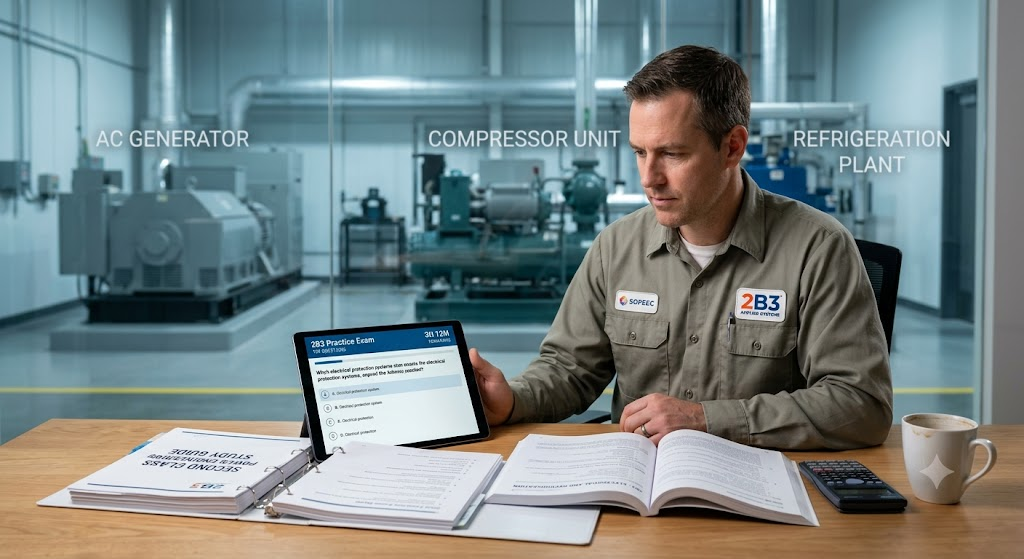
Additional Information
What the Course Entails and Exam Details
This particular exam, Part 2B3, focuses extensively on the intersection of applied electrical theory and specialized auxiliary plant systems. The syllabus, set by the Standardization of Power Engineer Examinations Committee (SOPEEC), covers a complex array of topics critical to modern plant leadership. When preparing for the 2B3 exam, you must master:
Electrical Theory and Application: Advanced Alternating Current (AC) theory, direct current (DC) machines, AC generators and motors, transformers, and complex electrical protection systems.
Air and Gas Compression: Principles of complex compression cycles, types of compressors (centrifugal, reciprocating, rotary), auxiliary systems, and performance monitoring.
Refrigeration Systems and Calculations: The physics of refrigeration, industrial system design and operation, thermodynamics of the cycle, and detailed performance and capacity calculations.
What to Expect in the Final Exam
While a practice exam simulates these conditions, the final certification exam itself is structured as follows:
Format: 100 Multiple Choice Questions, all papers in the 2nd Class suite are now multiple choice.
Time Limit: 3.5 Hours (210 minutes), giving you approximately 2.1 minutes per question.
Passing Score: A minimum of 65% on each paper is required to pass.
Rules: The official exams are "closed-book" and invigilated (proctored) by provincial or territorial safety authorities. You are typically allowed only approved non-programmable calculators and sometimes specifically listed code reference material, but no external study aids.
How to Study and Exam Centers
Preparation for an exam of this caliber requires a strategic and disciplined approach. Do not rely on memorization alone; focus on a deep comprehension of physical and engineering principles and their practical applications.
Study Strategies:
Utilize SOPEEC Study Guides: Begin with the official reference syllabus from SOPEEC and accredited technical college course material.
Practice with a 2B3 Practice Exam: Take multiple timed practice exams to simulate the pacing and pressure of the 100-question multiple-choice format. Use the results to pinpoint and study your weak areas.
Create Custom Notes: Condense your study material into concise summaries, focused diagrams (especially for electrical circuits), and comprehensive formula sheets.
Master Calculations: The refrigeration section, in particular, requires significant calculation skills. Work through numerous numerical problems to build speed and accuracy.
Exam Centers:
You cannot take the official 2nd Class certification exams online. You must register to write them in person. The exams are administered and invigilated by the safety authority in your specific province or territory. For example:
ABSA (Alberta Boilers Safety Association)
TSSA (Technical Standards and Safety Authority, Ontario)
TSBC (Technical Safety BC)
TSASK (Technical Safety Authority of Saskatchewan)
These authorities maintain dedicated examination centers. In some cases, authorized technical colleges or institutes of technology may also serve as physical testing locations, but your registration must always proceed through the relevant safety authority. Practice exams, however, are commonly available through online platforms.
Job Opportunities from the Course
Earning your 2nd Class Power Engineering certification dramatically shifts your career trajectory from operational and supervisory roles to senior, management, and Chief Engineer positions. This credential validates your expertise and leadership capability to employers. Specific career paths and job titles this certification unlocks include:
Chief Power Engineer
Deputy Chief Engineer
Shift Engineer (in first-class plants)
Assistant Shift Engineer (in first-class plants)
Plant Manager
Facilities Superintendent
Utilities Manager
Utilities Superintendent
Senior Operating Engineer
Senior Power Generation Technician
Power Plant Compliance Officer
We wish you the best of luck in your studies for the 2nd Class (2B3) exam!
Frequently Asked Questions
Reviews
5.0
Based on 0 reviews
Leave a Review
No reviews yet. Be the first to review!