
2PD Top 200 Drugs Anti-Infectives and Cardiovascular Agents Practice Test
$69.00
- Buy to unlock unlimited access to all Quiz questions and Answers in this Quiz.
- After purchase you can print a PDF of the whole quiz at any point. The PDF will contain the questions and the correct answers.
About this Exam
Welcome to your essential preparation resource for the 2PD Top 200 Drugs Anti-Infectives and Cardiovascular Agents Practice Test. This exam is a critical academic milestone specifically designed for second-year Pharmacy Doctor (2PD) students within a professional PharmD program. It serves as a rigorous assessment of your foundational knowledge of the most commonly prescribed medications in two vital therapeutic categories: anti-infectives (antibiotics, antivirals, antifungals) and cardiovascular agents (antihypertensives, anticoagulants, lipid-lowering drugs). Mastering this content is crucial not only for passing the course but also for building the clinical competence required for future rotations and licensure examinations like the NAPLEX.
This practice test is an invaluable tool for students to gauge their readiness, identify knowledge gaps, and become familiar with the format and types of questions they will encounter on the high-stakes final examination.
Ready to test your knowledge?
Buy Now to Access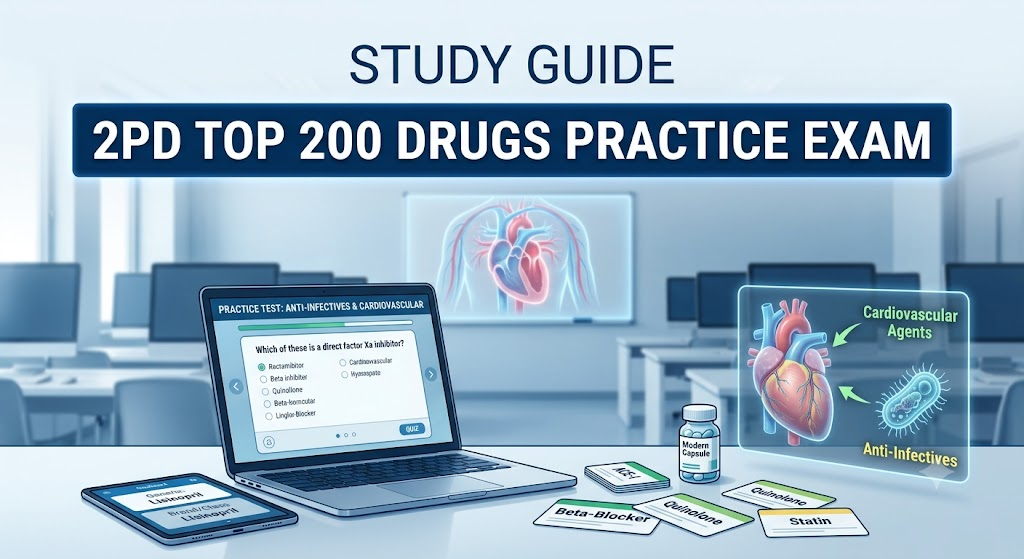
Additional Information
What the Course Entails and Exam Details
This examination is typically the culmination of a dedicated module or series of lectures within the second professional year. The core focus is on comprehensive drug knowledge. You are expected to demonstrate proficiency in several key areas for every drug on the specified Top 200 list within these classes. The exam content will cover:
Drug Names: Flawless recall of both Brand and Generic names.
Therapeutic Class and Subclass: Correct classification (e.g., Identifying Lisinopril as an ACE Inhibitor within the Cardiovascular class).
Mechanism of Action (MOA): A detailed understanding of how each drug works at the physiological and molecular level (e.g., How beta-blockers affect heart rate and contractility).
Primary Clinical Indications: The FDA-approved uses for each medication.
Critical Adverse Effects: Identifying common, severe, or 'red-flag' side effects.
Major Drug Interactions and Contraindications: Knowing when a drug should not be used and what it should not be combined with.
The "Anti-Infectives and Cardiovascular Agents" focus area represents a massive and high-yield portion of clinical pharmacy knowledge.
What to Expect in the Final Exam
While specific details can vary by institution, the 2PD Top 200 Drugs exam is generally uniform in its style.
Exam Format: You should expect a rigorous, computer-based, multiple-choice examination. This format tests your ability to make rapid, accurate decisions. Questions may range from simple brand/generic matching to more complex clinical vignettes where you must select the most appropriate drug for a patient with specific cardiovascular or infectious conditions, considering their co-morbidities and current medication list.
Passing Score and Time Limits: As this is a foundational competence exam, the passing score is often set high, frequently 80% or above, reflecting the need for mastery. Time limits are typically strict, challenging your recall speed and efficiency. For a 50-100 question exam, you may have 60 to 90 minutes.
Rules: This is a closed-book, proctored exam. No outside materials, references, or mobile devices are permitted. The emphasis is on internalizing the information.
How to Study and Exam Centers
Preparation for the 2PD Top 200 Drugs exam must be structured and cumulative. Cramming is rarely successful for this volume of detailed information.
Study Strategies:
Active Recall with Flashcards: This is the gold standard. Use physical or digital flashcards (like Anki) to quiz yourself daily on brand/generic matching, MOA, and indications. Separate your cards by therapeutic class.
Spaced Repetition: Implement a system where you review known drugs less frequently and difficult drugs more often.
Group Study and "Teach-Back": Explaining the mechanism of action of a quinolone antibiotic or the contraindications of a statin to a peer is an excellent way to solidify your own understanding.
Create Comparison Charts: For large classes like beta-blockers or cephalosporins, make charts detailing their subtle differences in selectivity, route of elimination, and specific indications.
Utilize This Practice Test: Treat this practice test like the real exam. Take it under timed, closed-book conditions to accurately assess your current knowledge and manage exam-day anxiety.
Exam Centers:
Because this is an internal, academic examination, it is administered on-campus at your specific College of Pharmacy. Testing typically takes place in authorized, computer-based testing labs or through secure online portals (like Canvas or Honorlock) managed by the university. Consult your course syllabus for precise location and scheduling details.
Job Opportunities from the Course
Successfully mastering the Top 200 Drugs, starting with this 2PD assessment, is a direct prerequisite for the entire career path of a pharmacist. This foundational knowledge is not just for a test; it is the core toolkit you will use every day in practice. While this single exam doesn't unlock a job title on its own, it is a non-negotiable stepping stone to the following career paths:
Community Pharmacist: Utilizing Top 200 knowledge for accurate dispensing, patient counseling, and identifying potential errors.
Clinical Pharmacist (Hospital/Health-System): Applying deep knowledge of MOA, interactions, and dosing for complex patient care in internal medicine, infectious diseases, or cardiology teams.
Managed Care Pharmacist: Using drug knowledge for formulary management, prior authorization review, and population health initiatives.
Pharmaceutical Industry Professional: Roles in medical affairs, drug information, or sales where expert knowledge of specific therapeutic areas is required.
Pharmacy Resident: This academic foundation is essential for securing competitive residency positions post-graduation.
Your success here is the first major step toward your future in pharmacy practice. Good luck with your studies!
Frequently Asked Questions
Reviews
5.0
Based on 0 reviews
Leave a Review
No reviews yet. Be the first to review!