
30-Hour Driver's Ed Practice Test
$69.00
- Buy to unlock unlimited access to all Quiz questions and Answers in this Quiz.
- After purchase you can print a PDF of the whole quiz at any point. The PDF will contain the questions and the correct answers.
About this Exam
The 30-Hour Driver's Education program is a comprehensive curriculum designed for new drivers, often teenagers seeking their first learner's permit or provisional license. This structured course provides the essential knowledge base required for safe and responsible vehicle operation. The practice exam serves as a crucial checkpoint, validating a student's understanding of traffic laws, road signs, and defensive driving principles before they advance to behind-the-wheel training or the official state licensing exam. It is an indispensable tool for building confidence and identifying areas that require further study.
Ready to test your knowledge?
Buy Now to Access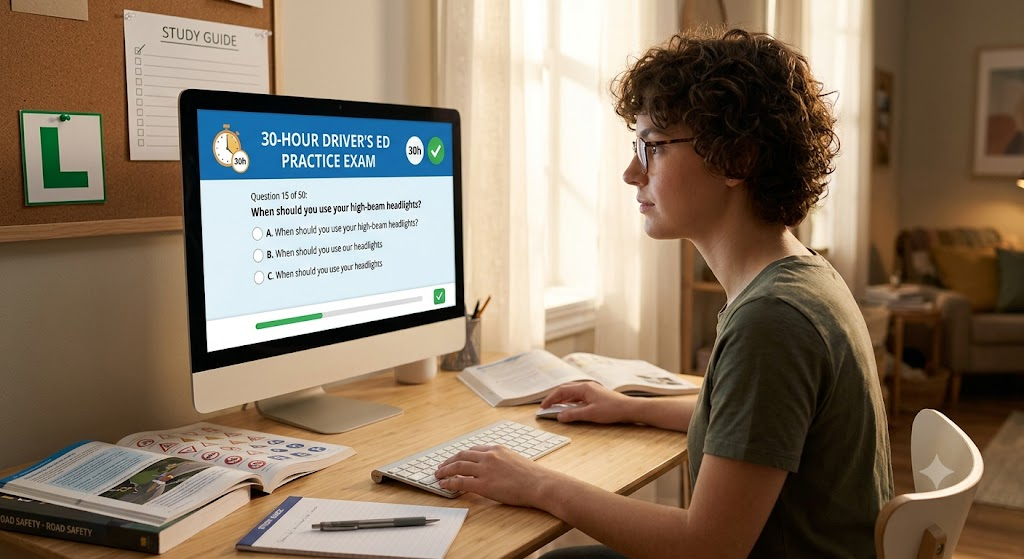
Additional Information
What the Course Entails and Exam Details
The 30-Hour Driver's Ed curriculum covers an extensive array of foundational driving topics. Students delve deeply into state-specific traffic laws, including right-of-way rules, speed limits, and intersection navigation. A significant portion of the course is dedicated to interpreting the meanings of hundreds of standardized road signs, signals, and pavement markings. Defensive driving strategies, such as maintaining a safe following distance and scanning the environment for hazards, are emphasized.
Furthermore, the course addresses critical safety subjects, such as the dangers of driving under the influence (DUI) and distracted driving (e.g., texting while driving). Vehicle maintenance basics, sharing the road with pedestrians and cyclists, and procedures for handling emergency situations like tire blowouts or skidding are also covered. The practice exam accurately reflects this syllabus, testing students on scenarios derived directly from these core modules.
What to Expect in the Final Exam
While a final state exam's structure varies, the 30-Hour Driver's Ed practice test is specifically engineered to simulate that experience closely. Students can expect a computerized test comprising multiple-choice questions. A typical practice exam might include 30 to 50 questions.
The content distribution is balanced to cover all critical areas of the 30-hour course equally. To pass this comprehensive review, students must demonstrate a high degree of accuracy, with a common passing score threshold of 70% to 80% correct answers. Although official state exams often impose strict time limits (such as 30-60 minutes), the practice environment allows for more flexible time allocation to encourage deep learning. Rules usually mirror professional testing standards, emphasizing independent work and the prohibition of external aids.
How to Study and Exam Centers
Effective preparation for the practice exam begins with actively participating in all 30 hours of instruction. Students should supplement class time by thoroughly reviewing their official state driver’s manual and any provided course textbooks.
The single most effective study strategy is taking multiple varied practice tests. Retaking exams allows students to become accustomed to the question phrasing and timing. Focusing revision efforts on incorrect answers is essential for improvement. Many authorized driver education providers offer their practice exams directly through their secure online student portals, often the same platform where the 30-hour course is completed. In some cases, authorized physical testing centers or public library computer labs may host access to these resources.
Job Opportunities from the Course
A driver's license is a powerful credential that unlocks extensive employment possibilities across numerous industries. Successfully completing the prerequisite 30-hour driver’s education course and practice exam is the critical first step in obtaining that license, which is a common requirement for the following roles:
Delivery Driver (Food, Retail, Courier)
Ride-Share Driver (Uber, Lyft)
Professional Chauffeur or Valet Parking Attendant
Field Sales Representative
Real Estate Agent
Home Health Aide requiring patient transport
Construction Trades requiring site visits
Commercial Driver (with additional licensing)
By dedicating sufficient time to mastering the material covered in the practice exam, new drivers set themselves up for success both on the road and in their future career paths.
Frequently Asked Questions
Reviews
5.0
Based on 0 reviews
Leave a Review
No reviews yet. Be the first to review!