
3rd Class Power Engineering (3A1) Practice Exam Prep
$69.00
- Buy to unlock unlimited access to all Quiz questions and Answers in this Quiz.
- After purchase you can print a PDF of the whole quiz at any point. The PDF will contain the questions and the correct answers.
About this Exam
Prepare for a crucial milestone in your Power Engineering career. The 3rd
Class Power Engineering (3A1) Practice Exam is designed for professionals and
students aiming to advance their certification to the third-class level. Power
Engineers are responsible for operating and maintaining complex, high-pressure
equipment like boilers, turbines, and refrigeration systems. This certification
verifies your advanced knowledge of thermodynamics, power plant systems,
mechanical concepts, and essential safety regulations required to oversee
facilities and mentor lower-class operators. Earning this certificate
demonstrates the competency needed for increased responsibility and leadership
roles in industrial settings.
Ready to test your knowledge?
Buy Now to Access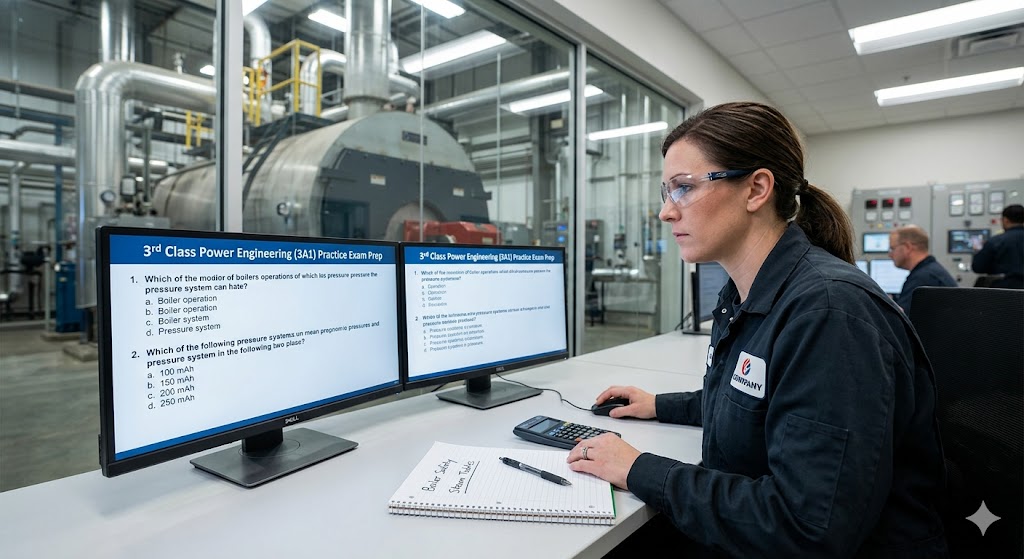
Additional Information
What the Course Entails and Exam Details
This examination covers a wide array of core engineering
principles and practical applications critical for efficient and safe power
plant operation. The 3A1 curriculum and exam focus heavily on fundamental
knowledge that underpins complex systems.
You can expect questions spanning:
<!--[if !supportLists]-->·
<!--[endif]-->Thermodynamics and Heat Transfer: Understanding energy
forms, laws of thermodynamics, and calculating heat transfer rates.
<!--[if !supportLists]-->·
<!--[endif]-->Boiler Types and Construction: Identifying various
boiler designs (water-tube, fire-tube) and their operational characteristics.
<!--[if !supportLists]-->·
<!--[endif]-->Fuels and Combustion: Analyzing different types of
fuels, the combustion process, and efficiency optimizations.
<!--[if !supportLists]-->·
<!--[endif]-->Water Treatment: Knowledge of necessary chemical
treatments for boiler feed water to prevent corrosion and scaling.
<!--[if !supportLists]-->·
<!--[endif]-->Pumps and Compressors: Operational principles,
maintenance, and troubleshooting for essential fluid handling equipment.
<!--[if !supportLists]-->·
<!--[endif]-->Lubrication: Applying lubrication theory to maintain
machinery reliability.
<!--[if !supportLists]-->·
<!--[endif]-->Plant Safety and Regulations: Strict adherence to
safety codes, provincial acts (like the Safety Standards Act), and regulatory
bodies.
What to Expect in the Final Exam
The final certification exam typically consists of
multiple-choice questions. It is rigorous and requires thorough preparation.
Candidates generally have a three-hour time limit to complete the test. A
passing score of 65% is standard for most jurisdictional authorities across
Canada. Strict testing protocols are enforced; you will likely only be
permitted to bring approved materials, such as a calculator, reference tables,
and writing instruments. Ensure you check the specific requirements of your
testing authority beforehand.
How to Study and Exam Centers
Effective preparation is key to success on the 3A1
exam. We recommend a multi-faceted approach:
<!--[if !supportLists]-->1.
<!--[endif]-->Review
the Syllabus: Thoroughly understand the exam weighting and topics provided
by your provincial safety authority or testing body (e.g., TSBC in British
Columbia, ABSA in Alberta, TSSA in Ontario).
<!--[if !supportLists]-->2.
<!--[endif]-->Master
Reference Material: Become extremely familiar with the approved ASME codes,
CSA standards, and act summaries, as you will need to reference them during the
exam.
<!--[if !supportLists]-->3.
<!--[endif]-->Utilize
Practice Exams: Regularly take practice exams to simulate the testing
environment, improve time management, and identify knowledge gaps.
<!--[if !supportLists]-->4.
<!--[endif]-->Join
Study Groups: Interacting with peers can provide different perspectives and
help clarify complex concepts.
<!--[if !supportLists]-->5.
<!--[endif]-->Hands-on
Review: If currently working in the field, relate your studying directly to
the equipment you operate daily.
The official 3rd Class Power Engineering exams must be
taken at designated testing centers. These include:
<!--[if !supportLists]-->·
<!--[endif]-->Authorized schools, colleges, and polytechnic
institutes offering Power Engineering programs.
<!--[if !supportLists]-->·
<!--[endif]-->Provincial safety authority or boiler branch
testing centers.
<!--[if !supportLists]-->·
<!--[endif]-->Third-party proctored centers (like Pearson VUE)
where authorized by the jurisdiction.
You must apply through your specific provincial
regulator to register for an exam date.
Job Opportunities from the Course
Earning your 3rd Class Power Engineering Certificate
drastically expands your potential career paths within industrial sectors. This
level of certification qualifies you for more senior operating roles and
supervisory positions. Specific job titles you will unlock include:
<!--[if !supportLists]-->·
<!--[endif]-->3rd Class Power Engineer
<!--[if !supportLists]-->·
<!--[endif]-->Steam Plant Operator
<!--[if !supportLists]-->·
<!--[endif]-->Boiler Operator
<!--[if !supportLists]-->·
<!--[endif]-->Control Room Operator
<!--[if !supportLists]-->·
<!--[endif]-->Maintenance Power Engineer
<!--[if !supportLists]-->·
<!--[endif]-->Shift Supervisor (Power Engineering)
<!--[if !supportLists]-->·
<!--[endif]-->Refrigeration Plant Operator (3rd Class)
<!--[if !supportLists]-->·
<!--[endif]-->Process Operator (Senior level, requiring 3rd
Class ticket)
<!--[if !supportLists]-->·
<!--[endif]-->Building Systems Engineer (Major facilities)
Frequently Asked Questions
Reviews
5.0
Based on 0 reviews
Leave a Review
No reviews yet. Be the first to review!