
3rd Class Stationary Steam Engineer License Practice Test
$69.00
- Buy to unlock unlimited access to all Quiz questions and Answers in this Quiz.
- After purchase you can print a PDF of the whole quiz at any point. The PDF will contain the questions and the correct answers.
About this Exam
The 3rd Class Stationary Steam Engineer License is a vital professional certification designed for individuals who operate and maintain steam boilers, steam engines, and other high-pressure mechanical equipment. This license represents a significant step in a stationary engineer’s career, demonstrating a practical and theoretical understanding of steam systems, safety protocols, and operational procedures. It is typically designed for those with entry to intermediate experience in the field of boiler operation and plant maintenance who are looking to advance in responsibility and qualify for a broader range of roles. This qualification ensures that personnel managing potentially hazardous, pressurized steam equipment have the necessary skills to do so safely and efficiently. Successful candidates will prove their competence to handle complex steam-generating systems, making them critical assets to facilities ranging from manufacturing plants and hospitals to schools and power generation stations.
Ready to test your knowledge?
Buy Now to Access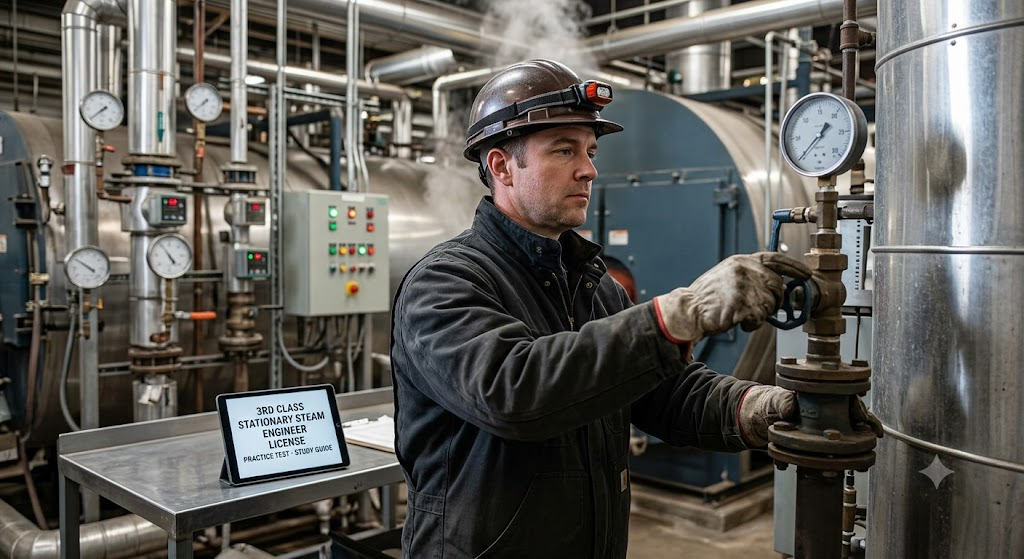
Additional Information
What the Course Entails and Exam Details
A comprehensive preparation course or self-study for the 3rd Class license covers a wide range of essential topics. Key areas of focus include:
Boiler Fundamentals: Types (fire-tube, water-tube), components, and core operating principles.
Steam Generation & Properties: Understanding saturation, superheated steam, and related thermodynamic concepts.
Safety Measures & Devices: Operation, testing, and maintenance of safety valves, gauge glasses, flame safeguards, and low-water cutoffs.
Water Treatment: Importance of boiler water chemistry to prevent scale, corrosion, and carryover, including understanding testing and treatment methods.
Combustion & Fuel Systems: Principles of burning various fuels (oil, gas, solid), burner operation, and related safety controls.
operational Procedures: Startup, shutdown, normal operation, and emergency response protocols for boilers and associated systems.
Regulatory Codes: Familiarity with relevant standards, such as the ASME Boiler and Pressure Vessel Code, and local safety regulations.
Basic Mechanics & Mathematics: Principles required for pressure, temperature, flow, and efficiency calculations relevant to plant operations.
Auxiliary Systems: Knowledge of pumps, turbines, feed water systems, and piping.
Exam details themselves—including the exact structure of questions and relative weight of topics—are designed to directly reflect this body of knowledge. Practice tests and study guides are invaluable resources that break down this comprehensive syllabus into manageable concepts and common question formats.
What to Expect in the Final Exam
The final licensing exam is a rigorous test of your knowledge and decision-making abilities. While specific formats can vary slightly by jurisdiction, candidates should typically expect:
Multiple-Choice Questions: This is the most common format, designed to test a wide breath of knowledge efficiently. Questions may present operational scenarios, ask for technical specifications, or require calculation of various parameters.
Passing Score Requirements: Jurisdictions usually require a passing score of approximately 70% to 75%. It is crucial to check the specific requirements of the licensing board in your area, as this threshold is strictly enforced.
Time Limits: Candidates are generally given a specific time limit to complete the exam, often ranging from two to four hours. Effective time management during the test is key, emphasizing the need for familiarity with the material.
Practical Components: Some regions or specific license grades may include a practical evaluation or interview component in addition to the written test, though for many initial classifications, the multiple-choice exam is the primary assessment.
Standardized Rules: Strict rules will apply during the exam—generally, no outside study materials or mobile devices are permitted, though essential tools like a basic calculator might be allowed in some cases. Official identification is always required for entry.
Preparation resources, including dedicated practice exams, will simulate these conditions to help you feel more comfortable and prepared for the real thing.
How to Study and Exam Centers
Effective studying requires a structured approach and consistent effort.
Actionable Study Strategies:
Utilize Textbooks: Study foundational material in recognized stationary engineering and boiler operation textbooks.
Enroll in Preparatory Courses: Many technical colleges, unions, and private training organizations offer specific courses tailored for steam engineer licensing, combining classroom instruction with practical insights.
Prioritize Practice Tests: Taking multiple-choice practice tests is one of the most effective strategies. These tests not only reinforce key concepts but also familiarize you with the question style, help you identify areas where your knowledge is weak, and allow you to practice working within a time limit. Treat each practice exam as a serious opportunity to test your readiness.
Hands-on Experience: Whenever possible, correlate your theoretical study with real-world equipment and operations in your workplace, seeking guidance from experienced engineers.
Create Study Aids: Develop flashcards for key formulas, definition of terms, and critical code references.
Exam Centers: The actual licensing exam must be taken in a proctored, official setting. It is not generally administered purely online for the official license itself.
How and Where: Candidates usually need to apply through their local jurisdiction’s licensing board, often found within the Department of Public Safety, Engineering Division, or a similar state or city authority. Once application and experience requirements are met, candidates can typically register to take the exam at a designated proctored testing center, such as:
Authorized technical colleges and vocational schools.
Specific state-run examination centers.
Proctored testing services with multiple locations (e.g., PSI in some areas), where you may be able to register and schedule your exam online, though the test itself will be in-person. Candidates must obtain specific, current location details and registration instructions from their local licensing authority.
Job Opportunities from the Course
Successfully obtaining your 3rd Class Stationary Steam Engineer License opens doors to a variety of rewarding and stable career opportunities, allowing you to advance from entry-level positions. Potential job titles and career paths include:
3rd Class Stationary Steam Engineer: Directly utilizing the classification for roles requiring this specific license to operate boilers and related equipment.
3rd Class Boiler Operator: A focused title reflecting the primary responsibility in boiler plants.
Stationary Engineer: A more general title often used, with progression grades (e.g., 2nd Class, 1st Class) unlocked by further licensing. Potentially starting at entry-level and advancing with experience and licensure.
Boiler Plant Operator: Concentrated roles in dedicated boiler facilities.
Junior Plant Engineer: With experience and additional training, moving towards greater technical responsibility and supervision.
Facilities Maintenance Engineer: Managing heating, ventilation, and critical steam systems within large buildings, hospitals, or campus facilities.
Assistant Power Plant Operator: Working in electricity generation facilities in roles related to steam-powered components.
Further licensure to higher classes (2nd Class, 1st Class/Chief Engineer) generally enables operation of larger, more complex systems and plants, and typically offers increased responsibility, leadership roles, and higher earning potential.
Frequently Asked Questions
Reviews
5.0
Based on 0 reviews
Leave a Review
No reviews yet. Be the first to review!