
4-H Livestock Skillathon Practice Exam
$69.00
- Buy to unlock unlimited access to all Quiz questions and Answers in this Quiz.
- After purchase you can print a PDF of the whole quiz at any point. The PDF will contain the questions and the correct answers.
About this Exam
The 4-H Livestock Skillathon is an intensive, interactive,
hands-on educational competition designed to test the comprehensive knowledge
of youth in animal science and livestock management. This event is typically
designed for 4-H members, often structured across different age divisions
(Junior, Intermediate, and Senior). The primary species covered are beef
cattle, meat goats, sheep, and swine. The contest aims to blend knowledge and
skills acquired through 4-H livestock projects and judging demonstrations into
one challenging activity, providing a platform for participants to demonstrate
their understanding of the livestock industry, ethical values, and product
evaluation skills.
Ready to test your knowledge?
Buy Now to Access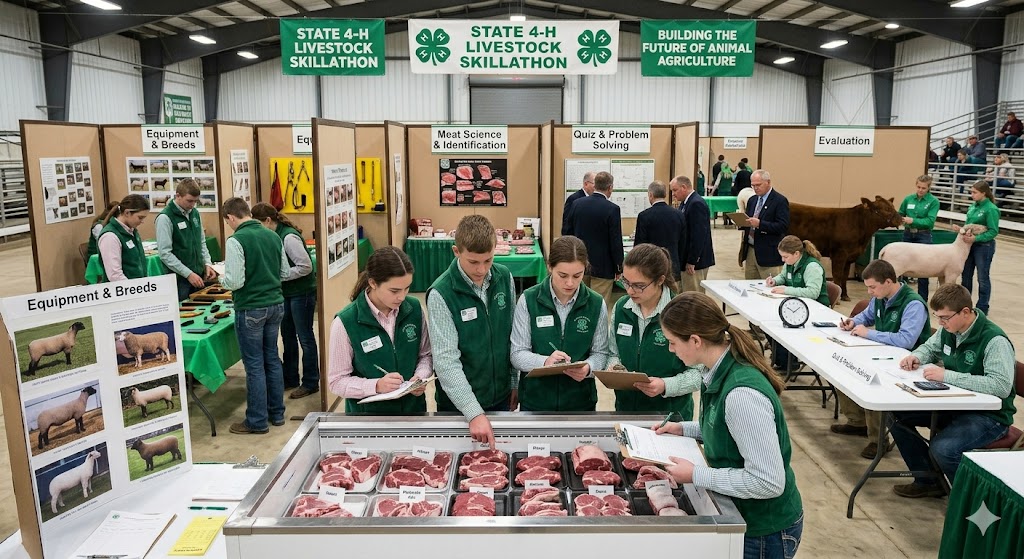
Additional Information
What the Course Entails and Exam Details
The course of study for the 4-H Livestock Skillathon is a
deep dive into practical animal science. It is not a structured
"course" in a traditional sense, but rather a set of knowledge areas
that participants must master. The syllabus is broad, focusing on beef, sheep,
swine, and meat goat projects. It includes essential topics such as detailed
breed identification from photographs or descriptions; identifying a wide range
of livestock equipment and their uses; identifying various types of feed
samples, interpreting feed tags, and formulating basic rations; interpreting
medicine labels and understanding withdrawal times and quality assurance;
identifying retail meat cuts from the beef, lamb, and pork species; and
understanding skeletal anatomy. In some instances, it may also include
evaluation or judging of wool, mohair, and performance classes, as well as
general knowledge related to current industry issues, ethics, and animal health.
What to Expect in the Final Exam
The "final exam" for a 4-H Livestock Skillathon is
the state or national competition, which has a distinct multi-part format. It
is rarely just a written test. The structure usually includes three main
components: an individual written quiz, individual hands-on identification
stations, and a team problem-solving exercise. The written quiz may feature
approximately 25 multiple-choice, true/false, and short-answer questions
testing general animal science knowledge. The physical stations are rotating
points where participants must identify actual items, such as retail meat cuts,
equipment, or feedstuffs. The team portion involves group collaboration on a
critical thinking problem, such as a farm scenario or a breeding selection
task. Scoring rules and passing requirements are contest-specific and defined
by the organizing state’s 4-H extension office. While there is no universal
time limit, participants generally have a set period (often 5 to 10 minutes) at
each station to complete their tasks and cannot converse except during the team
component.
How to Study and Exam Centers
Effective preparation for the 4-H Livestock Skillathon
requires a mix of theoretical study and practical experience. Students are
strongly encouraged to utilize official 4-H Resource Handbooks, particularly
the detailed livestock series from Ohio State University. Utilizing flashcards,
online educational tools like quizlets, and physical identification practice
with real items or sample kits is essential for mastering the identification
stations. Participants should also seek guidance from their local 4-H club
leaders, extension agents, or form study teams to practice problem-solving
scenarios together. Regarding testing centers, this "exam" is typically
tied to competitive events rather than a fixed test center like a Pearson VUE
facility. It is generally held at specific physical locations such as local
county fairs, regional extension offices, state university agricultural
facilities during a state fair or exposition, or national competition venues.
Students must register for the event through their county 4-H office or on
their state’s 4-H online system.
Job Opportunities from the Course
Participating in the 4-H Livestock Skillathon does not provide
a formal license, but it develops the critical thinking, communication,
decision-making, and teamwork skills—along with the deep technical
knowledge—that are vital for success in agricultural careers. This experience
often inspires youth to pursue further education and career paths such as:
- Livestock
Producer or Rancher
- Veterinarian
(Large Animal Focus)
- Veterinary
Technician
- Animal
Nutritionist
- Agricultural
Educator (School or Extension Agent)
- Meat
Science Professional / Meat Packer / Processor
- Ranch
or Farm Manager
- Livestock
Equipment or Feed Sales Representative
- Quality
Assurance Specialist
- Agricultural
Policy Analyst
Frequently Asked Questions
Reviews
5.0
Based on 0 reviews
Leave a Review
No reviews yet. Be the first to review!