
4-H Pygmy Goat Showmanship Practice Test
$69.00
- Buy to unlock unlimited access to all Quiz questions and Answers in this Quiz.
- After purchase you can print a PDF of the whole quiz at any point. The PDF will contain the questions and the correct answers.
About this Exam
The 4-H Pygmy Goat Showmanship program is a cornerstone of youth agricultural education, designed to cultivate responsibility, leadership, and animal husbandry skills in participants. This activity is open to children and young adults (typically ages 8-18) involved in local 4-H clubs. Pygmy goats, known for their petite size and engaging personalities, are popular choices for youth projects. Showmanship competitions evaluate the participant's knowledge, poise, and ability to present their animal effectively to a judge. While focused on handling goats, the program instills discipline, communication, and confidence that extend far beyond the show ring. This specific practice test serves as a crucial preparation tool, helping youth assess their knowledge and ready themselves for the practical application of these skills in competitive settings.
Ready to test your knowledge?
Buy Now to Access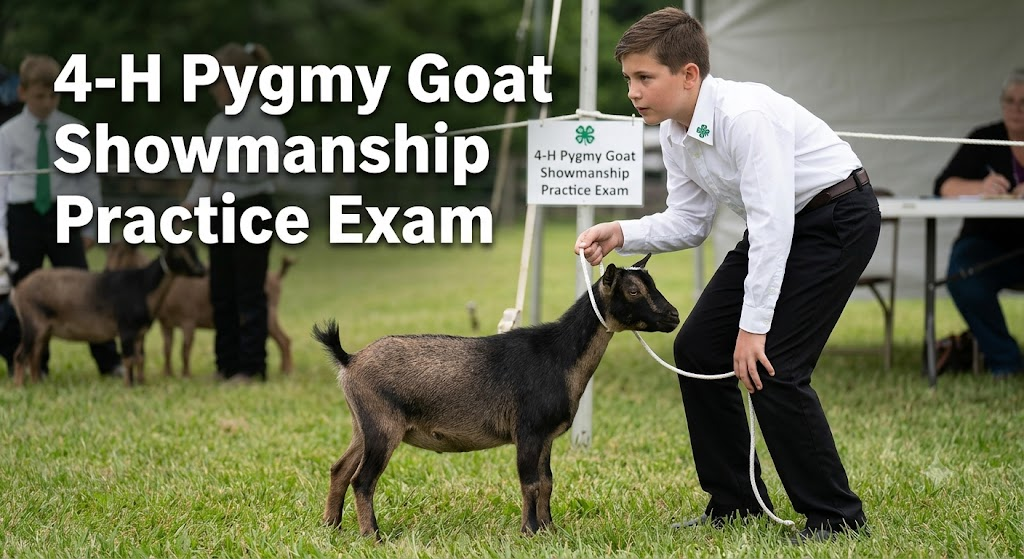
Additional Information
What the Course Entails and Exam Details
This comprehensive program covers essential aspects of pygmy goat care and presentation. Participants learn about the history and breed standards of pygmy goats. They delve into goat nutrition, health maintenance, and common illnesses. Fitting and grooming techniques are fundamental, teaching members how to properly trim hooves, clip hair for shows, bathe, and generally present a clean, healthy animal. The program emphasizes understanding goat conformation and anatomical terms. Furthermore, it details the specific rules and regulations governing 4-H livestock exhibitions. The practical showmanship element includes mastering leading, setting up the goat to display its strong points, and responding with knowledge and poise to judges' evaluations.
What to Expect in the Final Exam
The actual "exam" is not a written test but a live competition evaluation, often referred to as a "Showmanship Class." This takes place at local, county, or state fairs and organized 4-H shows. The judge evaluates the participant (the showman) on three main criteria:
Showman (40%): This includes neatness, appropriate dress, poise, attention, knowledge, and sportsmanship.
Animal (30%): While not judged as heavily on breed type as a breeding class, the goat should be clean, in good health, and properly fitted and groomed.
Presentation (30%): The focus here is on the showman's control of the animal, leading correctly, changing speed, turning smoothly, and setting up the goat efficiently and accurately.
There are different divisions based on age, such as Junior, Intermediate, and Senior. The judge often asks individual participants direct questions regarding goat anatomy, breed characteristics, nutrition, and husbandry to test their depth of knowledge. Ribbons or rankings (e.g., Grand Champion, Reserve Champion) are awarded. The key objective is to demonstrate skill, responsibility, and dedication rather than just having a "winning" goat.
How to Study and Exam Centers
Effective preparation for 4-H Pygmy Goat Showmanship involves both study and consistent practice. Actionable strategies include:
Obtain 4-H Study Guides: Acquire official 4-H manuals on goat management and showmanship from your local or state extension office. These contain specific knowledge and guidelines.
Practice Showmanship Routines: Work with your pygmy goat regularly. Practice leading at different paces, making turns, and "setting up" the goat in different positions. Seek feedback from experienced members or leaders.
Master Grooming Techniques: Practice cleaning, clipping, and fitting your goat for show condition. Learn from workshops or experienced mentors.
Review Goat Anatomy: Study diagrams and lists of goat body parts, breed standards, and basic health practices. Create flashcards or take online quizzes to self-assess.
Attend Clinics and Shows: Observe other competitions and learn by watching more experienced showmen and listening to judges' comments. Attend local 4-H workshops.
Mock Showmanship Questions: Practice answering questions about goat care, nutrition, breed, and confirmation that judges commonly ask during shows.
4-H Pygmy Goat Showmanship competitions are not held in traditional testing centers. These practical "exams" take place at regional, county, and state fairs, and special 4-H show events organized by local extension offices or breed associations. Check with your county 4-H program coordinator for specific dates and locations of qualified competitions.
Job Opportunities from the Course
While designed primarily for youth development, the skills and experience gained through 4-H goat showmanship can inspire many career paths within the agricultural and animal sciences. This foundational work demonstrates discipline, responsibility, and dedication, making participants appealing candidates in various fields.
Veterinary Medicine: Becoming a Veterinarian, specialized in livestock or large animals.
Veterinary Technician or Assistant: Providing crucial medical support for animals.
Animal Nutritionist: Formulating feeds for different species and production stages.
Extension Agent or 4-H Coordinator: Working in agricultural education and community outreach.
Agricultural Educator/Vocational Teacher: Teaching animal science and agriculture in high schools or colleges.
Livestock Judge: Critically evaluating animals at shows and competitions (requires extensive experience).
Farm or Ranch Manager: Supervising operations in large-scale animal production.
Breeder or Livestock Producer: Developing and improving pygmy goat genetics for sale or exhibition.
Breed Association Staff: Working for breed-specific organizations in marketing, registration, and education.
Agri-Business Positions: Roles in sales of feed, animal equipment, or agricultural pharmaceuticals.
Meat or Dairy Inspector: Ensuring the safety and quality of food products.
Agricultural Communications or Marketing: Writing, photography, or promotion for agricultural businesses and media.
Public Relations in Agriculture: Managing communication and image for agricultural companies.
Research Scientist: Conducting research in animal genetics, reproduction, or behavior.
Zoologist or Zoo Keeper: Working in animal care and education at zoological parks.
Animal Trainer or Behaviorist: Understanding animal psychology for training or management.
Wildlife Biologist: Researching and managing wild animal populations and habitats.
Laboratory Animal Care Technician: Providing care in research or medical environments.
Rural Land Appraiser or Real Estate Agent: Specialized knowledge in agricultural properties.
Agri-Tourism Manager: Directing operations for farms open to the public.
Frequently Asked Questions
Reviews
5.0
Based on 0 reviews
Leave a Review
No reviews yet. Be the first to review!