
45-Foot Response Boat-Medium (RB-M 45) Engineer Practice Exam
$69.00
- Buy to unlock unlimited access to all Quiz questions and Answers in this Quiz.
- After purchase you can print a PDF of the whole quiz at any point. The PDF will contain the questions and the correct answers.
About this Exam
Becoming a certified Engineer for the US Coast Guard’s 45-Foot Response Boat-Medium (RB-M 45) is a significant achievement and a critical operational capability. The RB-M 45 is a modern, fast, and multi-mission platform, and its performance depends entirely on its engineering department. This rigorous certification is designed for active-duty US Coast Guard personnel and potentially members of the Coast Guard Auxiliary who have advanced training. It validates a student’s comprehensive knowledge of the vessel’s propulsion, electrical, mechanical, and safety systems. An RB-M 45 Engineer ensures the vessel is always mission-ready, capable of conducting challenging search and rescue, law enforcement, and homeland security operations in demanding maritime environments. This study guide and practice exam preparation are essential steps on the path to technical mastery and operational leadership.
Ready to test your knowledge?
Buy Now to Access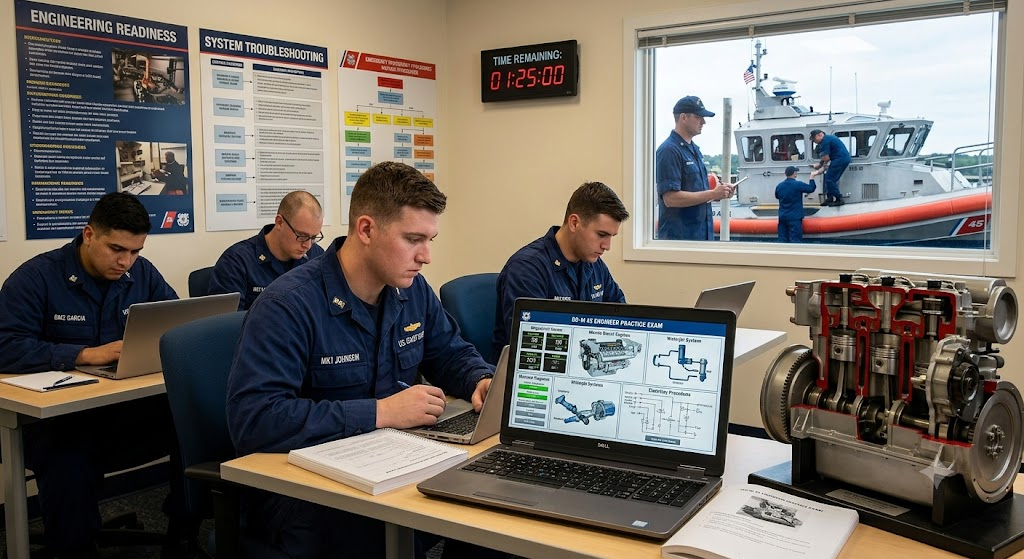
Additional Information
What the Course Entails and Exam Details
The path to certification as an RB-M 45 Engineer involves both formal instruction and extensive practical training, often detailed within US Coast Guard Rate Training Manuals (RTMs) and boat-specific technical publications. A primary focus is on the vessel's complex engineering plant. Topics covered extensively include the twin MTU Series 2000 Diesel Engines (or comparable powerplants) and their associated systems: cooling, fuel, lubrication, and electronic controls. Students must master the intricacies of marine gears, propulsion shafts, and vector jet drives. The syllabus details the electrical generation and distribution network (both 24V DC and 120V AC systems), including batteries, power management, and vessel electronics. Furthermore, the course encompasses comprehensive knowledge of the RB-M’s auxiliary systems: the dynamic positioning system (DPS), steering, bilge and fire main systems, vessel-wide damage control systems, and fire suppression systems (such as FM-200). General engineering principles, preventative maintenance schedules, troubleshooting techniques, technical documentation review, and Coast Guard safety regulations and engineering standard operating procedures (ESOPs) are fundamental to the curriculum.
What to Expect in the Final Exam
Successfully achieving the RB-M 45 Engineer certification is a multi-stage process. The written practice exam is a crucial step to test theoretical knowledge.
The written final exam is typically a structured assessment consisting of multiple-choice and perhaps some true/false or diagram labeling questions, testing theoretical understanding of all vessel systems, regulations, and procedures. This exam is usually administered in a secure, timed setting. The exact time limit varies by command but is designed to challenge comprehensive recall under pressure, often lasting several hours. A high passing score, typically 80% or better, is required to demonstrate necessary proficiency.
It is important to remember that passing the written exam is only one component. The final certification almost always requires the completion of a rigorous practical assessment, often detailed in a Practical Qualification Standards (PQS) booklet. This involves "check rides" and real-world system demonstrations verified by an authorized Engineer or Engineering Petty Officer. Candidates must demonstrate competence in conducting pre-underway checks, operational troubleshooting of engines and auxiliary systems, execution of emergency procedures (like loss of steering or fire drills), underway system monitoring, and the accurate maintenance of engineering logs and records, all under observation by subject matter experts. The entire process ensures that a certified Engineer can not only answer questions but also apply their knowledge effectively in challenging maritime scenarios.
How to Study and Exam Centers
Effective preparation for the RB-M 45 Engineer certification requires a strategic and dedicated approach. Mastering the core knowledge is essential.
Your primary resources are official US Coast Guard technical publications, commandant instruction manuals (COMDTINSTs), and the specific Rate Training Manuals (RTMs) for ratings like Machinery Technician (MK). Focus heavily on the vessel’s specific operations and maintenance manuals.
Begin by downloading and reviewing the Practical Qualification Standards (PQS) or Boat Crew Qualification (BQC) booklet to understand all requirements. Don’t just read the manuals; develop a deep understanding of why systems are designed and operate as they do. Trace fluid and electrical flows on diagrams and on the actual vessel. Utilize official practice tests if available through your command or online USCG training portals. Form study groups with other candidates to discuss systems and troubleshooting. Participate in hands-on training whenever possible, engaging in preventative maintenance and emergency drills under supervision. Review damage control and safety procedures relentlessly.
The written exam is not generally taken through commercial testing vendors like Pearson VUE. Instead, it is administered locally through US Coast Guard channels. You will typically coordinate with your local unit’s training officer, engineering department head, or a designated command educational services officer (ESO). Testing centers are located at US Coast Guard bases, sectors, or individual station training locations across the country. Candidates must schedule their exam through their chain of command after verifying they have met the necessary prerequisites, such as finishing pre-training courses and completing relevant sections of their PQS packet. For non-USCG personnel, specific arrangements via Coast Guard auxiliary leaders or affiliated educational programs may apply, always leading back to an official, authorized testing location.
Job Opportunities from the Course
A successful certification as an RB-M 45 Engineer opens clear career paths within the US Coast Guard and highly transferable skills for the civilian maritime sector.
Within the Coast Guard, specific job titles and advancements include:
Engineering Petty Officer (EPO) or Assistant Engineering Petty Officer (AEPO) on a small boat station.
Machinery Technician (MK) across various ranks, leading towards leadership as a Chief Machinery Technician (MKC) or Senior Chief (MKCS).
Station Engineer, responsible for the maintenance and readiness of a small boat fleet.
Specialized instructor positions at Coast Guard training centers or boat forces schools.
Advanced leadership and technical roles within Coast Guard Sectors, Districts, or technical command staffs.
Opportunities to cross-train into other engineering and damage control fields, such as becoming a Damage Controlman (DC) or advanced technician.
The technical skills, leadership experience, and discipline gained from this certification are in high demand in the commercial maritime industry. Qualified professionals can pursue careers as Port Engineers, commercial workboat engineers (e.g., tugboats, ferries, offshore support), marine surveyors, technical managers for maritime operations, and roles demanding technical leadership in critical infrastructure management.
Frequently Asked Questions
Reviews
5.0
Based on 0 reviews
Leave a Review
No reviews yet. Be the first to review!