
4th Class Power Engineering Part B Practice Exam
$69.00
- Buy to unlock unlimited access to all Quiz questions and Answers in this Quiz.
- After purchase you can print a PDF of the whole quiz at any point. The PDF will contain the questions and the correct answers.
About this Exam
The 4th Class Power Engineering Part B exam is a critical
milestone for aspiring Power Engineers across Canada. It represents the second
half of the theoretical requirement for the Fourth Class Certificate of
Competency. While Part A establishes the foundational scientific and safety
principles, Part B focuses directly on the practical equipment, systems, and
operational procedures found in energy and industrial plants. This
certification is specifically designed for individuals looking to enter the
stationary engineering field, allowing them to legally operate and maintain
boilers, refrigeration units, and related auxiliary machinery in settings like
hospitals, pulp mills, food processing facilities, and power generation
stations. Passing this exam, in addition to Part A and required firing time,
unlocks the full 4th Class designation.
Ready to test your knowledge?
Buy Now to Access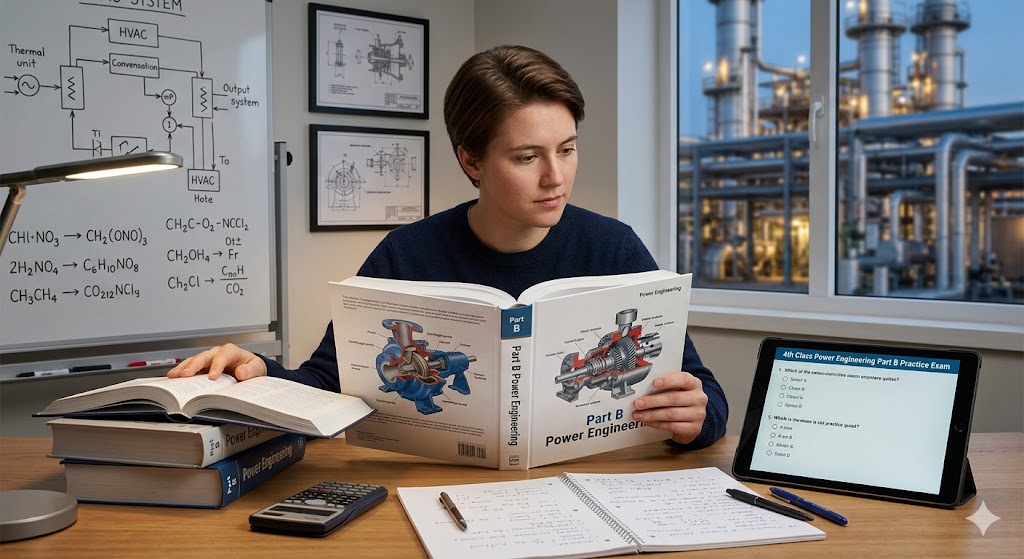
Additional Information
What the Course Entails and Exam Details
This examination tests a comprehensive syllabus that
translates theoretical knowledge into operational competence. Candidates must
demonstrate proficiency in the following core areas:
- Prime
Movers: The design, operation, and maintenance of steam turbines, gas
turbines, and internal combustion engines (gasoline and diesel).
- Auxiliary
Systems: Detailed knowledge of pumps (centrifugal and positive
displacement), air compressors, and lubrication systems, including their
various types and troubleshooting.
- Boiler
Operation and Safety: Principles of boiler control systems, feed water
treatment (internal and external), boiler safety devices, and standardized
plant operating procedures.
- Maintenance
Procedures: Techniques for maintaining plant equipment, including
piping, valves, and practical knowledge of tools.
- Refrigeration
and HVAC: Fundamentals of compression and absorption refrigeration
systems, including leak detection and safety regulations. You must also
understand building environmental systems (heating, ventilation, and air
conditioning).
- Electricity
and Instrumentation: Continued application of electricity principles
and the basics of control systems used to monitor and manage plant
processes.
What to Expect in the Final Exam
The 4th Class Power Engineering Part B exam is standardized
by the Standardization of Power Engineer Examinations Committee (SOPEEC).
- Format:
The exam consists entirely of multiple-choice questions. It is a
theoretical exam; there is no practical "hands-on" component
during this specific written session.
- Question
Count: You can expect to answer 100 questions.
- Time
Limit: Candidates are typically allotted 3 hours to complete the
examination.
- Passing
Score: The required minimum passing grade is 65% on this paper (as
well as on Part A).
- Rules:
This is a closed-book exam. Candidates are usually provided with essential
reference materials, such as specific steam tables or formula sheets, but
personal textbooks or notes are prohibited. You must have valid
government-issued photo identification to enter the testing center.
How to Study and Exam Centers
Preparation for Part B demands a structured approach that
emphasizes understanding operational scenarios. Effective study strategies
include:
- Focus
on the Syllabus: Ensure you have the official SOPEEC syllabus and are
studying with approved textbooks (typically the PanGlobal Fourth Class
Part B set). These are the direct source material for the exam questions.
- Practice
with Purpose: Utilize practice exams extensively. Power Engineering
101 or accredited college test banks are invaluable. Do not just memorize
answers; understand why a particular operating procedure or safety
check is correct.
- Visualize
the Machinery: Because this part focuses on physical equipment, visual
aids are powerful. Seek out cutaway diagrams of turbines, pumps, and
refrigeration cycles.
- Where
to Take the Exam: The exam is administered by the provincial or
territorial regulatory body responsible for boiler safety (e.g., ABSA in
Alberta, Technical Safety BC, TSASK in Saskatchewan). Most testing is done
in person at authorized physical testing centers, which may include
government offices, community colleges, or recognized technical schools.
Some jurisdictions may offer proctored online exams at specified
locations. You must register through your provincial safety authority's
portal.
Job Opportunities from the Course
Obtaining a 4th Class Power Engineering Certificate of
Competency opens the door to numerous stable and well-paying career paths. This
qualification is an entry-level requirement for key roles such as:
- Fourth
Class Power Engineer / Operating Engineer
- Plant
Operator
- Building
Operator (specifically for large commercial or institutional facilities)
- Stationary
Engineer
- Boiler
Operator
- Refrigeration
Plant Operator
- Maintenance
Mechanic (with a focus on plant systems)
- Utilities
Technician
Frequently Asked Questions
Reviews
5.0
Based on 0 reviews
Leave a Review
No reviews yet. Be the first to review!