
68W Combat Medic Specialist Training – Module 3 Practice Test
$69.00
- Buy to unlock unlimited access to all Quiz questions and Answers in this Quiz.
- After purchase you can print a PDF of the whole quiz at any point. The PDF will contain the questions and the correct answers.
About this Exam
The 68W Combat Medic Specialist Training, often referred to as '68 Whiskey,' is the backbone of medical care within the U.S. Army. This rigorous program transforms soldiers into highly skilled medical professionals capable of providing life-saving interventions in the most challenging environments on Earth. The training is divided into multiple phases, with Module 3: Advanced Tactical Combat Casualty Care (TCCC) and Operations being a critical turning point. This module is designed for soldiers who have mastered basic medical skills and are ready to apply advanced, combat-specific trauma protocols while operating as part of a tactical team. Completing Module 3 demonstrates a medic's readiness to function under fire and transition from initial care to prolonged field care.
Ready to test your knowledge?
Buy Now to Access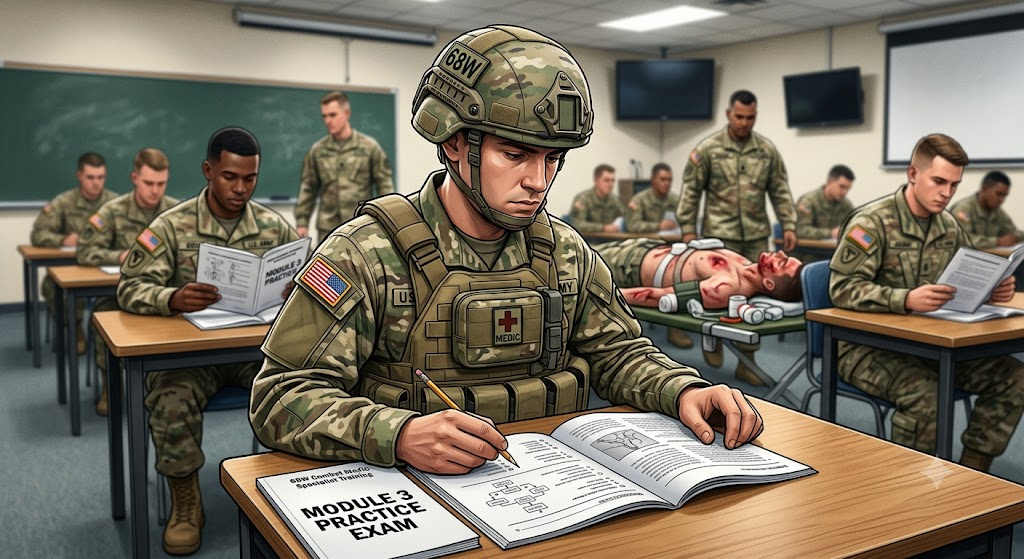
Additional Information
What the Course Entails and Exam Details
Module 3 shifts the focus from purely clinical settings to the chaotic, resource-limited realities of tactical environments. Students delve deeply into advanced physiology, pharmacology relevant to trauma, and complex surgical skills. The core curriculum for Module 3 includes, but is not limited to:
Advanced Airway Management: Mastery of supraglottic airways (like the King LT) and surgical cricothyroidotomy.
Hemorrhage Control: Advanced techniques including Junctional Emergency Treatment Tool (JETT) and combat gauze application in difficult anatomical locations.
Thoracic Trauma Management: Needle decompression for tension pneumothorax and advanced occlusive dressings.
Tactical Combat Casualty Care (TCCC) Guidelines: In-depth application of Care Under Fire, Tactical Field Care, and Tactical Evacuation Care phases.
Prolonged Field Care (PFC): Managing casualties for extended periods (hours to days) when evacuation is delayed, including fluid resuscitation protocols.
Medical Operations: Planning medical support for missions, understanding the chain of evacuation, and operating communication systems.
This module is heavily weighted toward physical application and validated hands-on performance.
What to Expect in the Final Exam
The final evaluation for 68W Module 3 is not merely a written test; it is a high-stakes validation of your ability to perform under pressure. The exam is composite, meaning it requires passing multiple components:
Written Examination (Cognitive): A multiple-choice exam administered via a secure online portal. This tests your knowledge of TCCC guidelines, pharmacological dosages, and physiological responses to trauma. A passing score, typically 70% or higher, is required to proceed.
Practical Skills Evaluation (Psychomotor): This is the most critical component. It consists of standardized, dynamic trauma lanes. You will be expected to treat a simulated casualty (mannequin or live actor) in a tactical scenario, adhering strictly to TCCC guidelines while being evaluated by senior 68W instructors. This section is often graded on a pass/fail basis for critical skill steps (e.g., failing to manage a massive hemorrhage immediately is an automatic failure).
The exam has strict time limits for specific tasks (like establishing an airway) and total scenario time. You must demonstrate situational awareness and communicate effectively throughout.
How to Study and Exam Centers
Preparation for the Module 3 exam must be comprehensive and blend book knowledge with hands-on practice.
Study Strategies:
Master the TCCC Guidelines: This is your bible. Download the latest version from the Joint Trauma System (JTS) website and memorize the protocols for all three phases.
Utilize Practice Exams: Seek out dynamic practice tests that simulate the written portion, specifically focusing on scenario-based questions rather than simple recall.
Hands-on Repetition: You cannot pass the practical exam without practice. Use training aids (King LT trainers, cric kits, tourniquets) until the movements are muscle memory. Get a study partner to run you through randomized trauma scenarios in a noisy or distracting environment to simulate combat stress.
Review Official Curriculum: Focus on the specific materials provided during your 68W AIT (Advanced Individual Training) at Fort Sam Houston.
Exam Centers: The final Module 3 written and practical exams are conducted exclusively at authorized U.S. Army training centers. For initial entry soldiers, this is typically the Medical Center of Excellence (MEDCoE) at Fort Sam Houston, Texas. For National Guard or Reserve components, testing may occur at designated Regional Training Sites-Medical (RTS-Med). The written portion may be proctored through official Army learning management portals, but the dynamic practical exam must be completed in person.
Job Opportunities from the Course
Successfully completing the 68W Combat Medic training, validated by passing modules like Module 3, unlocks a diverse and critical range of career paths within the military structure and lays a strong foundation for civilian transition. The certification allows you to hold specialized roles, such as:
Line Medic (embedded with Infantry, Armor, or Cavalry units)
Medical NCO (Non-Commissioned Officer)
Ambulance Squad Leader
Medical Simulation Training Center (MSTC) Instructor
Flight Medic (requires additional critical care training)
Special Operations Combat Medic (SOCM) (pathway for Army Special Forces, Rangers, or Civil Affairs)
Beyond the military, the 68W training provides prerequisites and significant experience for careers as a Paramedic (NRP), Physician Assistant (PA), or in hospital trauma center operations.
Frequently Asked Questions
Reviews
5.0
Based on 0 reviews
Leave a Review
No reviews yet. Be the first to review!