
68W Emergency Medical Technician (EMT) Practice Exam
$69.00
- Buy to unlock unlimited access to all Quiz questions and Answers in this Quiz.
- After purchase you can print a PDF of the whole quiz at any point. The PDF will contain the questions and the correct answers.
About this Exam
The 68W Emergency Medical Technician (EMT) Practice Exam is your gateway to success in one of the most critical and rewarding roles within the U.S. Army: the Combat Medic Specialist. This comprehensive practice tool is specifically designed for soldiers in Advanced Individual Training (AIT) at Fort Sam Houston, Texas, who are preparing to challenge the National Registry of Emergency Medical Technicians (NREMT) cognitive examination. Earning your NREMT certification is not just a requirement for the 68W Military Occupational Specialty (MOS); it is a demonstration of your dedication to providing life-saving care in the most challenging environments.
Ready to test your knowledge?
Buy Now to Access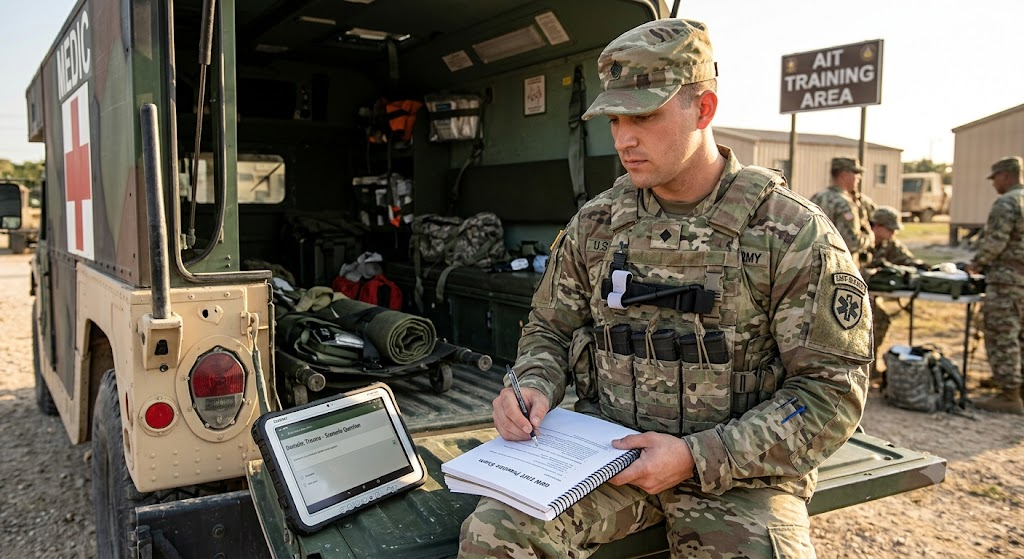
Additional Information
What the Course Entails and Exam Details
The 68W Combat Medic training is divided into two parts, and the EMT phase is a condensed and intense version of a civilian EMT program. This practice exam mirrors the structure and complexity of the NREMT, which serves as the final cognitive hurdle of the first phase. The exam assesses your proficiency across five key domains, encompassing both pediatric and adult patient populations:
Airway, Respiration, and Ventilation: Techniques for managing a patient's airway, ensuring oxygenation, and assisting with breathing.
Cardiology and Resuscitation: Assessment and management of cardiovascular emergencies, including the application of life-saving interventions.
Medical and Obstetrics/Gynecology: Understanding and treating common medical emergencies, including issues of the central nervous system, endocrine, and reproductive systems.
Trauma: Rapid assessment and stabilization of injuries resulting from external forces, from simple cuts to complex multi-system trauma.
EMS Operations: Principles of ambulance operation, patient transport, incident management, and communication within the healthcare system.
What to Expect in the Final Exam
The actual NREMT cognitive exam you will face is a Computer Adaptive Test (CAT). This means that every question you answer changes the difficulty and selection of the subsequent questions, aiming to determine your true level of competency efficiently. You must answer every question; you cannot skip or return to a previous item. You can expect a variable number of questions, ranging from 70 to 120, and you will have a maximum of two hours to complete the test. The exam does not result in a simple percentage. Instead, it provides a scaled score from 100 to 1500, with a score of 950 required to pass. The primary goal is to demonstrate entry-level competency across all domains.
How to Study and Exam Centers
Preparation is the absolute key to success. Your 68W AIT will provide structured instruction, but dedicated individual study is essential. Your study strategy should include the following actions:
Utilize official NREMT-B curriculum materials and comprehensive 68W field manuals.
Focus your efforts on taking multiple full-length practice exams and review every rationale, whether you got the question right or wrong. Understanding the 'why' is more important than memorizing the answer.
Identify your weakest subject areas and dedicate extra time to mastering that content.
Form study groups with fellow soldiers to discuss complex scenarios and reinforce knowledge.
Recreate exam conditions by taking timed practice tests to manage time pressure.
For 68W candidates in AIT, the primary testing path will be structured for you. You will take the NREMT cognitive exam within a highly controlled, proctored setting provided during the course at Fort Sam Houston. Your chain of command will guide you through the logistics, including registration and exact testing location. In the event of a retest, or for individuals challenging the exam via the NREMT military pathway after initial training, the testing is typically conducted at authorized Pearson VUE testing centers worldwide or through NREMT-approved online proctoring platforms. Always coordinate with your training command or the NREMT for the most current information regarding eligibility and location.
Job Opportunities from the Course
Upon passing the NREMT and completing your 68W training, you will be a certified Combat Medic Specialist with the National Registry. This powerful credential unlocks a wide range of civilian and military career opportunities, often with expedited pathways due to your military experience. The skills you acquire are in high demand and transferable.
Civilian Job Titles and Paths:
Emergency Medical Technician (EMT) - Private Ambulance
Emergency Medical Technician (EMT) - Municipal or Fire-Based EMS
Hospital Emergency Room Technician (ER Tech)
Dispatcher - Emergency Services
Flight Paramedic (with further training and Paramedic certification)
Tactical EMT (for law enforcement teams)
Medical Logistics Specialist
Military and Government Paths:
68W Combat Medic Specialist (Active Duty, Reserve, or National Guard)
Flight Medic (Critical Care Flight Paramedic, MOS 68W-F2)
Special Operations Combat Medic (SOCM) (with SOF pipelines)
Practical Nursing Specialist (LPN) (with a transition program)
Medical logistics and operations roles within the Department of Defense (DoD) or Department of Veterans Affairs (VA)
Frequently Asked Questions
Reviews
5.0
Based on 0 reviews
Leave a Review
No reviews yet. Be the first to review!