
68W EMT Practice Exam
$69.00
- Buy to unlock unlimited access to all Quiz questions and Answers in this Quiz.
- After purchase you can print a PDF of the whole quiz at any point. The PDF will contain the questions and the correct answers.
About this Exam
The 68W EMT Practice Exam is a critical preparatory tool
designed specifically for U.S. Army Soldiers training for the Combat Medic
Specialist Military Occupational Specialty (MOS 68W). This exam is tailored for
candidates in 68W Advanced Individual Training (AIT), where passing the
National Registry of Emergency Medical Technicians (NREMT) exam is a
non-negotiable graduation requirement.
This practice exam mimics the difficulty, structure, and style of the civilian NREMT certification test, which forms the first phase of the standard 68W training pipeline. Mastering this content is essential not only for passing the course but also for ensuring you possess the foundational medical knowledge required for tactical combat casualty care (TCCC) in operational environments.
Ready to test your knowledge?
Buy Now to Access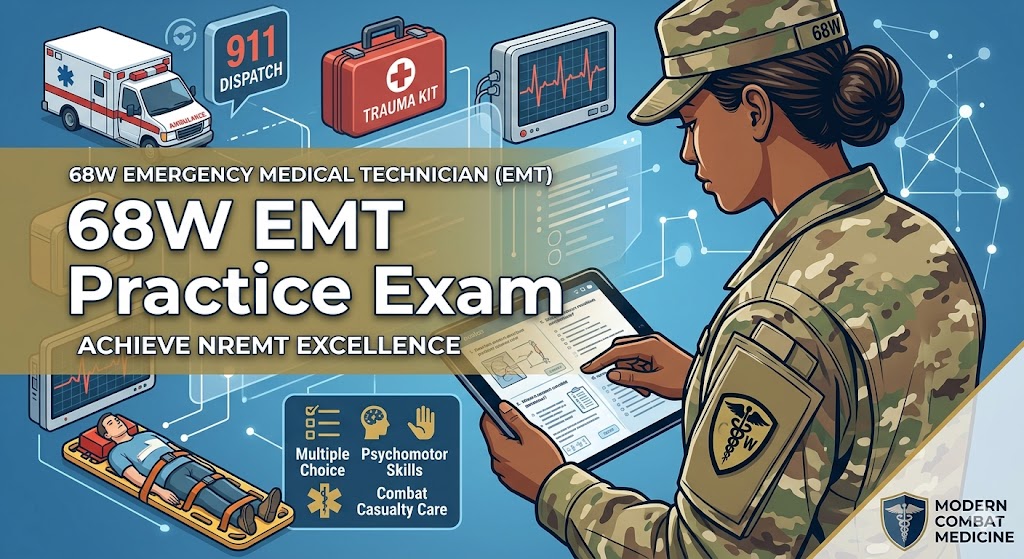
Additional Information
What the Course Entails and Exam Details
The path to 68W qualification begins with a dedicated block
of EMT training, known as Phase I of 68W AIT. During this phase, soldiers
undergo intense classroom and practical instruction focused on civilian
emergency medical care.
The core topics and syllabus covered in this course form the
backbone of the 68W EMT Practice Exam. They include:
- Airway
Management, Respiration, and Artificial Ventilation: Techniques for
assessing and managing airways, including oxygen administration.
- Patient
Assessment: The systematic approach to scene size-up, primary,
secondary, and ongoing assessments.
- Medical
Emergencies: Recognizing and managing neurological (stroke),
respiratory (asthma), cardiovascular (heart attack), and endocrine
(diabetes) emergencies.
- Trauma:
Assessing and managing soft tissue injuries, hemorrhage control, shock,
and musculoskeletal trauma.
- Special
Patient Populations: Specialized care considerations for pediatric,
geriatric, and obstetric patients.
- EMS Operations: Ambulance safety, incident management, and communication protocol.
What to Expect in the Final Exam
The final evaluation at the end of 68W Phase I is the actual
National Registry of EMTs (NREMT) examination. This evaluation consists of two
separate components: a cognitive test and a psychomotor test. Both must be
passed to earn your EMT certification and continue in the 68W course.
The Cognitive Exam (The Written Test)
- Format:
The cognitive exam is a Computer Adaptive Test (CAT). This means the test
adapts the difficulty of the questions based on your previous answers. The
number of questions can vary, ranging from 70 to 120.
- Time
Limit: You are given a maximum of two hours to complete the test.
- Passing
Requirements: There is no fixed "percentage" score. Instead,
the CAT stops once it is statistically confirmed that your skill level is
at or above the predefined entry-level competency standard.
- Specific
Rules: All testing is conducted at an authorized Pearson VUE
professional testing center, located on Fort Sam Houston during AIT. No
reference materials or electronic devices are allowed.
The Psychomotor Exam (The Practical Test)
- Format:
This is a hands-on examination evaluating your clinical decision-making
and manual skills. During 68W AIT, you will be evaluated by certified
instructors on several standard stations.
- Required
Skills: Typical stations include:
- Patient
Assessment – Trauma
- Patient
Assessment – Medical
- Cardiac
Arrest Management/AED
- BVM
Ventilation of an Apneic Adult Patient
- Spinal
Immobilization (Seated and Supine)
- Bleeding
Control/Shock Management
- Passing
Requirements: You must successfully demonstrate every critical step of
each station. You are typically allowed re-tests if you fail a limited
number of stations, but consistent failure results in elimination from the
68W program.
How to Study and Exam Centers
Preparation is the key difference between failure and
success in the 68W EMT Practice Exam. While the Army provides intense
training, individual study and application of effective strategies are
paramount.
Actionable Study Strategies
- Utilize
Dedicated 68W/NREMT Prep Tools: Relying only on class notes is
insufficient. Use reputable 68W EMT Practice Exams (such as dynamic
adaptive tests or mobile study apps) that mimic the NREMT cognitive
formatting and challenge your critical thinking.
- Master
the Textbooks: The primary curriculum is usually based on a
comprehensive EMT textbook (e.g., AAOS's Emergency Care and
Transportation of the Sick and Injured). Read, highlight, and master
every chapter.
- Verbalize
Your Practical Skills: Practice your psychomotor skills with a study
partner (or a "buddy"). Verbally walk through the steps of
medical and trauma assessments. Memorizing the flowsheet algorithms is
critical.
- Simulate
Test Conditions: When taking your 68W EMT Practice Exam, time
yourself, remove distractions, and answer questions without consulting
study materials. This helps manage anxiety and improves time management.
- Focus
on Pathophysiology: The NREMT focuses on applying knowledge, not just
memorization. Do not just memorize a protocol; understand why you
are performing a specific intervention for a given condition.
Exam Centers
For Soldiers in 68W AIT, the cognitive (written) NREMT exam
is typically conducted at the dedicated Army learning centers and testing
facilities located directly on Fort Sam Houston, which are certified by Pearson
VUE. The practical (psychomotor) testing is managed and evaluated by the
authorized military instructors within the training environment at Fort Sam
Houston.
Job Opportunities from the Course
Earning your 68W MOS and obtaining your National Registry
EMT certification opens up dynamic career paths both within the military and
the civilian sector.
- U.S.
Army Combat Medic Specialist (68W): The foundational job, providing
life-saving care in any military environment.
- Flight
Medic (68W-F1): Specialized aeromedical evacuation and critical care roles.
- Civilian
EMT-Basic: Standard 911 response or inter-facility transport in
ambulance services.
- Emergency
Room Technician: Hospital-based patient care role.
- Special
Operations Medic: Elite roles within Ranger, Special Forces, or other
specialized units (often requiring additional training).
- Paramedic
(Civilian): The foundation provided by 68W and EMT certification
allows you to enter advanced-level paramedic bridging programs.
- Firefighter/EMT:
A crucial requirement for many modern fire departments.
- Tactical
Medical Professional: High-threat protection, corporate security, and
remote medicine roles.
Frequently Asked Questions
Reviews
5.0
Based on 0 reviews
Leave a Review
No reviews yet. Be the first to review!