
720-Hour Law Enforcement Phase I Practice Exam
$69.00
- Buy to unlock unlimited access to all Quiz questions and Answers in this Quiz.
- After purchase you can print a PDF of the whole quiz at any point. The PDF will contain the questions and the correct answers.
About this Exam
Welcome to your essential guide for mastering the 720-Hour
Law Enforcement Academy Phase I Written Practice Exam.
This critical examination is the foundational written
assessment within comprehensive police training programs designed to prepare
future officers for the demands of modern law enforcement.
It targets aspiring law enforcement professionals, serving
as a vital benchmark to evaluate their understanding of fundamental police
principles, ethics, and legal frameworks.
Securing a strong score on this written exam is a crucial step towards ultimately achieving certification and embarking on a rewarding career in public safety.
Ready to test your knowledge?
Buy Now to Access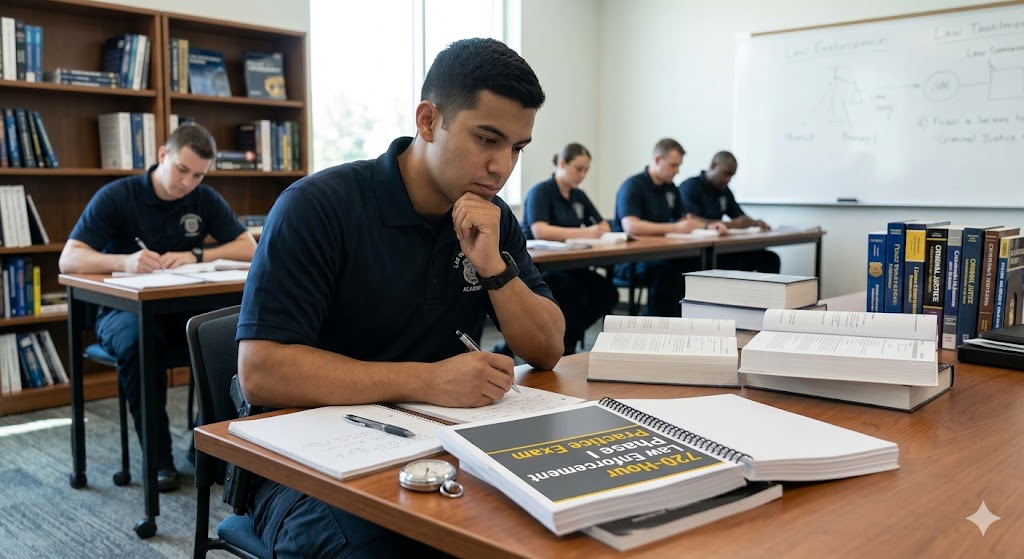
Additional Information
What the Course Entails and Exam Details
The extensive 720-hour curriculum provides deep instruction
across multiple facets of policing.
You will delve into core areas such as criminal law,
constitutional law, and search and seizure protocols.
Beyond legalities, the course heavily emphasizes ethics,
community policing strategies, and effective communication skills.
Expect detailed training in report writing, defensive
tactics theory, and emergency response procedures.
This practice exam specifically tests your comprehension of
these theoretical knowledge bases covered throughout Phase I of the academy.
What to Expect in the Final Exam
Understanding the final exam format is key to your strategy.
The 720-Hour Law Enforcement Academy Phase I Written Exam
typically consists of multiple-choice questions, challenging your recall and
application of learned concepts.
Candidates are generally expected to achieve a passing
score, often set around 70-80?pending on the specific state POST or academy
requirements.
While time limits are strictly enforced, they are designed
to be sufficient for well-prepared individuals to complete the exam.
Remember, specific rules regarding materials allowed,
calculators, or other aids will be clearly communicated beforehand, and
adherence is mandatory.
How to Study and Exam Centers
Preparation is paramount, and there are many effective ways
to study.
Begin by thoroughly reviewing all academy materials, lecture
notes, and provided textbooks, paying close attention to key definitions and
procedures.
Regular practice using practice exams, like this one, is
incredibly beneficial for familiarizing yourself with the question style and
identifying areas needing further focus.
Forming study groups with classmates can offer diverse
perspectives and enhance collaborative learning on complex topics.
Dedicate consistent time for self-testing and review,
gradually increasing difficulty and speed.
As for exam centers, official testing for this academy level
typically takes place within the specific authorized law enforcement training
facility or approved government testing centers.
Online proctoring or Pearson VUE centers might be utilized
for some related certifications, but for foundational academy written exams,
physical testing at the training site is most common, though you should always
verify the exact location and scheduling process through your academy
administration.
Job Opportunities from the Course
Successfully completing the 720-hour academy and passing all
examinations, including Phase I, positions you for various roles within the law
enforcement sector.
Prospective career paths are extensive.
You may explore opportunities as a Municipal Police Officer,
working directly within city limits, or a County Deputy Sheriff, with broader
jurisdictional responsibilities.
State Trooper positions offer a chance to serve across an
entire state, focusing on highway patrol and statewide law enforcement.
Beyond traditional policing, this foundational training can
open doors to roles such as Correctional Officer, Transit Police Officer, or
University Police Officer, each with unique challenges and operational focuses.
Frequently Asked Questions
Reviews
5.0
Based on 0 reviews
Leave a Review
No reviews yet. Be the first to review!