
AAMC MCAT PS FL1 Practice Exam
$69.00
- Buy to unlock unlimited access to all Quiz questions and Answers in this Quiz.
- After purchase you can print a PDF of the whole quiz at any point. The PDF will contain the questions and the correct answers.
About this Exam
The AAMC Psychological, Social, and Biological Foundations
of Behavior (often abbreviated as PS or P/S) section is a critical component of
the Medical College Admission Test (MCAT). This standardized exam is the
definitive gateway for students aspiring to enter medical schools in the United
States and Canada. The PS section specifically assesses an applicant's
understanding of the ways psychological, social, and biological factors impact
human behavior, perceptions of health, and the social determinants of wellness.
It is designed to evaluate how well future doctors will comprehend and interact
with an increasingly diverse patient population.
The AAMC Full-Length (FL) 1 Practice Test is one of the most
vital resources available to students preparing for the MCAT. It is an official
full-length exam provided by the test makers themselves, the Association of American
Medical Colleges. This practice test mimics the exact format, structure,
length, and difficulty level of a real MCAT, providing you with a baseline
score and a highly realistic testing experience. FL1 is renowned for its
representativeness of the actual exam, making a thorough review of its contents
essential for achieving a top-tier score.
Ready to test your knowledge?
Buy Now to Access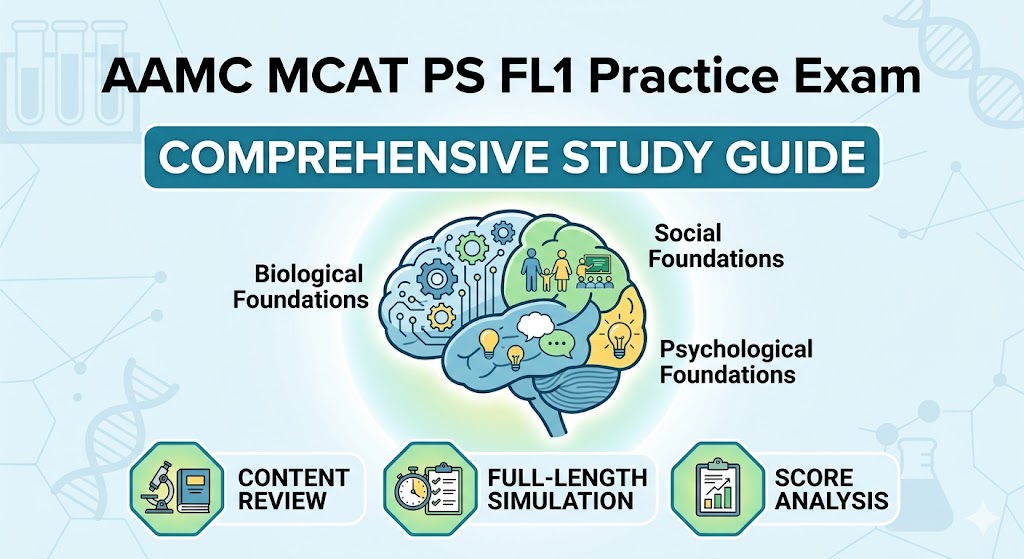
Additional Information
What the Course Entails and Exam Details
This study guide focuses on the curriculum required to
master the Psychological, Social, and Biological Foundations of Behavior
section, as represented in the AAMC FL1. The course covers a broad range of
foundational concepts derived from introductory psychology, sociology, and
biology. The AAMC divides this section into three major disciplines and five
Foundational Concepts, each integrated with Scientific Inquiry and Reasoning
Skills (SIRS).
The primary disciplines covered are Introductory Psychology
(approximately 65%), Introductory Sociology (approximately 30%), and
Introductory Biology (approximately 5%). The five Foundational Concepts tested
in this section are:
- Foundational
Concept 6: Biological, psychological, and sociocultural factors that
influence the ways we perceive, think about, and react to the world.
- Foundational
Concept 7: Biological, psychological, and sociocultural factors that
influence behavior and behavior change.
- Foundational
Concept 8: The ways we think about ourselves and others and how we
interact with others.
- Foundational
Concept 9: Cultural and social differences that influence well-being.
- Foundational
Concept 10: Social stratification and access to resources that
influence well-being.
What to Expect in the Final Exam
While you are preparing for a full-length practice
test, it is crucial to understand what the actual final exam entails to
simulate the conditions accurately. On test day, the AAMC Psychological,
Social, and Biological Foundations of Behavior section will be your fourth and
final section of the day.
You will have 95 minutes to answer 59 multiple-choice
questions. These questions are organized into 10 passage-based sets, each with
4-7 questions, and 15 independent, "discrete" questions that do not
rely on a passage. The entire MCAT is computer-based.
There is no penalty for guessing; your score is based on the
number of questions answered correctly. The number correct score for each
section is converted to a scaled score ranging from 118 (lowest) to 132
(highest). While there is no "passing" score defined by the AAMC,
most competitive medical school applicants aim for a section score above 127
and a total MCAT score well above 510.
How to Study and Exam Centers
Studying for the MCAT requires a highly disciplined and
structured approach. Start by mastering the core concepts through a combination
of content review books (like Kaplan, Princeton Review, or Blueprint), official
AAMC prep materials, and Khan Academy’s comprehensive MCAT Psychology and
Sociology collection. Spaced repetition is critical for memorizing the numerous
definitions and theories; tools like Anki with pre-made or self-made decks are
highly recommended.
Once you have a solid content base, shift your focus to
practice questions. Use official AAMC question banks and sectional practice.
The AAMC FL1 is a full-length simulation and should be treated as such: take it
under real, timed testing conditions.
After taking FL1, dedicate a full day, or more, to reviewing
your results. The value is not just in the score, but in analyzing why
you got questions right or wrong. Understand the logic behind the correct
answer and the fallacies in the incorrect ones. If you struggled with a
passage, analyze whether your issue was content knowledge, passage
interpretation, or critical reasoning.
Where to Take the Exam: The final, official MCAT exam
must be taken at a secure, computerized testing center. The AAMC administers
the exam exclusively at designated Pearson VUE centers across the United
States, Canada, and select international locations. You must register for a
specific test date and location through your AAMC account on their official
portal. However, the AAMC Full-Length 1 Practice Test is taken online, at your
convenience, through the AAMC Official Prep online portal.
Job Opportunities from the Course
Mastering the content required for the AAMC Psychological,
Social, and Biological Foundations of Behavior section and performing well on
the MCAT are the crucial steps toward gaining admission to medical school.
While this section itself does not grant a specific certification for a
singular job, a high MCAT score is a prerequisite for unlocking the path to
become a physician or to pursue other elite roles within the healthcare
ecosystem.
Below is a clear list of the specific job titles and career
paths this course of study ultimately unlocks:
- Physician
(M.D. or D.O.): Specializing in areas such as Family Medicine,
Psychiatry, Pediatrics, Surgery, Neurology, and more.
- Dentist
(D.D.S. or D.M.D.): Requires separate dental school admission (DAT),
but the behavioral science foundation is valued.
- Podiatrist
(D.P.M.): Specializing in foot and ankle health.
- Veterinarian
(D.V.M.): Requires veterinary school (GRE or VCAT), but similar
scientific foundations apply.
- Physician
Assistant (PA-C): Requires PA school and the GRE/PA-CAT.
- Nurse
Practitioner (NP) or Doctor of Nursing Practice (DNP): Following
nursing school and licensure.
- Biomedical
Researcher: Working in academia or industry (requires Ph.D.).
- Public
Health Administrator (MPH): Leading healthcare policy and community
health initiatives.
- Medical
Educator: Teaching at medical or osteopathic schools.
Frequently Asked Questions
Reviews
5.0
Based on 0 reviews
Leave a Review
No reviews yet. Be the first to review!