
ABAA Whole-Building Airtightness Testing Level 1 Practice Exam
$69.00
- Buy to unlock unlimited access to all Quiz questions and Answers in this Quiz.
- After purchase you can print a PDF of the whole quiz at any point. The PDF will contain the questions and the correct answers.
About this Exam
The ABAA Whole-Building Airtightness Testing (WBAT) Level 1
Certification is a crucial step for professionals seeking to quantify and
improve the energy performance and durability of buildings. This certification,
overseen by the Air Barrier Association of America (ABAA), validates an
individual's proficiency in conducting airtightness tests on both new and
existing structures.
The program is designed for energy auditors, green building
consultants, building envelope specialists, construction project managers,
quality control personnel, and anyone committed to optimizing building
performance. By earning this credential, you demonstrate your capability to
accurately measure and report building air leakage, directly contributing to
energy savings and regulatory compliance.
Ready to test your knowledge?
Buy Now to Access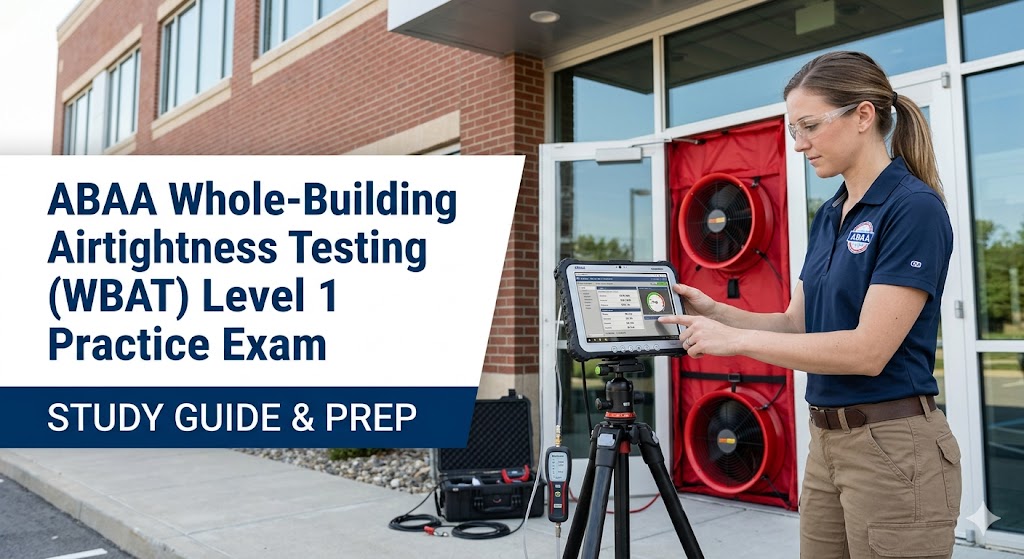
Additional Information
What the Course Entails and Exam Details
This course provides a deep dive into the practical and
theoretical aspects of whole-building airtightness testing at Level 1. Students
gain comprehensive knowledge on several key topics essential for effective
testing:
- Understanding
Airflow and Building Physics: Learners explore the fundamental
principles of air pressure, airflow, and the effects of infiltration and
exfiltration on energy use, occupant comfort, and structural longevity.
- Airtightness
Standards: The curriculum thoroughly covers relevant industry
standards, primarily focusing on ASTM testing methods for building
airtightness and the necessary calculations involved.
- Test
Preparation and Safety: Detailed instructions on how to properly
prepare a building for testing, identify potential hazards, and implement
required safety procedures are a core part of the training.
- Fan
Pressurization (Blower Door) Systems: Students get hands-on experience
and instructions on operating standard multi-fan systems, understanding
system components, and troubleshooting.
- Data
Collection and Reporting: Learning how to collect accurate test data
using manometers and software, perform the necessary corrections, and
produce professional reports in compliance with industry requirements is a
critical focus area.
What to Expect in the Final Exam
Achieving the ABAA WBAT Level 1 Certification requires
successfully completing a two-part assessment process:
- Written
Examination: The final exam includes a proctored written component.
Expect multiple-choice questions that thoroughly evaluate your
understanding of the theoretical concepts, standards, calculations, and
safety protocols covered in the training. While specific passing scores
can vary, a minimum score of around 70-80% is typically required. The time
limit for the written portion is usually sufficient but requires efficient
time management.
- Practical
Field Examination: In addition to the written test, a practical field
test must be passed. Candidates are observed by a registered ABAA assessor
and are required to physically demonstrate proficiency by setting up a
test, operating the fan system, collecting accurate data, and documenting
the procedure correctly within a real or simulated building environment.
This is generally a pass/fail component.
How to Study and Exam Centers
Preparation is key to succeeding on both portions of the
ABAA WBAT Level 1 Exam. Here are actionable strategies:
- Review
ABAA Materials: The primary study resource will be the official
training manual and materials provided by ABAA or their authorized training
providers. Review these thoroughly, focusing on key terms, standards, and
formulas.
- Practice
with Equipment: Gain as much hands-on practice as possible using
multi-fan systems. Familiarity with the hardware, software, and
troubleshooting will be invaluable for the practical exam. Practice
setting up the equipment, running simulated tests, and verifying data
accuracy.
- Utilize
Practice Exams: Seek out sample questions and practice tests, like
this one, to familiarize yourself with the written exam's format, style,
and potential difficulty. These are effective tools for identifying areas
where you need more study.
- Study
ASTM Standards: Carefully review relevant standards (like ASTM E779)
that govern airtightness testing. Understand the test methods, conditions,
and calculation requirements.
Taking the Exam:
- Authorized
Training Providers: The certification exam, including both the written
and practical portions, is typically taken immediately following an
ABAA-authorized training course. ABAA lists their approved training
locations and schedules on their official website. You will register
directly through these training organizations.
- Physical
Testing Centers: Because of the hands-on nature of the practical field
assessment, the majority of exams are conducted in person at dedicated
physical training facilities equipped with the necessary testing equipment
and structures for the practical demonstration.
Job Opportunities from the Course
Earning your ABAA Whole-Building Airtightness Testing Level
1 Certification significantly enhances your professional credibility and opens
doors to numerous career paths within the building performance and construction
sectors. Consider these specialized roles:
- Airtightness
Tester / Specialist: Conduct independent building air leakage tests to
verify code compliance and performance standards.
- Energy
Auditor: Provide comprehensive energy assessments that include
quantitative airtightness data.
- Building
Envelope Consultant: Advise architects, builders, and building owners
on materials and design strategies to improve the performance of the
building envelope.
- Sustainability
/ Green Building Consultant: Contribute your expertise to LEED,
Passive House, or other high-performance building certification projects.
- Construction
Quality Control Manager: Implement and oversee rigorous airtightness
verification programs during new construction projects.
- Building
Inspector: Specializing in the inspection of air barrier systems and
verifying energy efficiency requirements.
Frequently Asked Questions
Reviews
5.0
Based on 0 reviews
Leave a Review
No reviews yet. Be the first to review!