
ABRET Digital Instrumentation Practice Exam
$69.00
- Buy to unlock unlimited access to all Quiz questions and Answers in this Quiz.
- After purchase you can print a PDF of the whole quiz at any point. The PDF will contain the questions and the correct answers.
About this Exam
The ABRET Digital Instrumentation Practice Test is a crucial
preparatory tool designed for neurodiagnostic professionals striving to achieve
their credentials, such as the Registered Electroencephalographic Technologist
(R. EEG T.) or Certified Neurophysiologic Intraoperative Monitoring
Technologist (CNIM).
This practice test specifically targets the core technical
foundation of modern neurodiagnostic testing: understanding how digital systems
capture, process, and display delicate physiological signals.
It is designed for technologists who already possess basic
clinical knowledge but need to master the filters, amplifiers, sampling rates,
and digital concepts that are critical for accurate data interpretation and
patient safety in a modern, computerized lab or operating room environment.
Ready to test your knowledge?
Buy Now to Access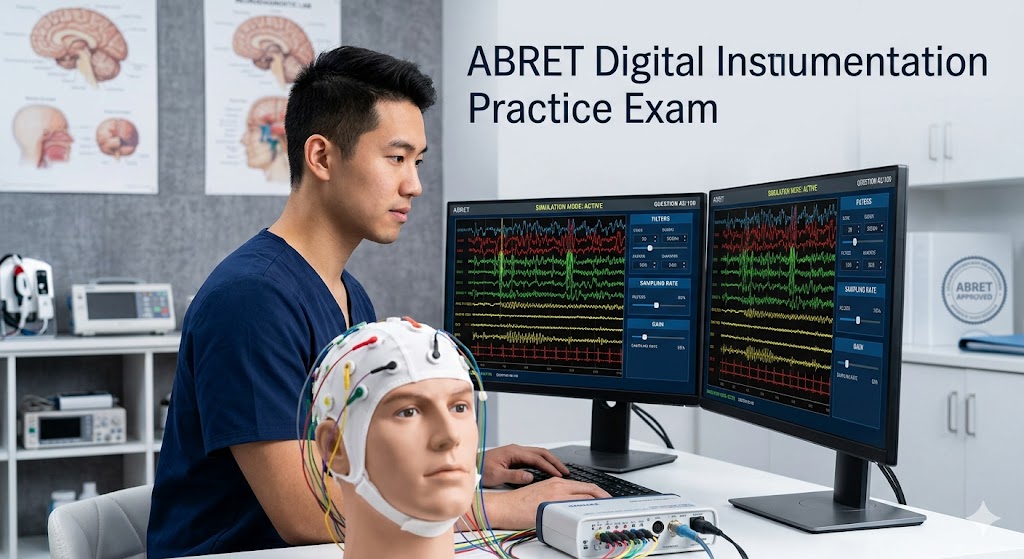
Additional Information
What the Course Entails and Exam Details
This practice examination focuses heavily on the engineering
and physics principles that underpin modern neurodiagnostic equipment.
Candidates will face a rigorous assessment of their
knowledge in key domain areas, including:
- Filter
Theory and Application: Comprehensive knowledge of high-pass,
low-pass, and notch (50/60 Hz) filters, including their cutoff
frequencies, rolloff characteristics, and how they affect wave morphology.
- Digital
Concepts and Processing: Mastery of sampling rates (Nyquist Theorem),
aliasing, analog-to-digital (A/D) conversion, gain vs. sensitivity, and
dynamic range.
- Electrode
Technology: Understanding impedance, electrode materials, proper
application techniques, and standard placement systems (like the
International 10-20 and 10-10 systems).
- Artifact
Identification and Elimination: The ability to distinguish
physiological artifacts (e.g., eye movement, muscle, EKG) from
non-physiological artifacts (e.g., electrical interference, equipment
noise) and apply technical solutions to resolve them.
- System
Troubleshooting: Basic maintenance and problem-solving skills for
resolving common hardware and software issues during a recording.
What to Expect in the Final Exam
While this is a practice test, it is meticulously
crafted to simulate the rigor and structure of the digital instrumentation
sections found on actual ABRET certification board exams.
The practice test is typically computer-based and primarily
consists of objective, multiple-choice questions.
These questions often present candidates with technical
scenarios, equipment diagrams, or specific waveform segments, asking them to
identify the correct setting, troubleshooting step, or conceptual definition.
Upon completion, candidates usually receive immediate
feedback and a performance breakdown by content domain, which is invaluable for
identifying specific areas requiring further study before challenging the
official board examination.
The actual final ABRET exams are much longer and have a
predetermined time limit (often around 4 hours) and require a specific passing
score determined by statistical equating methods.
How to Study and Exam Centers
Effectively studying for the digital instrumentation section
requires a blend of conceptual understanding and practical application.
Your strategy should include:
- Use
Official ABRET Resources: Utilize the official ABRET candidate
handbooks and any recommended study guides or practice tools directly from
the board.
- Review
Core Textbooks: Deeply study standard neurodiagnostic textbooks that
specialize in clinical neurophysiology and the physics of EEG/EP
instrumentation.
- Engage
with ASET Materials: The American Society of Neurodiagnostic Technologists
(ASET) offers extensive online courses, webinars, and publications focused
specifically on digital concepts.
- Repeat
Practice Tests: Take the ABRET Digital Instrumentation Practice Test
multiple times to build test-taking stamina and familiarity with the
question style.
- Hands-on
Application: Connect the theory to practice in your lab; actively
adjust filter settings and gain during routine recordings (under proper
supervision) to observe the visual effects on the signal.
The practice test is accessed online, typically through a
dedicated ABRET portal, allowing you to take it from the comfort of your home
or office.
For the final ABRET certification exams, candidates will
need to schedule their test at a Pearson VUE authorized professional testing
center, which are located throughout the world.
Job Opportunities from the Course
Mastery of digital instrumentation is not just for passing
the exam; it is a required competency that directly leads to specialized career
paths in neurodiagnostics.
Earning your R. EEG T. or CNIM unlocks job opportunities
such as:
- Registered
EEG Technologist
- Neurodiagnostic
Technologist
- Intraoperative
Neuromonitoring (IONM) Technologist
- CNIM
Technologist
- Evoked
Potential Technologist
- Polysomnographic
(Sleep) Technologist (with instrumentation cross-training)
- Neurodiagnostics
Lab Supervisor
- Epilepsy
Monitoring Unit (EMU) Specialist
Frequently Asked Questions
Reviews
5.0
Based on 0 reviews
Leave a Review
No reviews yet. Be the first to review!