
ABRSM Grade 8 Music Theory Practice Exam
$69.00
- Buy to unlock unlimited access to all Quiz questions and Answers in this Quiz.
- After purchase you can print a PDF of the whole quiz at any point. The PDF will contain the questions and the correct answers.
About this Exam
The ABRSM Grade 8 Music Theory exam is the pinnacle of the
Associated Board of the Royal Schools of Music’s theory graded exams. It is
designed for advanced musicians, composers, teachers, and university-bound
students who require a deep, sophisticated understanding of musical mechanics,
harmony, and analysis. While lower grades focus on the building blocks of
music, Grade 8 tests the application of these concepts in complex, creative,
and analytical contexts. Mastering this level demonstrates a professional competency
in theory that supports advanced performance, composition, and academic study.
Ready to test your knowledge?
Buy Now to Access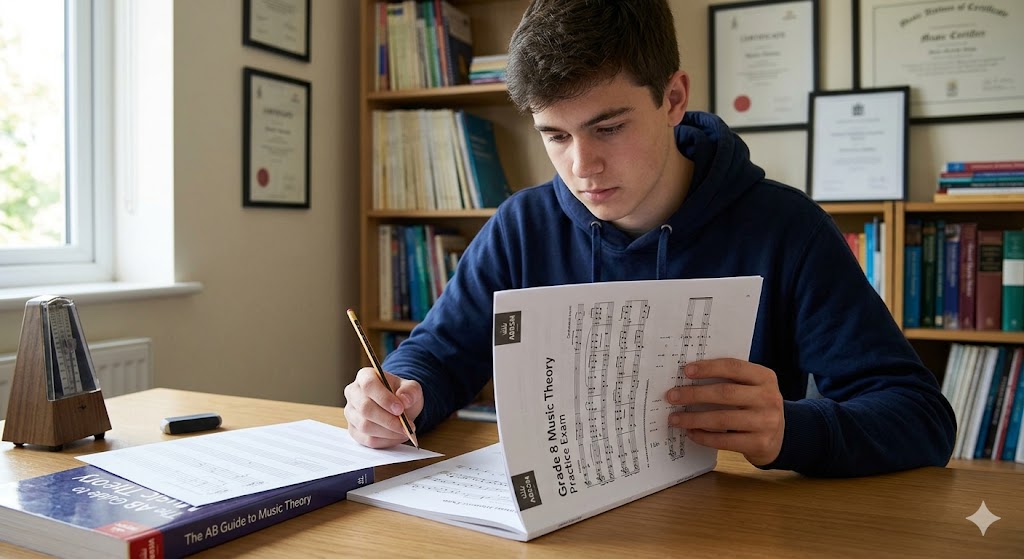
Additional Information
What the Course Entails and Exam Details
This exam moves beyond basic terminology and tests harmony,
counterpoint, composition, and score analysis at an advanced level. The primary
areas covered include:
- Harmony
and Counterpoint: You will be expected to complete a harmonic
progression from a given opening, which may involve figuring a bass,
realizing a figured bass, or completing a chromatic harmony example.
Knowledge of advanced techniques like secondary dominants, Neapolitan
sixths, diminished sevenths, and thematic development is crucial.
- Melodic
Composition: You must compose a complete melody for a specified
instrument (which may require transposition) based on a given rhythmic or
melodic fragment, demonstrating an understanding of balance, phrase
structure, and style.
- Score
Analysis: A significant portion of the exam involves analyzing a
provided excerpt from a complex orchestral, chamber, or vocal score. You
will answer questions regarding orchestration, instrumentation,
transposition, harmonic analysis, stylistic features, and musical
terminology used within the score.
- Contextual
Knowledge: Understanding the historical context, performance practice,
and common forms/structures of Western classical music (baroque,
classical, romantic, and early 20th century) is integrated into the
analysis questions.
What to Expect in the Final Exam
The ABRSM Grade 8 Music Theory exam is a traditional,
written paper-based test that lasts for three hours. It is generally structured
into five complex questions:
- Format:
The exam consists of five substantial questions that require a combination
of musical notation writing (for harmony and composition) and written
English responses (for score analysis and terminology).
- Question
Types: The first few questions focus on advanced harmony,
counterpoint, or melodic composition. The final questions center on a
detailed analysis of a long musical score excerpt.
- Scoring:
The exam is marked out of 100. The passing score is 66, a Merit is awarded
for 80-89 marks, and a Distinction for 90 or more.
- Specific
Rules: Only pencils and erasers are allowed for notation; ink is
permitted for written answers. Standard musical terminology in Italian,
German, French, and English may be used. Students must be proficient in
reading all clefs (treble, bass, alto, and tenor).
How to Study and Exam Centers
Preparation for Grade 8 requires consistent, high-level
practice. Actionable strategies include:
- Master
Past Papers: Work through many years of past papers. The format is
consistent, and understanding how the questions are structured and how
examiners allocate marks is vital. Aim to complete them within the
three-hour time limit.
- Focus
on Figured Bass and Harmony: These are often the most challenging
sections. Practice realizing figured basses by prominent baroque composers
(Bach, Handel) and focus on smooth, correct voice-leading.
- Develop
Compositional Skills: Practice writing balanced melodies and
completing 4-part harmonies from a melody line, ensuring your harmonic
vocabulary is varied and stylishly appropriate.
- Analyze
Scores Constantly: Download or borrow orchestral scores and practice
identifying transpositions, instrumentation details, harmonic
progressions, and structural landmarks. Learn the French, German, and
Italian names for all common instruments.
- Exam
Centers: Unlike the lower theory grades (1-5), which have moved
online, Grades 6-8 remain in-person, written exams held at specific times
during the year. Candidates must register through the ABRSM online portal,
and the exam is taken at authorized physical locations, such as designated
ABRSM exam centers, music schools, or colleges worldwide.
Job Opportunities from the Course
Achieving Grade 8 Music Theory is a strong credential that
can unlock numerous career paths and further academic opportunities:
- Private
Music Teacher: Demonstrates the advanced knowledge necessary to teach
theory through all graded levels.
- Composer/Arranger:
Provides the essential harmonic and structural foundation needed for
professional composition and arranging.
- Orchestrator:
Mastery of score analysis and instrumentation is critical for adapting
music for different ensembles.
- Music
Journalist/Critic: Offers the technical understanding required to
write sophisticated, analytical reviews and articles.
- Music
Editor/Publisher: Useful for correcting proofs and editing scores for
professional publication.
- Academic
Researcher/Musicologist: An essential prerequisite for higher
education studies (BMus, MMus, PhD) in music theory or musicology.
- Conductor:
Advanced knowledge of score reading and analysis is a prerequisite for
orchestral or choral conducting.
Frequently Asked Questions
Reviews
5.0
Based on 0 reviews
Leave a Review
No reviews yet. Be the first to review!