
ABSA 4th Class Power Engineer Part A Practice Exam
$69.00
- Buy to unlock unlimited access to all Quiz questions and Answers in this Quiz.
- After purchase you can print a PDF of the whole quiz at any point. The PDF will contain the questions and the correct answers.
About this Exam
Embarking on a career as a Power Engineer in Alberta often
begins with achieving the 4th Class Certificate of Competency, governed by the
Alberta Boilers Safety Association (ABSA). This certification is the essential
entry-level credential required to operate and maintain power plants and
associated equipment safely and legally within the province. The Part A Practice
Test is a crucial stepping stone designed for individuals looking to gain their
initial certification and build a strong foundation in power engineering
principles. Whether you are a student just starting your journey, looking to
formalize existing skills, or making a career change into a technical field,
this practice test will help you identify knowledge gaps and prepare
effectively for the actual examination.
Ready to test your knowledge?
Buy Now to Access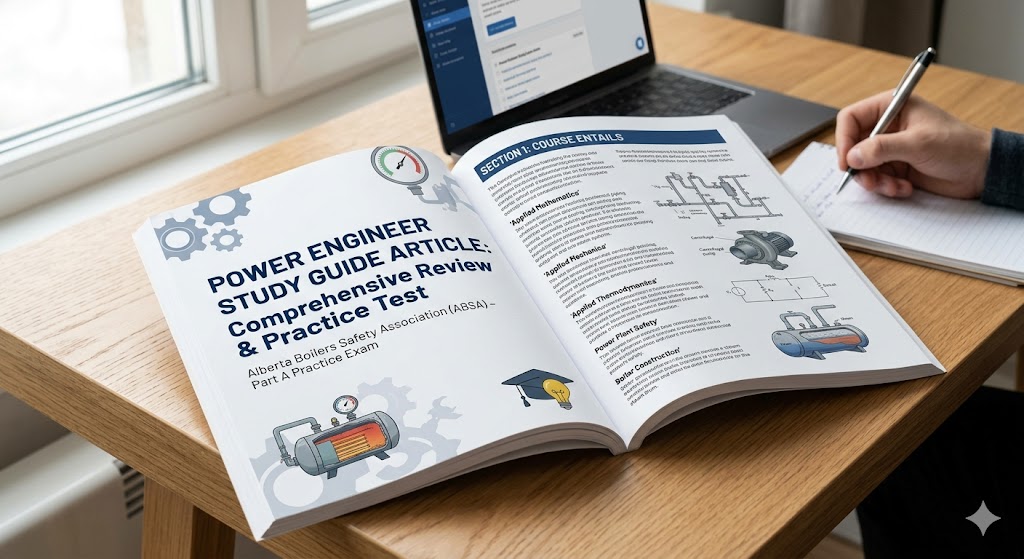
Additional Information
What the Course Entails and Exam Details
This examination covers the fundamental knowledge required
for initial Power Engineer certification. Key areas typically include: basic
mathematics applied to technical problems, introductory mechanics, and
foundational thermodynamics. Candidates must demonstrate an understanding of
plant safety procedures, workplace hazards, and relevant safety legislation.
Specific technical topics will often encompass boiler types and components,
combustion systems, feedwater systems, basic instrumentation and control, and
common auxiliary equipment found in modern industrial plants. Understanding
these core concepts is vital for ensuring the safe operation of boilers,
pressure vessels, and other associated plant machinery.
What to Expect in the Final Exam
The actual ABSA 4th Class Power Engineer Part A examination
is typically a multiple-choice formatted test consisting of around 100
questions. Candidates must achieve a passing score, which is generally 65% or
70%, to obtain the certificate. A time limit, commonly three to three and a
half hours, is strictly enforced for completion. Exam rules usually permit the
use of non-programmable calculators. However, it is essential to review the
current official ABSA candidate guide for precise details on allowed reference
materials, as some examinations may be closed-book or permit specific steam
tables. Preparation with high-quality practice exams, mirroring this format and
subject matter, significantly enhances your chances of success on exam day.
How to Study and Exam Centers
Effective preparation requires a structured approach.
Utilize recommended textbooks, such as the relevant PanGlobal modules, as your
primary learning resource. Complement this by enrolling in authorized technical
college programs, which often offer comprehensive classroom or online
instruction. Practice tests are invaluable tools; use them repeatedly to assess
your readiness and become familiar with the question styles and time constraints.
Focus on understanding the why behind concepts, not just memorizing
answers. Create a dedicated study schedule and join or form study groups for
collaborative learning. For current exam schedules and locations, always
consult the official ABSA website. Examinations are typically conducted at
various designated technical institutions, colleges, or specialized testing
centers throughout Alberta, which may require in-person attendance. Ensure you
book your slot well in advance, and verify all specific proctoring requirements
if online options are available.
Job Opportunities from the Course
Upon obtaining your ABSA 4th Class Power Engineer
Certificate of Competency, you open the door to a wide range of essential and
stable career opportunities. Qualified 4th Class Power Engineers are in high
demand across many industries, fulfilling vital roles such as:
- Power
Engineer (4th Class and progression to higher levels)
- Plant
Operator
- Boiler
Operator
- Shift
Engineer
- Building
Operator
- Maintenance
Technician
- Utilities
Operator
- Process
Technician in petrochemical and oil and gas facilities
- Facilities
Manager in large buildings and institutions
Frequently Asked Questions
Reviews
5.0
Based on 0 reviews
Leave a Review
No reviews yet. Be the first to review!