
Ace Your Ohio Health Insurance Practice Exam
$69.00
- Buy to unlock unlimited access to all Quiz questions and Answers in this Quiz.
- After purchase you can print a PDF of the whole quiz at any point. The PDF will contain the questions and the correct answers.
About this Exam
The Ohio Health Insurance Practice Exam is a critical stepping stone for individuals aspiring to become licensed insurance agents in the state of Ohio, specifically within the Accident and Health line of authority.
Designed to mirror the official state licensing examination administered by the Ohio Department of Insurance (ODI) and its testing vendor, PSI, this practice test allows candidates to evaluate their readiness, identify knowledge gaps, and build the confidence necessary to succeed on their first attempt.
This exam is intended for students who have completed their mandatory pre-licensing education and are preparing for the final hurdle before licensure, ensuring they possess the minimum level of competence required to serve Ohio consumers.
Ready to test your knowledge?
Buy Now to Access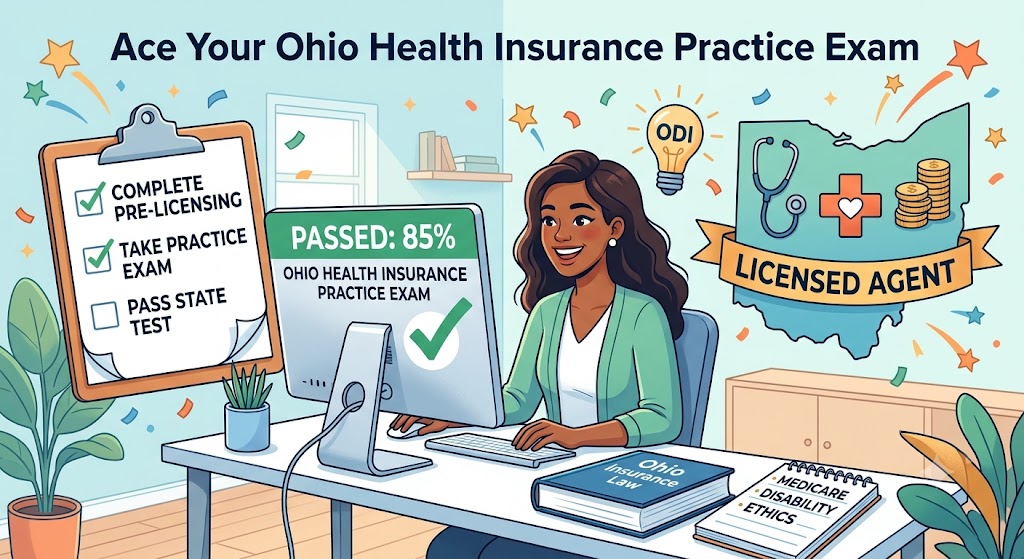
Additional Information
What the Course Entails and Exam Details
This practice exam covers the comprehensive syllabus required by the Ohio Department of Insurance for Accident and Health insurance agents.
It is structured into two main sections: National General Insurance Concepts and Ohio-Specific Laws and Regulations.
The national section tests fundamental insurance principles, such as different types of health policies (medical expense, disability income, Medicare supplement, long-term care), policy provisions, riders, and the taxation of insurance benefits.
The Ohio-specific section focuses on unique state regulations, including licensing procedures, agent responsibilities, unfair trade practices, and relevant statutes governing health insurance contracts within the state.
Passing this practice exam demonstrates a strong grasp of both the theoretical and applied knowledge needed for a successful insurance career in Ohio.
What to Expect in the Final Exam
While a practice test mimics the experience, knowing the official rules for the state licensing exam is crucial.
The official Ohio Accident and Health Insurance Examination is a proctored, computer-based, multiple-choice test.
Typically, single-line exams like Accident and Health contain 100 scored questions, plus additional unscored pre-test items, with a total time limit of 2 hours.
Combined exams, such as Life, Accident, and Health, feature 150 questions and a 2.5-hour time limit.
To pass, candidates must achieve a minimum score of 70%, and some variations require a 70% passing score on each of the national and state sections within the same attempt.
State law prohibits taking personal items, including phones and calculators, into the testing room, and breaks are generally not permitted during the exam.
How to Study and Exam Centers
Effective study for the Ohio licensing exam involves more than just reading the material.
Begin by focusing on the official exam content outlines provided by the testing vendor, PSI, and your pre-licensing course provider.
Take multiple timed practice tests to familiarize yourself with the pacing and question format, and use the score diagnostics to identify your weak content areas.
Create flashcards for key terms, definitions, policy provisions, and specific Ohio regulations to reinforce memorization.
Ensure you possess a strong understanding of state laws and ethics, as these often carry significant weight.
While practice tests are taken through your chosen training provider, the official state licensing exam must be scheduled in advance through the state's testing vendor, PSI, and taken at one of their authorized physical testing centers located throughout Ohio or via their approved online proctoring service.
Job Opportunities from the Course
Successfully passing the official licensing exam unlocks numerous career opportunities within Ohio's robust financial services sector.
Upon licensure, you can pursue diverse job titles and career paths, including:
Health Insurance Agent / Producer
Employee Benefits Specialist
Health Insurance Broker
Insurance Agency Manager
Insurance Compliance Officer
Sales Manager in Insurance
Frequently Asked Questions
Reviews
5.0
Based on 0 reviews
Leave a Review
No reviews yet. Be the first to review!