
Ace Your TAMU CHEM107 Exam 2: Practice Guide
$69.00
- Buy to unlock unlimited access to all Quiz questions and Answers in this Quiz.
- After purchase you can print a PDF of the whole quiz at any point. The PDF will contain the questions and the correct answers.
About this Exam
Welcome, Texas A&M engineering students! This study guide is specifically designed to help you navigate and succeed in your CHEM107 General Chemistry for Engineering Students Exam 2. We understand that this foundational course is a critical step in your engineering degree plan, and this second exam often covers pivotal concepts that bridge basic chemistry with engineering applications.
This practice guide provides a structured approach to your revision, offering insights into the core curriculum, exam format, and effective study strategies. Whether you are aiming to solidify your understanding or looking for focused practice, this resource is your roadmap to performing confidently on exam day. Note: This guide is a practice resource and is not affiliated with or endorsed by Texas A&M University.
Ready to test your knowledge?
Buy Now to Access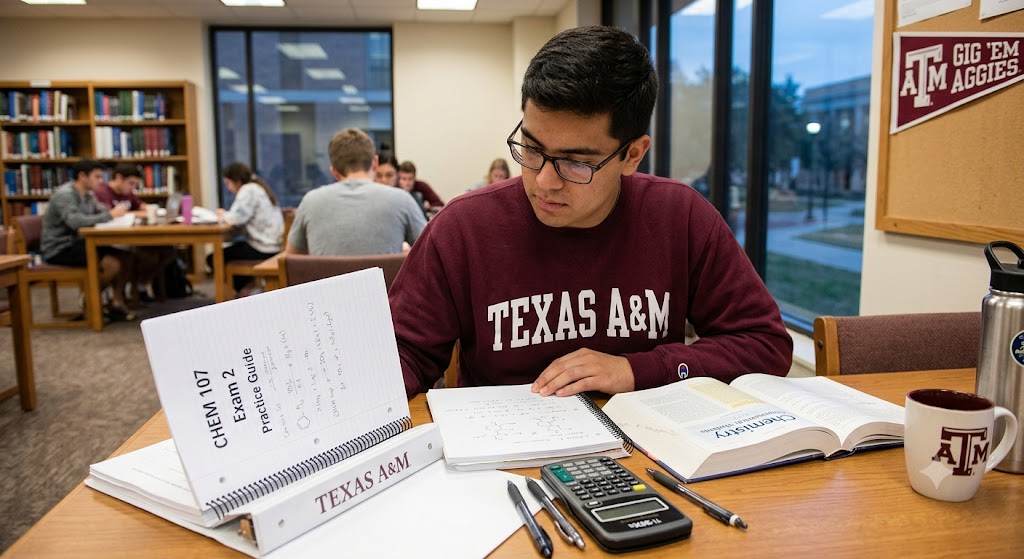
Additional Information
What the Course Entails and Exam Details
CHEM 107: General Chemistry for Engineering Students is a comprehensive, fast-paced course that provides an introduction to the major concepts of modern chemistry. The course curriculum is uniquely tailored to the needs of engineering majors, emphasizing topics relevant to material science, thermodynamics, and environmental engineering.
Specifically, Exam 2 typically covers the crucial "middle" section of the semester. Building upon the atomic theory and stoichiometry from the first part of the course, you will dive into the following core topics:
Chemical Reactions in Aqueous Solutions: This includes master balance equations, precipitation reactions, acid-base neutralizations, and oxidation-reduction (redox) titrations.
Gases and Kinetic-Molecular Theory: Mastering the Ideal Gas Law, partial pressures, effusion, diffusion, and understanding the behavior of real gases versus ideal gases.
Thermochemistry: Introduction to energy changes, enthalpy ($\Delta H$), calorimetry, Hess’s Law, and standard enthalpies of formation.
Electronic Structure and Periodicity (often introduced): Understanding the quantum mechanical model of the atom, electron configurations, and periodic trends (ionization energy, atomic radius, etc.).
Success in CHEM107 requires not only understanding these concepts theoretically but also applying them through rigorous problem-solving.
What to Expect in the Final Exam
While this guide focuses on Exam 2 Practice, it’s vital to understand the structure of the course assessment to contextualize your studying. In a standard semester, students will take three mid-term exams (including Exam 2) and one comprehensive final exam.
The actual CHEM107 Exam 2 typically has the following format:
Format: The exam is primarily multiple-choice, which requires precision in calculations. However, some instructors may include short-answer or free-response questions where you must show your work for partial credit, especially regarding complex stoichiometry or thermodynamics problems.
Time Limit: You are usually allotted 75 minutes to complete the exam. This emphasizes the need for speed and accuracy in your calculations.
Passing Score: While there is no single "passing score" for an individual exam, success is typically defined by a strong cumulative grade in the course (A, B, or C) to progress seamlessly in your engineering track. A score below 70% often indicates a need for immediate intervention and review.
Rules: Standard university exam rules apply. You are usually required to bring a scientific calculator (approved models only), pencils, and your TAMU Student ID. Formula sheets or scratch paper are typically provided by the chemistry department.
How to Study and Exam Centers
Preparation for CHEM 107 is not about passive reading; it’s about active problem-solving. Here is an actionable strategy for tackling Exam 2:
The Power of Practice: The most effective way to study is by solving chemistry problems. Utilize the suggested practice problems from your professor, textbook (typically "Chemistry for Engineering Students"), and previous years' exams if available.
Utilize TAMU Resources: Take advantage of Texas A&M’s robust academic support. This includes attending Supplemental Instruction (SI) sessions, utilizing tutoring at the Academic Success Center (ASC), and attending your professor’s and TA’s office hours.
Form Study Groups: Collaborating with fellow engineering students can expose you to different problem-solving methods and clarify complex concepts.
Timed Practice Exams: Treat the practice exams provided by your instructor like the real thing. Sit in a quiet room, set a timer for 75 minutes, and take the exam without notes to accurately gauge your readiness and identify weak areas.
Exam Centers (Important Distinction):
For the actual CHEM107 Exam 2 during the semester, you do not take the test at an external testing center (like Pearson VUE).
Where to Take the Exam: The midterm exams (Exams 1, 2, and 3) are held on campus in designated lecture halls, often during your scheduled class time or in combined evening exam slots announced early in the semester. The location and time are posted on the official course learning management system (e.g., Canvas).
The Practice Exam: This CHEM107 Exam 2 Practice is a study resource provided via your university portal or department. You are meant to use it for self-assessment and practice wherever you choose to study.
Job Opportunities from the Course
While CHEM 107 is an introductory course, it is the fundamental "gatekeeper" that enables you to pursue advanced coursework. Successfully mastering these chemical principles is essential for practically every engineering discipline.
A degree from Texas A&M’s College of Engineering—made possible by succeeding in foundational courses like CHEM107—unlocks high-demand, lucrative career paths. Here are job opportunities related to various engineering disciplines that rely heavily on the principles covered in this course:
Chemical Engineering:
Process Engineer
Chemical Plant Manager
R&D Scientist in Pharmaceuticals or Energy
Materials Science & Engineering:
Materials Engineer
Quality Control Engineer in Metallurgy or Polymers
Semiconductor Process Engineer
Mechanical Engineering:
Design Engineer (especially for thermal systems/engines)
Energy Systems Engineer
Automotive Engineer
Environmental Engineering:
Water Treatment Engineer
Environmental Consultant
Remediation Engineer
Civil Engineering:
Geotechnical Engineer
Construction Materials Engineer
Frequently Asked Questions
Reviews
5.0
Based on 0 reviews
Leave a Review
No reviews yet. Be the first to review!