
Analyzing and Interpreting Literature Practice Test 2026 | Exam Prep Questions and Answers
$69.00
- Buy to unlock unlimited access to all Quiz questions and Answers in this Quiz.
- After purchase you can print a PDF of the whole quiz at any point. The PDF will contain the questions and the correct answers.
About this Exam
Welcome to your essential resource for the Analyzing and Interpreting Literature 2026 Practice Test. This study guide is meticulously designed for high school and college students, and anyone looking to fast-track their educational journey. The underlying exam is one of the most popular ways to earn college credit without taking a full-semester course. Successfully passing allows you to demonstrate proficiency in reading and critically analyzing various forms of literature, proving that you possess the skills equivalent to a student who has completed an introductory college literature course. If you aim to save money on tuition and shorten your time to graduation, this practice test and the skills it assesses are your first major step.
Ready to test your knowledge?
Buy Now to Access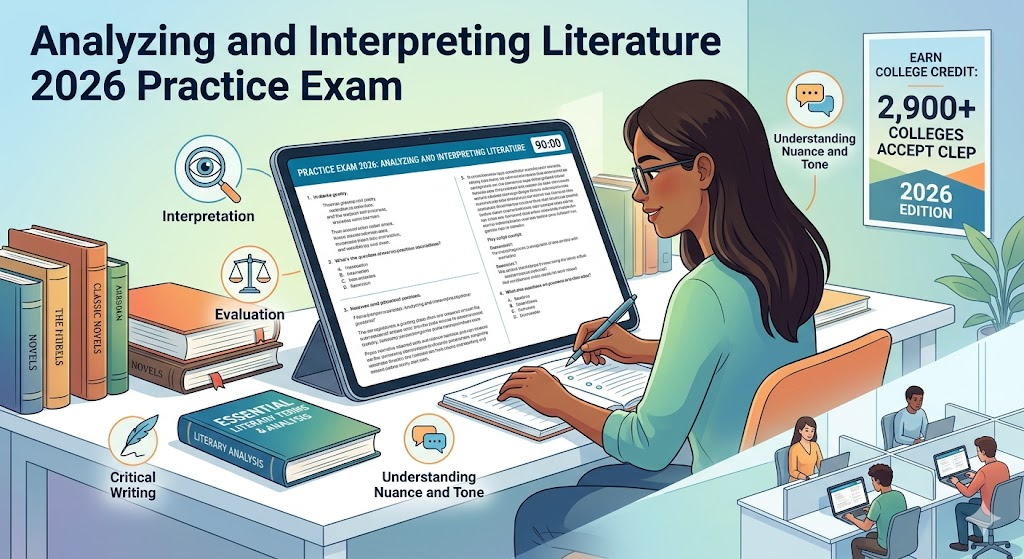
Additional Information
What the Course Entails and Exam Details
This comprehensive practice experience covers the same broad spectrum of literary genres and analytical skills as the final certification. The curriculum, implicitly structured around the material of a two-semester undergraduate course, focuses on your ability to read widely and perceptively. The core of your studies will revolve around three primary literary forms:
Poetry (35%–45%): Analyzing a variety of poetic structures, from sonnets to free verse.
Prose (35%–45%): Interpreting extracts from both fictional novels and short stories, as well as nonfiction essays and biographies.
Drama (15%–30%): Evaluating scenes from classical and contemporary plays.
The exam questions are based on provided passages, taken chiefly from American and British literature, ranging from the classical period through the 21st century. While you do not need specific prior knowledge of the included works, you will be required to demonstrate:
Comprehension: The ability to understand what you read on a literal and figurative level.
Analysis: Identifying and interpreting literary elements like imagery, metaphor, irony, tone, and style.
Interpretation: Grasping the author's or speaker's attitude, perceiving relationships between parts of a work, and understanding rhetorical devices.
Knowledge of Terminology: Familiarity with the basic vocabulary used to discuss and critique literary texts.
What to Expect in the Final Exam
While this guide focuses on a Practice Test, it is crucial to understand the format of the official proctored exam to direct your preparation. The actual full-length exam you will encounter is a computer-based test containing approximately 80 multiple-choice questions.
You will have 90 minutes to complete the entire section. The exam is structured around passages, and for each passage, you will answer multiple connected questions. A crucial detail to note is that some institutions may also require an optional essay section, administered separately, which allows for two 45-minute responses. For the multiple-choice section, the final raw score is converted to a scaled score ranging from 20 to 80. A score of 50 is widely accepted by over 2,900 colleges and universities as the minimum to grant credit, usually equivalent to three to six semester hours, though you must always check your specific institution's policy.
How to Study and Exam Centers
Preparation is paramount, as this exam tests skills rather than rote memorization. We recommend a four-pronged approach to master the content:
Read Widely and Actively: Immerse yourself in a diverse range of prose, poetry, and drama from different historical periods. Practice summarizing plots, identifying main themes, and noting how authors use language to achieve specific effects.
Master Literary Devices: Create a glossary of key literary terms (e.g., alliteration, foreshadowing, unreliable narrator, hyperbole) and ensure you can identify and explain their function in a text.
Take Multiple Practice Tests: The most effective strategy is to simulate the real testing experience. Use a reputable Analyzing and Interpreting Literature 2026 Practice Test to learn the timing, question types, and how to analyze complex passages under pressure.
Use Official Resources: Leverage study materials from the College Board, including their official study guide and online resources. Consider free, comprehensive courses like those offered by Modern States to further your preparation.
When you are ready for the final proctored exam, you will not go to a dedicated physical center just for practice. The actual CLEP exam is administered year-round at over 2,000 testing centers, which are primarily located on college and university campuses. You can find and register at a testing center near you through the College Board website. Additionally, for maximum convenience, the exam is available through remote proctoring, allowing you to take the test from your own home or a secure private location, provided your equipment meets technical requirements. The practice test itself is typically accessed through online educational portals.
Job Opportunities from the Course
While this exam grants academic credit rather than a direct job-specific certification, the advanced critical thinking and analytical communication skills it verifies are highly prized by employers. Completing a degree that includes these foundation skills unlocks a wide array of professional career paths. The abilities to read with nuance, analyze complex information, and interpret meaning are foundational for success in fields such as:
Editor: Reviewing and improving written content for clarity, tone, and style in publishing.
Content Writer / Copywriter: Crafting engaging narrative, informational, or persuasive text for media and marketing.
Journalist: Researching, analyzing facts, and writing compelling news stories and features.
Educator / Teacher: Instructing students in English literature and critical reading.
Lawyer / Legal Professional: Analyzing case law, interpreting legal statutes, and constructing strong arguments.
Public Relations Specialist: Interpreting public sentiment and crafting strategic communication for organizations.
Marketer: Analyzing consumer trends and interpreting data to create effective campaigns.
Librarian / Archivist: Managing information resources and helping others access and interpret information.
Frequently Asked Questions
Reviews
5.0
Based on 0 reviews
Leave a Review
No reviews yet. Be the first to review!