
Area Detective Practice Exam
$69.00
- Buy to unlock unlimited access to all Quiz questions and Answers in this Quiz.
- After purchase you can print a PDF of the whole quiz at any point. The PDF will contain the questions and the correct answers.
About this Exam
The Area Detective
Practice Exam is a crucial stepping stone for sworn law enforcement officers
aiming to elevate their careers and specialize in criminal investigations. This
exam is meticulously designed for dedicated professionals who have served as
patrol officers or in similar entry-level roles and are now seeking promotion
to the detective or investigator rank within specialized geographic or
functional units (often referred to as 'Areas' or 'Divisions' in larger
departments). This practice exam simulates the rigorous knowledge-based and
analytical assessments used by law enforcement agencies to identify individuals
with the potential, critical thinking skills, and legal understanding necessary
to solve complex crimes, from burglary and assault to homicides and sexual
offenses. It serves as both a benchmark for current knowledge and a roadmap for
targeted study.
Ready to test your knowledge?
Buy Now to Access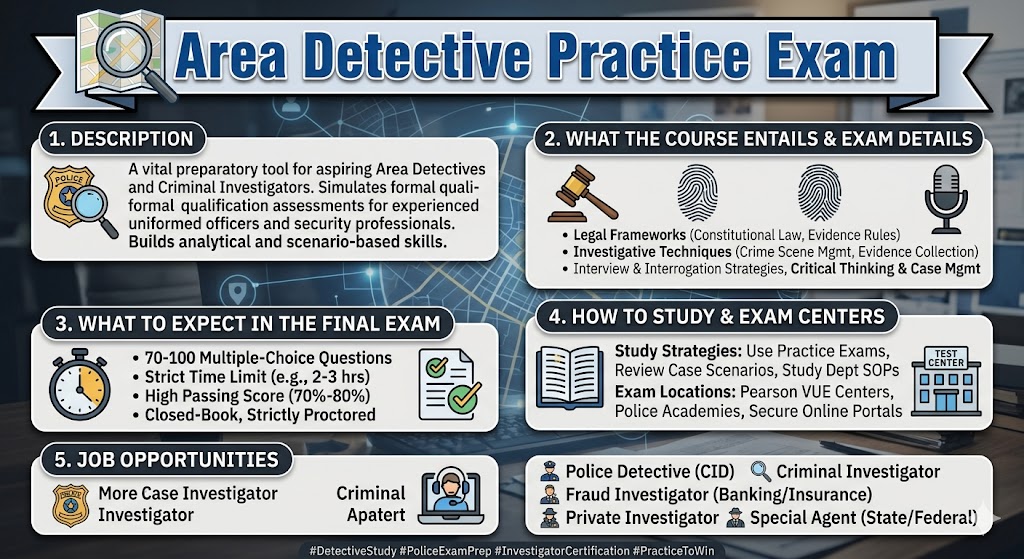
Additional Information
What the Course Entails and Exam Details
To succeed as an
Area Detective, candidates must possess a deep and multifaceted understanding
of criminal law and advanced investigative techniques. This exam covers a wide
spectrum of essential skills and core topics, including:
- Criminal Law & Procedure: Mastering
the nuances of state and local penal codes, standard rules of evidence,
the legal requirements for obtaining and executing search and arrest
warrants, and a firm command of constitutional rights (specifically
Fourth, Fifth, and Sixth Amendments).
- Investigative Techniques: Best practices
for crime scene management, including preservation, documentation,
photography, and the systematic collection and processing of various types
of physical evidence (e.g., DNA, fingerprints, ballistics).
- Interview & Interrogation:
Distinguishing between witness/victim interviews and suspect
interrogations, including legal requirements (Miranda rights), rapport
building, recognizing deceptive behavior, and ethical, result-oriented
questioning strategies.
- Case Management & Report Writing:
The administrative side of the job, including effective case
prioritization, maintaining detailed and objective investigative files,
and writing accurate, comprehensive reports suitable for prosecutorial
review and court testimony.
- Specialized Investigative Areas:
Foundational knowledge in specific crime areas, such as Homicide and
Violent Crimes, Property Crimes (burglary, theft, arson), Special Victims
Unit (SVU) topics, and sometimes basic economic or fraud crimes.
- Courtroom Testimony: Preparation for and
delivery of effective, truthful, and professional
- testimony under direct and
cross-examination.
While exact
structures vary by jurisdiction and department, candidates must be prepared for
a comprehensive and challenging evaluation. The Area Detective Exam typically
features one or more of the following formats:
- Multiple-Choice Questions: A significant
portion of the written exam, testing broad knowledge of law, procedure,
and investigative standard operating procedures (SOPs).
- Case Scenario Analysis: Written prompts
presenting complex, simulated crime scenes or investigations. Candidates
must analyze the given information to make legally sound decisions,
identify procedural errors, or propose next logical steps.
- Oral Board/Practical Assessment: Some
agencies include a panel interview or practical simulation where
candidates must verbally respond to scenarios or demonstrate skills (like
conducting a mock interview or managing a mock scene) to evaluate communication
and judgment under pressure.
Passing score
requirements are usually high, often needing 70% or 80% to be considered for
promotional lists, and time limits are strictly enforced, requiring candidates
to manage their time efficiently across sections. Candidates are typically not
allowed external materials or personal electronic devices.
How to Study and Exam Centers
Effective
preparation requires a structured study plan combined with active practical
application. Expert-recommended strategies include:
- Master the Department Manual: Prioritize
your own agency’s General Orders, Standard Operating Procedures (SOPs),
and Detective Bureau manuals. These are the primary source for accepted
practices and administrative requirements.
- Utilize Practice Exams: Regularly taking
simulations like this Area Detective Practice Exam identifies weak areas,
builds stamina, and familiarizes you with the phrasing of common question
types. Focus on why a choice is correct or incorrect, not just
memorizing the answer.
- Study Key Statute Codes: Create
flashcards or study sheets for frequently cited criminal statutes and
crucial procedural requirements regarding search and seizure.
- Form Study Groups: Collaborating with
colleagues allows you to discuss complex scenarios, debate legal
interpretations, and practice oral response techniques.
- Attend Workshops: If available,
participate in specialized investigative training workshops or promotional
prep classes offered by your agency or local police academies.
The final official
exam is managed exclusively by your department’s Human Resources division,
Civil Service commission, or an authorized external testing agency contracted
by your employer (e.g., Pearson VUE). Specific details regarding testing
logistics, authorized test centers (usually official department facilities or
government buildings), and available dates will be provided through formal
internal promotional announcements.
Job Opportunities from the Course
Successfully passing
this exam and securing promotion unlocks a prestigious and challenging
specialized career path. Common job titles and career opportunities that follow
this milestone include:
- Area Detective / Division Investigator
- Detective (Homicide, Violent Crimes,
SVU, or Property Crimes specialized units)
- Detective Supervisor (e.g., Sergeant or
Lieutenant within the Detective Bureau)
- Internal Affairs Investigator
- Task Force Officer (assigned to state or
federal joint operations)
- Private Investigator (after eventual
retirement or separation from law enforcement)
Frequently Asked Questions
Reviews
5.0
Based on 0 reviews
Leave a Review
No reviews yet. Be the first to review!