
Arizona Esthetics State Board Practice Exam
$69.00
- Buy to unlock unlimited access to all Quiz questions and Answers in this Quiz.
- After purchase you can print a PDF of the whole quiz at any point. The PDF will contain the questions and the correct answers.
About this Exam
The Arizona
Esthetics State Board exam is the final, essential step for aspiring skin care
professionals to gain licensure and legally practice within the state. Managed
by the Arizona State Board of Barbering and Cosmetology, this rigorous
examination ensures that every candidate possesses the necessary theoretical
knowledge and practical hands-on skills to operate safely, ethically, and
effectively. This exam is specifically designed for students who have
successfully completed the required hours of training from an approved
esthetics or cosmetology school in Arizona. Earning this license validates your
expertise and opens the door to a dynamic and rewarding career in the beauty
and wellness industry.
Ready to test your knowledge?
Buy Now to Access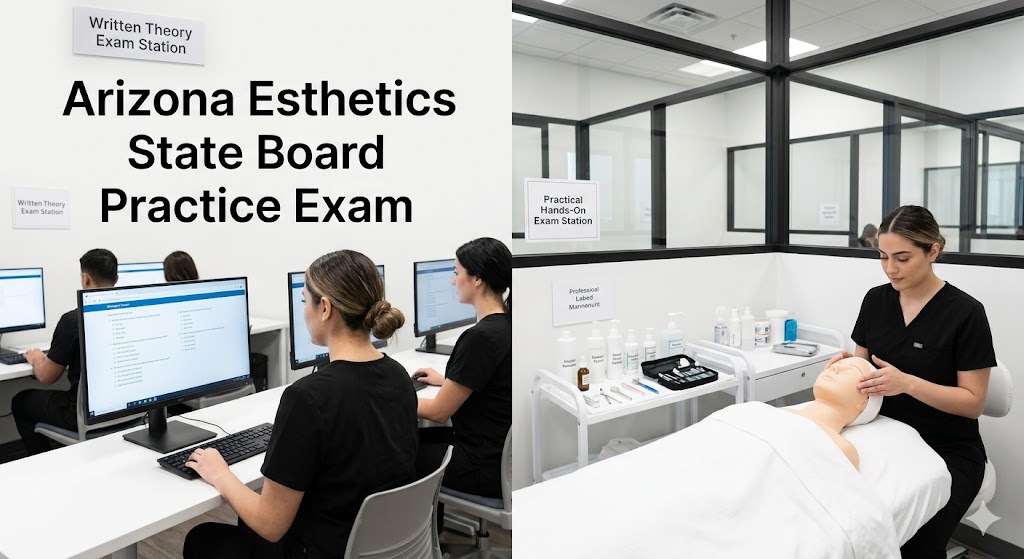
Additional Information
What the Course Entails and Exam Details
To be eligible for
the exam, candidates must first complete a standardized curriculum, which in
Arizona usually requires 600 hours of specialized esthetics training. The core
topics covered during this coursework and subsequently tested on the exam are divided
into theoretical understanding and practical application.
The theoretical
portion focuses heavily on the foundation of the craft, including scientific
concepts such as anatomy and physiology of the skin, skin disorders and
diseases, and basic chemistry related to skin care products. Significant
emphasis is placed on infection control, sanitation standards, state laws, and
regulations.
The practical
portion requires students to demonstrate their technical proficiency in
standard esthetic services. This includes client consultation, skin analysis,
cleansing procedures, manual exfoliation techniques, massage movements, mask
application, and hair removal. Understanding proper draping, equipment safety,
and maintaining a sterile environment are paramount throughout both segments.
What to Expect in the Final Exam
The Arizona
Esthetics State Board examination is composed of two primary sections, which
may be scheduled together or separately depending on the current testing
provider.
The Theory
(Written) Examination is a computer-based, multiple-choice assessment.
Candidates generally have approximately 90 to 120 minutes to complete around
100 to 110 questions. This part evaluates your comprehension of the core
scientific, legal, and safety concepts outlined above.
The Practical
Examination is a hands-on demonstration of your technical skills.
Candidates perform a series of timed esthetic services in a simulated salon
environment, often utilizing a mannequin head or occasionally a live model. You
are required to bring your own pre-labeled kit with all necessary supplies.
Examiners evaluate you based on a strict rubric, looking primarily at your
ability to follow safety and sanitation protocols, proper technique, and the
final results of each service.
A passing score of
at least 75% is typically required on both the written and practical segments
independently to be eligible for licensure. Candidates are usually allowed to
take the exam in either English or Spanish. Strict security measures are
enforced at all testing centers, and specific dress codes (often clean, white,
or black professional attire) are required for the practical exam.
How to Study and Exam Centers
Effective
preparation requires a balanced focus on both knowledge retention and physical
practice. Develop a dedicated study schedule that breaks down your textbooks
into manageable sections. Utilize the official candidate information bulletin
(CIB) provided by the testing vendor, as it lists the exact domains covered.
For the theory
portion, use flashcards for vocabulary and state regulations. Practice
multiple-choice questions constantly. Focus heavily on infection control and
safety standards, as these represent a large percentage of the written score.
For the practical
portion, practice is non-negotiable. Timed mock exams on a mannequin are
crucial. Memorize the exact order of steps for each service, especially the
"sanitation first" steps, such as hand washing before and after every
service. Ensure your kit is perfectly organized and labeled according to the
specific checklist provided by the testing vendor.
The Arizona Board
currently utilizes a third-party testing vendor, typically Professional
Credential Services (PCS), to administer the exams through national providers
like NIC (National Interstate Council of State Boards of Cosmetology). Theory
exams are taken at authorized computer-based testing centers, often located in
major cities like Phoenix, Tucson, or Flagstaff.
The practical exams
are held at designated, specialized facilities or authorized schools equipped
for salon simulations. Always check the official website of the Arizona State
Board of Barbering and Cosmetology or their designated testing partner for the
most current information regarding scheduling, center locations, and any recent
policy updates.
Job Opportunities
from the Course
Obtaining your
Arizona Esthetics license unlocks numerous professional paths within the
expanding beauty and wellness sector. Below is a clear list of potential career
avenues available to licensed estheticians in Arizona.
- Licensed
Esthetician / Skin Care Specialist: The most common path, performing facials, skin treatments, and
consultations in salons and day spas.
- Medical
Esthetician: Working in a
medical environment, such as a dermatology office or plastic surgery
center, providing pre- and post-operative skin care treatments.
- Spa
Manager / Owner: Overseeing
the operations, staffing, and business strategy of a salon or spa
facility.
- Waxing
Specialist / Hair Removal Technician: Focusing exclusively on hair removal services, including facial
waxing, body waxing, and sometimes laser treatments (with additional
certification).
- Makeup
Artist: Applying cosmetic
products for special events, photography shoots, film, or TV, using their
deep knowledge of skin tones and textures.
- Eyebrow
& Lash Technician:
specializing in advanced services like brow shaping, tinting, lamination,
and eyelash extensions.
- Beauty
Product Representative / Brand Ambassador: Working for cosmetic manufacturers to educate salon professionals
and consumers about specific skin care lines.
- Spa
Concierge / Esthetics Educator:
Teaching future estheticians in approved schools (usually requires
additional experience and an instructor's license).
- Beauty
Blogger / Influencer:
Utilizing expertise to create educational content, product reviews, and
tutorials for online platforms.
Frequently Asked Questions
Reviews
5.0
Based on 0 reviews
Leave a Review
No reviews yet. Be the first to review!