
Arizona HGN Practice Exam
$69.00
- Buy to unlock unlimited access to all Quiz questions and Answers in this Quiz.
- After purchase you can print a PDF of the whole quiz at any point. The PDF will contain the questions and the correct answers.
About this Exam
Welcome to your
essential resource for mastering the Arizona Horizontal Gaze Nystagmus (HGN)
examination.
This certification
process is a cornerstone of traffic safety and specialized DUI enforcement
across the Grand Canyon State.
It is designed
primarily for current and aspiring Arizona law enforcement officers.
This includes police
officers, deputy sheriffs, and state troopers who must possess the specialized
skills to accurately detect impairment.
By successfully
passing this exam, you demonstrate your proficiency in one of the most
scientifically validated field sobriety tests used today.
Your dedication to
this training directly contributes to keeping Arizona’s roadways safe from
impaired drivers.
Ready to test your knowledge?
Buy Now to Access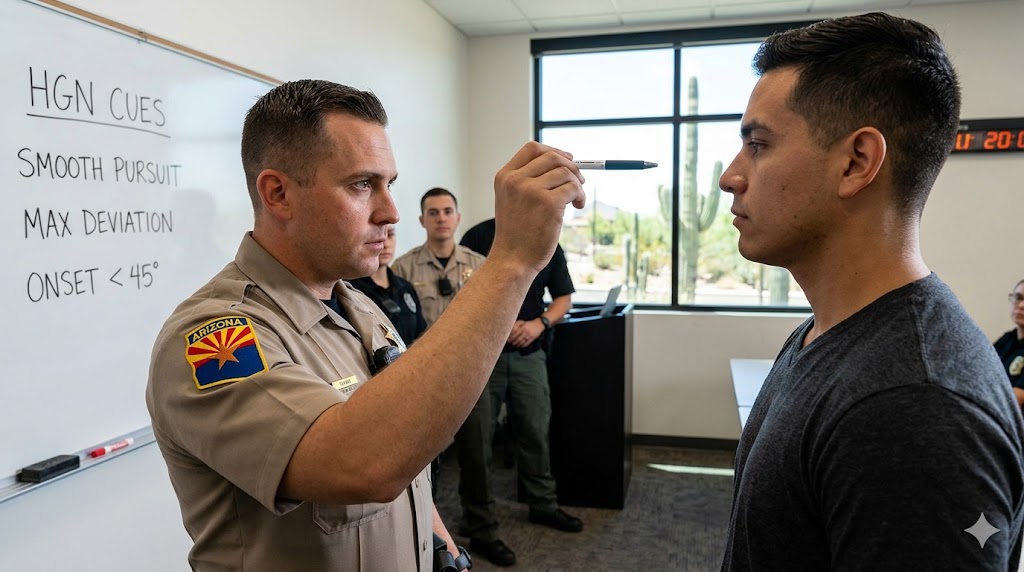
Additional Information
What the Course
Entails and Exam Details
The training
curriculum is intense and comprehensive, blending technical knowledge with
rigorous practical application.
This course is
meticulously built around the standards set by the National Highway Traffic
Safety Administration (NHTSA) and adopted by the Arizona Peace Officer
Standards and Training Board (AZPOST).
You will first build
a foundational understanding of the physiology of the human eye and the
scientific principles behind nystagmus, which is the involuntary jerking of the
eye.
The course goes far
beyond general definitions, requiring you to memorize and understand the
distinct differences between pathological nystagmus, vestibular nystagmus, and
neural-nystagmus caused by alcohol or specific drug categories.
The core training
focus is the standardized HGN procedure.
You will master the
correct administration sequence, starting from the medical pre-screening checks
for resting nystagmus, equal pupil size, and equal tracking.
A massive portion of
the curriculum is dedicated to identifying the "Three Clues of HGN"
in each eye: the lack of smooth pursuit, distinct and sustained nystagmus at
maximum deviation, and the onset of nystagmus prior to forty-five degrees.
You will learn to
differentiate between a true clue and natural fatigue nystagmus.
Beyond technical
observation, the course covers the mandatory instructional phrasings you must
deliver to a subject, positioning techniques, and crucial documentation
procedures necessary to create an accurate and legally defensible report.
You must understand
how to prepare for and deliver effective courtroom testimony regarding your
observations.
What to Expect in the Final Exam
The final
certification exam is a standardized two-part assessment designed to test both
your cognitive knowledge and your physical proficiency in administering the
test.
Both components must
be passed within the same testing cycle to achieve certification.
The first component
is the written examination.
This is typically
presented in a multiple-choice format and is designed to test your knowledge of
vocabulary, the standardized clues, procedural steps, court rulings related to
HGN, and the scientific rationale for the test.
While the exact time
limit may vary slightly by training academy or provider, the written portion is
usually strictly timed, requiring quick recall of the material.
The passing score is
universally high, typically requiring a minimum score of 80% to demonstrate
adequate mastery.
The second, and
perhaps more daunting, component is the practical proficiency exam.
In this phase, you
will be required to physically administer the complete HGN test battery on a
live subject—who may be an instructor or another student—while being graded by
a certified HGN Instructor.
You will be judged
against a standardized checklist.
The grader will look
for flawless execution of the three clues administration, correct timing (e.g.,
holding the eye at max deviation for the required four seconds), correct
stimulus distance (12-15 inches), proper positioning, and verbatim recall of
the required instructions to the subject.
Any significant
deviation from the standardized procedure, such as incorrect timing on smooth
pursuit or moving the stimulus too quickly, can result in failure of the
proficiency component.
How to Study and
Exam Centers
Preparation for this
exam must involve active, hands-on practice.
Passive reading is
insufficient.
Your first step is
to thoroughly master the NHTSA SFST Student Manual, which is the official text
for this training.
Utilize flashcards
to memorize the six specific clues and their definitions, the exact
instructions you must say to the subject, and the anatomical terminology
related to the eye.
Use practice tests
to prepare for the written section.
However, the most
important study method is physical practice.
You must practice
the administration of the HGN test on partners as often as possible.
Use a stimulus, such
as a penlight or your finger, and practice maintaining the precise 12-15 inch
distance.
Have your partner time
your movements: can you move the stimulus at a rate that takes exactly two
seconds to reach maximum deviation for smooth pursuit?
Can you hold it
steadily at maximum deviation for exactly four seconds?
Practice until the
physical movement becomes second nature.
The HGN examination
is restricted to those entering law enforcement and is not open to the general
public.
In Arizona, you can
only take this exam through authorized training centers.
These include
Arizona Law Enforcement Academies (ALEA), such as those in Phoenix, Tucson, or
Mesa.
Many larger police
and sheriff’s departments have their own in-house, AZPOST-certified training
staffs who administer the certification.
If you are an active
officer, your agency’s training coordinator is the only point of contact to
schedule your HGN testing or refresher certification.
Job Opportunities
from the Course
A strong score on
your Arizona HGN examination is not merely a box to check; it is a vital
prerequisite for any officer actively working in traffic safety.
This certification
opens doors to several crucial law enforcement career paths.
It is mandatory or
highly preferred for the following roles:
Uniformed Patrol
Officer: The most common role, where HGN proficiency is essential for everyday
DUI detection during routine traffic stops.
Deputy Sheriff
(Patrol Division): Performing similar traffic and criminal enforcement duties
as municipal officers, often in county-wide or unincorporated areas.
State Trooper
(Arizona Department of Public Safety): Focuses heavily on highway safety and
proactive DUI enforcement.
DUI Task Force
Officer: A specialized role where your primary focus is detecting and
apprehending impaired drivers, often involving high-volume stops during
targeted enforcement periods.
Drug Recognition
Expert (DRE): The HGN certification is the absolute prerequisite training
required before an officer can apply for the rigorous DRE program, which
specializes in detecting drug impairment.
Traffic Homicide
Investigator: In severe collisions involving fatalities, your proven expertise
in impairment detection is vital for the investigation.
Frequently Asked Questions
Reviews
5.0
Based on 0 reviews
Leave a Review
No reviews yet. Be the first to review!