
Arizona Low Voltage CR-67 Practice Exam
$69.00
- Buy to unlock unlimited access to all Quiz questions and Answers in this Quiz.
- After purchase you can print a PDF of the whole quiz at any point. The PDF will contain the questions and the correct answers.
About this Exam
The Arizona Contractor License – Low Voltage Communication Systems (CR-67) is a pivotal credential for professionals and businesses aiming to offer low-voltage communication system installation and maintenance services in Arizona. This license signifies that an individual or entity has the necessary expertise to legally and safely design, install, repair, or maintain various low-voltage systems, including data cabling, fiber optics, sound systems, and telecommunications infrastructure. The CR-67 license is designed for experienced technicians, project managers, and entrepreneurs within the telecommunications and integrated systems industries who wish to establish their own contracting business, expand their company's service offerings, or advance their career. The exam is required by the Arizona Registrar of Contractors (ROC) and ensures a standard of competence for the safety and reliability of communication systems across the state.
Ready to test your knowledge?
Buy Now to Access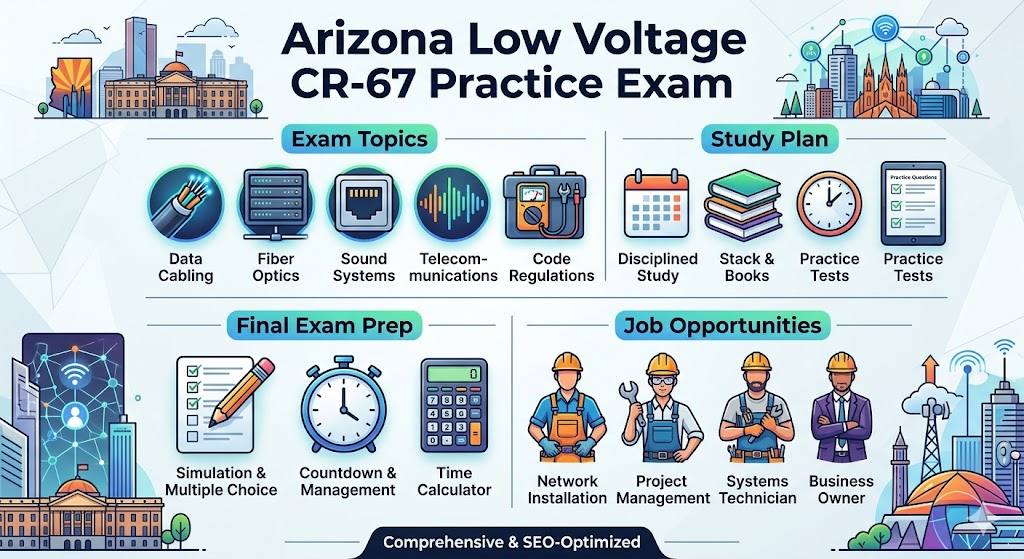
Additional Information
What the Course Entails and Exam Details
Preparing for the CR-67 exam requires comprehensive study
across several core domains. Candidates must demonstrate deep knowledge of
relevant building and electrical codes, particularly those related to
low-voltage, data, and communication systems. Key areas of focus typically
include:
- Arizona
Revised Statutes and Arizona Administrative Code: In-depth
understanding of the laws and regulations governing Arizona contractors,
including licensing requirements, contract provisions, lien laws, and the
ROC's jurisdiction and procedures.
- National
Electrical Code (NEC): Specifically, the articles relevant to
communication and signaling circuits, fiber optic installations, and
grounding/bonding for data systems. Mastery of these codes is critical for
ensuring compliance with safety and operational standards.
- Structured
Cabling Standards: Comprehensive knowledge of industry standards for
the design and installation of low-voltage cabling systems (e.g., Cat5e,
Cat6, Cat6a, and fiber optics). This includes understanding color codes,
termination methods, testing procedures, and best practices for routing
and managing cable infrastructure.
- Communication
Systems Technology: Familiarity with the various types of systems
covered by the CR-67 license, such as private telephone systems, public
address and sound systems, master antenna television (MATV) systems, and
related technology integration.
- General
Contracting Practices: General knowledge of safety standards (e.g.,
OSHA regulations), project management, estimating, and business practices
as applied to low-voltage contracting.
The exam itself typically has two main sections: the
Business Management (A) section, which covers laws, business practices, and
safety regulations, and the Trade (B) section, which focuses specifically on
the technical knowledge required for the CR-67 classification.
What to Expect in the Final Exam
The CR-67 examination is administered as a multiple-choice,
computer-based test, typically in an open-book format. The exam questions are
designed to assess a candidate's practical knowledge and their ability to
reference the appropriate codes and laws. The standard format includes:
- Format:
Multiple-choice questions, which may require referencing specific sections
of the approved study materials, code books, or the Arizona Statutes and
Administrative Code during the exam.
- Number
of Questions: While the exact number of questions can vary, the
combined exam (Business Management and Trade) usually consists of around
110 to 130 questions in total, with more questions typically allocated to
the Trade portion.
- Passing
Score: A score of 70% or higher is generally required to pass each
section of the examination. You must pass both sections (A and B) to be
eligible for the license.
- Time
Limit: Candidates are usually provided with 3 to 4 hours to complete
the entire combined examination. This allows adequate time to carefully
read each question and reference the approved materials.
- Specific
Rules: Only approved editions of specific code books and materials are
allowed in the testing center. These materials may have limited,
pre-approved annotations. All personal items and electronic devices are
typically prohibited in the examination room, and candidates must present
valid photo identification.
It's vital to use a practice exam that closely mimics this
format and style to become comfortable with the timing and the process of
navigating approved code books effectively.
How to Study and Exam Centers
Effective preparation for the CR-67 exam involves a blend of
thorough study of the reference materials and strategic practice.
Actionable Study Strategies:
- Obtain
Approved References: Secure the exact editions of the National
Electrical Code, the Arizona Contractor’s Guide to Business, Law and
Project Management, and all other specific references listed by the exam
administrator. Learning to navigate these books efficiently is crucial.
- Structured
Practice Exams: Consistently taking practice exams that emulate the
CR-67 test format, timing, and question style is one of the most effective
study methods. Focus on identifying weak areas and reinforcing knowledge
with the reference materials.
- Understand,
Don’t Just Memorize: The CR-67 exam often tests the ability to find
and apply specific codes or rules, not just recite them. Study how to use
the tables of contents, indices, and specific articles within code books.
- Create
a Study Schedule: Break down the core topics—business law, NEC code
articles, cabling standards—and dedicate specific study blocks to each,
ensuring comprehensive coverage.
- Utilize
Study Guides and Prep Courses: Consider reputable study guides, online
prep courses, or in-person seminars that specialize in Arizona contractor
license exams, as they can provide valuable insights and structured
learning paths.
Exam Administration and Testing Centers:
- Exam
Administrator: The examinations for the Arizona Registrar of
Contractors are currently administered by PSI Services, a leading global
provider of assessment solutions.
- How
to Register: Candidates must first submit a license application with
the Arizona Registrar of Contractors, or the ROC will instruct them to
register directly with PSI to take the required exams before applying.
Visit the PSI website (psiexams.com) to create an account, pay the exam
fees, and schedule your testing date.
- Where
to Take the Exam: PSI offers several physical testing centers across
Arizona, including locations in Phoenix, Tempe, Scottsdale, Tucson, and
Flagstaff. In some cases, PSI may also offer options for remote
proctoring, allowing you to take the exam online from a location that
meets specific technology and environmental requirements. Confirm current
options and availability on the PSI website.
Job Opportunities from the Course
Upon successfully passing the CR-67 exam and obtaining the
license, a range of compelling career paths and business opportunities are
unlocked in the specialized field of low-voltage systems:
- Owner/Operator,
Low-Voltage Contracting Business: The most common goal—founding your
own company to bid on and manage residential, commercial, or public works
projects for data, sound, and telecommunications.
- Project
Manager, Integrated Systems Firm: Managing the design, deployment, and
completion of large-scale, complex structured cabling and communication
system installations.
- Superintendent,
Commercial AV & Data: Leading on-site installation teams for major
projects such as corporate offices, conference centers, or sports venues.
- Estimator,
Telecommunications Projects: Accurately calculating the material,
labor, and compliance costs for bidding on low-voltage system contracts.
- Quality
Assurance Specialist, Data Infrastructure: Ensuring that installations
adhere to both regulatory codes (NEC, Arizona Statutes) and
client-specific performance standards.
- Network
Infrastructure Designer/Consultant: Providing expert guidance to
architects, engineers, and building owners on the design and
code-compliant installation of network and low-voltage systems.
Frequently Asked Questions
Reviews
5.0
Based on 0 reviews
Leave a Review
No reviews yet. Be the first to review!