
Arizona State University (ASU) SPE563 Philosophical Foundations of Applied Behavior Analysis in Educational Settings Practice Exam
$69.00
- Buy to unlock unlimited access to all Quiz questions and Answers in this Quiz.
- After purchase you can print a PDF of the whole quiz at any point. The PDF will contain the questions and the correct answers.
About this Exam
Preparing for the Arizona State University (ASU) SPE563
Philosophical Foundations of Applied Behavior Analysis (ABA) in Educational
Settings Practice Exam is a crucial step for many aspiring behavior analysts
and educators. This foundational course dives deep into the core philosophy,
ethics, and principles underpinning ABA, particularly within educational
environments. It is meticulously designed for individuals seeking a
comprehensive understanding of behavior analysis, including current and future
teachers, special education professionals, administrators, and those pursuing
board certification as behavior analysts (BCBA). By mastering these fundamental
concepts, students equip themselves with the necessary theoretical framework to
make significant, positive impacts in educational settings.
Ready to test your knowledge?
Buy Now to Access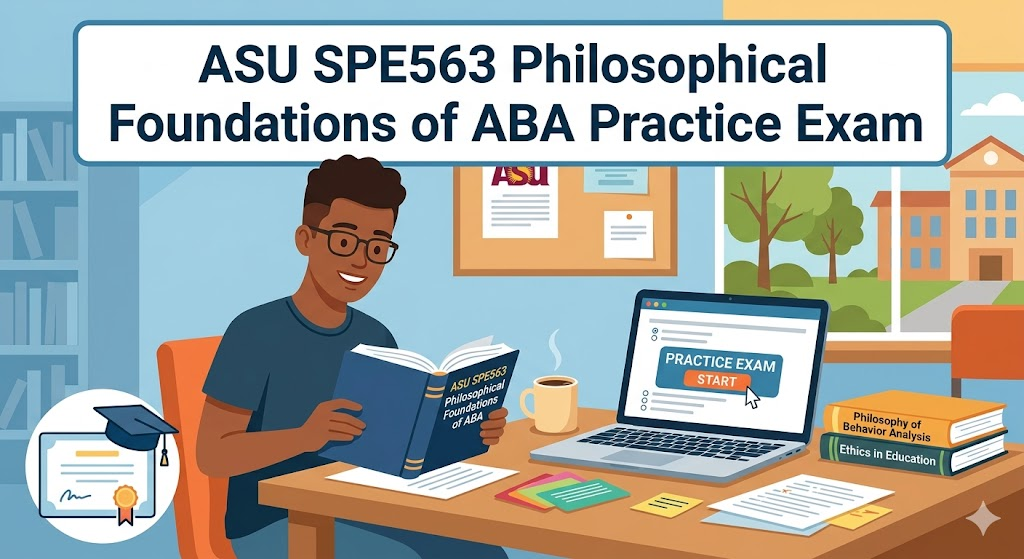
Additional Information
What the Course Entails and Exam Details
The SPE563 course and its practice exam focus on several
essential domains related to the philosophy and application of behavior
analysis in schools. You can expect to thoroughly explore:
- Foundational
Principles of ABA: Understanding the theoretical underpinnings and
core concepts of behavior analysis.
- Philosophical
Perspectives: Delving into different philosophical viewpoints and
historical context within ABA.
- Ethical
Considerations in Educational Settings: Applying ethical principles
specifically relevant to behavior analytic practice in schools and with
student populations.
- Research
Design and Data Analysis: Gaining a solid grasp of single-subject
research methodologies and data-driven decision-making.
- Functional
Assessment: Mastering the process of identifying the functions of
behavior to inform effective interventions.
- Intervention
Strategies: Learning evidence-based behavior change procedures
applicable in diverse educational contexts.
The accompanying practice exam mirrors these key areas,
testing your comprehension and ability to apply philosophical principles to
practical scenarios. While specific details regarding final course exams may
vary, understanding these core competencies is essential for passing related
course exams, and contributes significantly to preparation for broader
certifications such as the BCBA exam, which covers similar philosophical and
conceptual material.
What to Expect in the Final Exam
When taking the official SPE563 final exam or related
certification assessments, you can generally expect a combination of formats.
Most commonly, these exams include multiple-choice questions that assess
your knowledge of specific definitions, concepts, and key figures. Some exams
may also incorporate case study analysis or short-answer questions
requiring you to synthesize information, apply ethical considerations, or
interpret behavioral scenarios within an educational context.
Passing scores and specific time limits are determined by
the individual institution or certification board (like the Behavior Analyst
Certification Board - BACB for the BCBA exam). For typical university courses
like SPE563, a minimum passing grade (e.g., 70% or 80%) on the final exam is
required. Be sure to check the specific course syllabus or certification
requirements for precise details. Time limits are standard, ensuring you can
demonstrate efficiency alongside proficiency, likely ranging from 90 minutes to
several hours depending on the exam type.
How to Study and Exam Centers
Preparing effectively for the ASU SPE563 practice exam and
subsequent final assessments is key to success. Here are some highly
informative study strategies:
- Utilize
the Practice Exam: Take the SPE563 practice exam multiple times to
identify knowledge gaps, familiarize yourself with question formats, and
build confidence. Analyze all answer explanations, understanding
why correct options are right and incorrect ones are wrong.
- Deep
Dive into Readings and Materials: Thoroughly review the ASU course
syllabus, textbook, lecture notes, and any required readings on
philosophical foundations of ABA. Create detailed outlines and summaries
for each topic.
- Create
Flashcards: Use flashcards to memorize key terms, ethical principles,
influential historical figures, and fundamental behavioral concepts.
- Form
Study Groups: Collaborating with peers allows you to discuss complex
ideas, debate theoretical perspectives, and quiz each other on course
material.
- Apply
Concepts: Actively think about how the philosophical principles of ABA
could be applied to real-world educational scenarios you've encountered or
read about.
Exam Centers and Formats:
For the ASU SPE563 specific exams, these are
typically administered internally through ASU's online learning platforms (like
Canvas or similar) for online students, or sometimes in specific computer labs
on campus for in-person students. Check your syllabus for the exact location or
link.
If your ultimate goal includes broader certifications
like the BCBA, the actual certification exam is often taken through
official testing centers, such as Pearson VUE. These specialized facilities
provide standardized testing environments and ensure exam security.
Job Opportunities from the Course
Mastering the philosophical foundations of ABA through
courses like SPE563, and subsequent experience or certification, opens doors to
numerous rewarding career paths in educational settings. Potential job titles
and career opportunities include:
- Board
Certified Behavior Analyst (BCBA): Working in schools to develop,
implement, and supervise behavior analytic interventions for students.
- Behavior
Specialist / Behavior Consultant: Providing support and expertise
within school districts to address challenging behavior and implement
effective strategies.
- School-Based
Behavior Technician: Directly implementing behavior plans under the
supervision of a BCBA in educational environments.
- Special
Education Teacher: Using behavior analytic principles effectively
within the classroom to support diverse learners.
- Behavioral
Support Team Member: Contributing to school-wide behavioral systems
and individual student support plans.
- Educational
Administrator (with ABA knowledge): Incorporating behavioral insights
into school policy, staff training, and positive behavior supports.
- ABA
Clinic/Program Coordinator: Overseeing behavioral programs, sometimes
working within or in collaboration with educational systems.
- Early
Interventionist: Utilizing behavior analytic principles with young
children in educational or home-based settings.
Frequently Asked Questions
Reviews
5.0
Based on 0 reviews
Leave a Review
No reviews yet. Be the first to review!