
Army Space Cadre Basic Course Practice Exam
$69.00
- Buy to unlock unlimited access to all Quiz questions and Answers in this Quiz.
- After purchase you can print a PDF of the whole quiz at any point. The PDF will contain the questions and the correct answers.
About this Exam
The Army Space Cadre Basic Course (ASCBC) is the foundational training program required for Soldiers to join the Army’s specialized Space Cadre. Managed by the U.S. Army Space and Missile Defense Command (USASMDC), this course is designed for Officers, Warrant Officers, and Non-Commissioned Officers from various Military Occupational Specialties (MOS) who are slated to serve in positions that leverage space capabilities. The course provides the requisite knowledge to integrate space-based effects into Multi-Domain Operations, serving as a critical step toward earning the Army Space Badge and the 3Y Additional Skill Identifier (ASI).
Ready to test your knowledge?
Buy Now to Access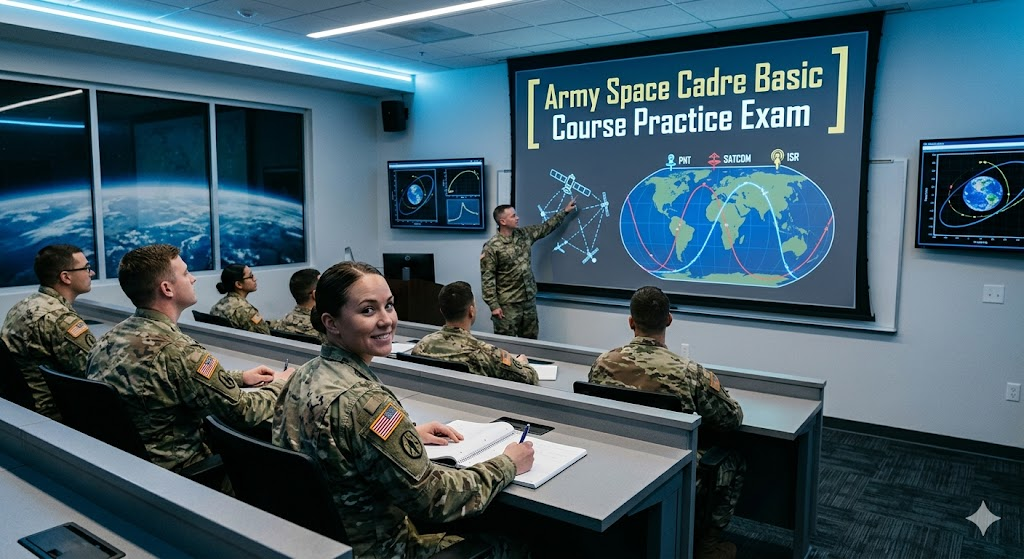
Additional Information
What the Course Entails and Exam Details
This comprehensive course provides an initial, rigorous understanding of how space assets support the ground commander. The syllabus covers several core academic pillars, beginning with foundational space science principles, including basic orbital mechanics, the laws of planetary motion, and the different types of satellite orbits (LEO, MEO, GEO, HEO). Students will delve deeply into the space environment, learning how solar weather, cosmic radiation, and debris can affect satellite performance and communication links.
The course extensively details the specific capabilities of joint and national space systems, focusing on how the Army utilizes five key functional areas: satellite communications (SATCOM), Position, Navigation, and Timing (PNT) provided by GPS, Intelligence, Surveillance, and Reconnaissance (ISR), space-based missile warning, and space control. Ultimately, the course emphasizes operational integration, teaching students how to plan for and mitigate threats in a contested, degraded, and operationally limited (CDO) space environment during Unified Land Operations.
What to Expect in the Final Exam
To successfully graduate from the ASCBC and earn the 3Y enabler identifier, students must demonstrate mastery of the curriculum through a comprehensive final examination. This is usually a written exam consisting of multiple-choice questions. The questions are designed to test both your recall of technical definitions (e.g., distinguishing between different satellite functions) and your ability to apply concepts to operational scenarios (e.g., predicting how a solar event might affect communication planning).
While specific format details can be adjusted by the schoolhouse, the exam is notoriously detailed. Candidates generally have a strict time limit to complete the test. A minimum passing score is required, often 70% or higher. It is essential to manage your time effectively during the test, as you will need to process technical data quickly to answer accurately.
How to Study and Exam Centers
Studying for the ASCBC exam requires a mix of technical understanding and operational application. Do not merely memorize acronyms; focus on understanding how space capabilities directly support tactical maneuvers on the ground. Take thorough notes during all lectures, as many of the instructors are subject matter experts who provide nuance not always found in standard slide decks.
Utilizing an ASCBC practice exam is one of the most effective study strategies available. These practice exams will help familiarize you with the cadence and phrasing of military-style technical questions, identify your knowledge gaps, and improve your test-taking speed.
The Army Space Cadre Basic Course is typically conducted as a resident course. The primary testing and training centers are operated by the USASMDC Future Warfare Center’s Space and Missile Defense School, often located at Peterson Space Force Base in Colorado Springs, Colorado. However, USASMDC also employs Mobile Training Teams (MTT) that travel to major Army installations worldwide to conduct the course locally for qualifying units. Enrollment must be coordinated through your unit’s training office and managed via the Army Training Requirements and Resources System (ATTRS).
Job Opportunities from the Course
Graduating from this course and joining the Space Cadre unlocks a unique and high-demand career path within the Army. It signals that a Soldier possesses specialized technical knowledge that is crucial to modern multi-domain warfare. Completing the ASCBC makes a Soldier eligible for assignments to specialized space billets across the Total Army. Potential career paths and job titles include:
Army Space Operations Officer (Functional Area 40)
Additional Skill Identifier (ASI) 3Y Space Enabler (Various MOSs)
SATCOM Planning and Operations Specialist
Missile Defense Analyst
Space Control Operator
Staff Officer within the 1st Space Brigade
Space Intelligence Analyst
Positions within Joint Space Operations Centers (JSpOC) or Space Force components
By mastering this material, you are not only enhancing your own career but also ensuring that the Army retains its decisive edge by effectively leveraging the space domain. Good luck with your studies and your upcoming exam.
Frequently Asked Questions
Reviews
5.0
Based on 0 reviews
Leave a Review
No reviews yet. Be the first to review!