
Aruba Certified Switching Associate Practice Exam
$69.00
- Buy to unlock unlimited access to all Quiz questions and Answers in this Quiz.
- After purchase you can print a PDF of the whole quiz at any point. The PDF will contain the questions and the correct answers.
About this Exam
The Aruba Certified Switching Associate (ACSA) certification is designed for networking professionals who are looking to validate their knowledge of Aruba's edge switching technology. This exam is perfect for entry-level network engineers or technicians who are just starting their careers in networking, as well as experienced professionals who want to formalize their understanding of Aruba's products and solutions. By earning this certification, you will demonstrate your proficiency in configuring, managing, and troubleshooting basic Aruba network deployments. This certification is a great first step towards a career in networking and is a required prerequisite for advanced Aruba certifications.
Ready to test your knowledge?
Buy Now to Access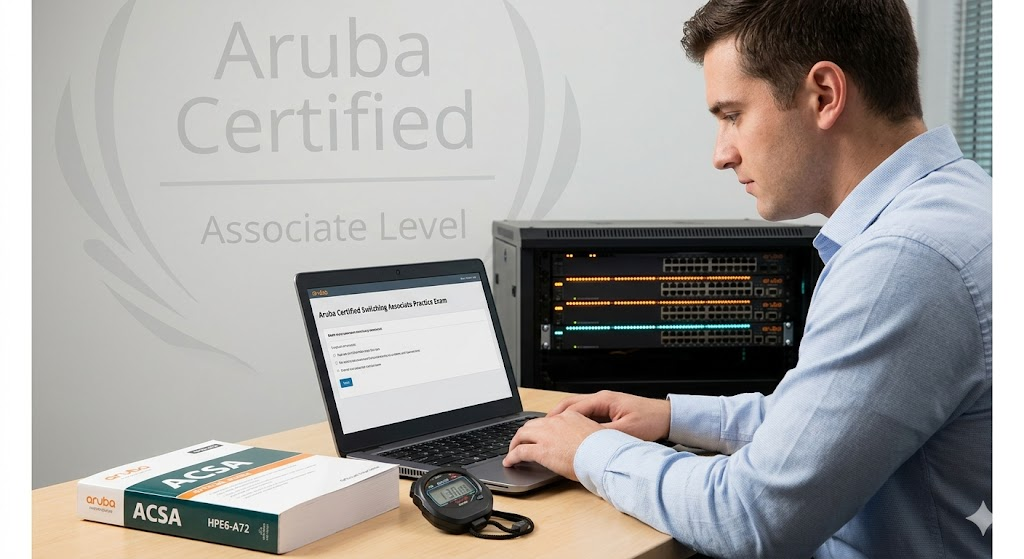
Additional Information
What the Course Entails and Exam Details
This practice exam environment aims to evaluate your understanding of key networking technologies and specific Aruba operating systems and hardware. Preparing for the ACSA certification requires comprehensive knowledge in several core domains. Candidates must demonstrate proficiency in:
Networking Fundamentals: Basic concepts of local area networks (LANs), wide area networks (WANs), the OSI and TCP/IP models, and the difference between hubs, switches, and routers.
Layer 2 Technologies: This is a heavy focus. Topics include VLAN configuration and management, spanning tree protocols (STP, RSTP), Link Aggregation (LACP), and basic Layer 2 security.
ArubaOS-CX Architecture and Management: Understanding the modularity of the ArubaOS-CX operating system, its configuration syntax, command-line interface (CLI), and management tools.
IP Routing: Fundamentals of static routing and an introduction to dynamic routing protocols.
Wireless Technologies: An introductory understanding of fundamental wireless concepts, terminology, and how mobility integrates with switched networks.
Network Security: A foundational layer focusing on standard authentication mechanisms and securing access to networking devices.
The ultimate goal of the underlying study material and the corresponding official exam (HP0-Axx or the updated version) is to ensure a technician can comfortably configure and manage basic Aruba Ethernet switching environments and troubleshoot common network connectivity issues.
What to Expect in the Final Exam
The actual ACSA exam is a comprehensive assessment that goes beyond simple recall and requires candidates to understand how to apply the principles in practice scenarios. Here are the typical expectations for the final exam:
Exam Format: The exam consists predominantly of multiple-choice questions (often with single or multiple correct answers). Additionally, there may be scenario-based questions that require analyzing network topology diagrams and configuring a device (or identifying the correct configuration) based on a specific set of requirements.
Time Limit: Test-takers are generally given 90 to 120 minutes to complete the exam. Time management is crucial for successfully finishing all sections.
Number of Questions: Typically, the exam contains approximately 60 to 70 questions.
Passing Score: The required passing score is typically determined by HPE and can vary slightly by version. Historically, a passing score falls somewhere around 70%.
Examination Language: The exam is primarily offered in English, but variations may exist in certain regions.
Calculators and Reference Materials: The ACSA is a closed-book exam. You are not allowed access to any external documentation, study guides, or personal calculators during the examination. Scrap paper and pens are usually provided for diagrams or calculations.
How to Study and Exam Centers
Preparation for the ACSA certification requires a combined approach of theoretical study and practical application. Candidates have several options available for structured learning. First, taking the official recommended training course, such as "Aruba Switching Fundamentals" (or equivalent), provides a highly structured learning pathway and direct access to instructor expertise.
However, for self-study and reinforcing concepts, using high-quality practice exams is a vital component. These practice exams help candidates identify weak areas, understand the phrasing and structure of official questions, and manage their time effectively. Candidates are strongly encouraged to set up a virtual laboratory using tools like GNS3 or Eve-NG to simulate ArubaOS-CX devices and practice configuration and troubleshooting scenarios.
Regarding taking the final certification, candidates do not need to attend a physical classroom. HPE has partnered with Pearson VUE as its official examination provider. To schedule your exam, you should create an account on the Pearson VUE website, register for the ACSA exam, and select your preferred method:
Online Proctored: This allows you to take the exam from the comfort of your home or office. A remote proctor will monitor your session via webcam and microphone to ensure exam integrity.
In-Person at a Pearson VUE Test Center: You can locate a certified physical testing center near you. This offers a traditional, controlled testing environment where computers are provided.
Select the option that best fits your requirements and comfort level.
Job Opportunities from the Course
Earning the Aruba Certified Switching Associate (ACSA) certification unlocks numerous entry- and associate-level career paths. This credential proves to employers that you possess the verified skills to manage Aruba infrastructure, an increasingly valuable asset as HPE networking solutions grow in market share. Key job roles and career paths available for ACSA-certified professionals include:
Network Administrator
Systems Administrator
Junior Network Engineer
Networking Support Technician
Network Security Associate
IT Support Specialist (Networking Specialist)
Solutions Architect Associate (Aruba Track)
Field Service Technician (Enterprise Networking)
Data Center Technician (Associate Level)
This certification provides the foundational groundwork for a diverse range of opportunities in corporate networking, managed service providers, and technology implementation teams.
Frequently Asked Questions
Reviews
5.0
Based on 0 reviews
Leave a Review
No reviews yet. Be the first to review!