
Assessment and Learning in Knowledge Spaces (ALEKS) Practice Exam
$69.00
- Buy to unlock unlimited access to all Quiz questions and Answers in this Quiz.
- After purchase you can print a PDF of the whole quiz at any point. The PDF will contain the questions and the correct answers.
About this Exam
The Assessment and Learning in Knowledge Spaces, commonly known as ALEKS, is a revolutionary, artificially intelligent assessment and learning system. It is designed to precisely measure a student’s current knowledge state in subjects like Mathematics and Chemistry. This exam is most frequently utilized by colleges and universities as a placement test to ensure incoming students are enrolled in the course that best matches their present skill level, thereby maximizing their chances of academic success. If you are a student preparing to enter higher education, or if you are looking to bypass introductory quantitative courses, the ALEKS system is designed specifically for you. It provides a unique, personalized path to mastery by identifying exactly what you know and what you are ready to learn next.
Ready to test your knowledge?
Buy Now to Access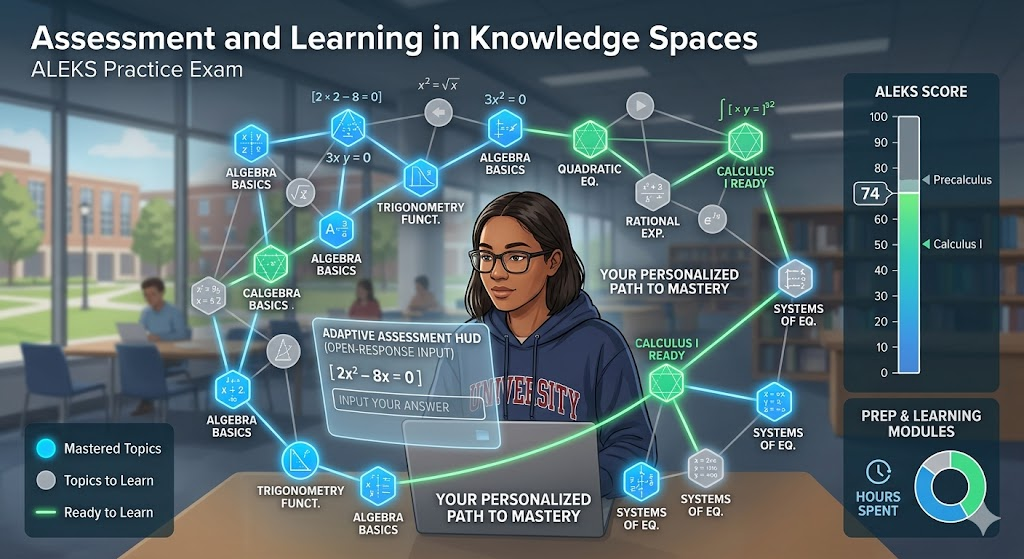
Additional Information
What the Course Entails and Exam Details
It is important to understand that ALEKS is not a traditional "course" with a fixed syllabus; rather, it is an adaptive system that assesses a broad spectrum of curricular topics to map your unique "Knowledge Space." In the context of the widely used Math PPL (Placement, Preparation, and Learning) exam, the assessment evaluates foundational skills required for success in college algebra, precalculus, and calculus.
The core domains covered by the assessment typically include:
Numerical Expressions: Understanding real numbers, fractions, decimals, percentages, and basic arithmetic operations.
Algebraic Expressions: Simplifying rational expressions, radical expressions, and polynomial arithmetic.
Equations and Inequalities: Solving linear equations, quadratic equations, systems of linear equations, and absolute value inequalities.
Functions and Graphs: Mastering function notation, domain and range, linear functions, quadratic functions, and their geometric representations (parabolas).
Geometry and Trigonometry: Calculating perimeter, area, and volume; understanding coordinate geometry; and mastering trigonometric functions, identities, and equations.
Exponentials and Logarithms: Applying properties of logarithms and solving exponential equations.
What to Expect in the Final Exam
You must approach the ALEKS Practice Exam knowing that it is unlike most standardized tests. The defining characteristic of the final assessment is that it is adaptive and open-response.
Exam Format: The test consists of approximately 25 to 30 questions. The ALEKS AI selects each subsequent question based on your previous answers, quickly narrowing down your precise knowledge state. Crucially, the exam does not use multiple-choice questions. You will be required to input complete mathematical expressions, construct graphs, or solve problems directly using on-screen input tools.
Passing Score: Because ALEKS is a placement tool, there is no universal "passing" score. Instead, your result will be a number between 0 and 100, representing the percentage of the full "Knowledge Space" you have mastered. Each university sets its own "cut scores" that determine which course you are eligible to take based on your result. For example, a score of 30 might place you in College Algebra, while a 76 might be required for Calculus I.
Time Limits and Rules: While the assessment itself is often not strictly timed by the ALEKS system (it typically takes 90–120 minutes), your testing center or proctoring service may impose a time limit. You are generally not permitted to use your own calculator; an on-screen calculator will be provided by the ALEKS interface only when a question requires it. You will be allowed to use scratch paper.
How to Study and Exam Centers
The best way to study for the ALEKS assessment is by using the ALEKS system itself. For placement purposes, students usually take an initial, unproctored assessment from home to establish a baseline. It is vital that you do not guess or use outside help on this initial check, as it will determine your personalized study plan.
Following the initial check, ALEKS will open your personalized "Prep and Learning Module." This module is your targeted study guide. Spend dedicated time mastering the topics in your "Pie" chart. ALEKS will present you with the material you are most "Ready to Learn," ensuring efficient progress. Many universities require students to spend a minimum number of hours in the learning modules before they are permitted to take the final, proctored placement exam for official course credit.
Exam Centers: The final, official assessment must be proctored to ensure academic integrity. There are two primary ways to take the exam:
On-Campus Testing Centers: Most institutions require students to take the exam in person at their physical testing facility or during a designated orientation session.
Remote Proctoring: Many universities now offer authorized remote proctoring options. This allows you to take the exam from home using a webcam and specialized lockdown browser software (such as Respondus LockDown Browser or Honorlock) that monitors your environment.
You must check the specific requirements of the college or university you are attending to understand their recognized testing methods.
Job Opportunities from the Course
Mastering the mathematical and quantitative concepts assessed by ALEKS is a critical step toward a wide array of career paths. This knowledge base is fundamental to virtually all Science, Technology, Engineering, and Math (STEM) fields, as well as business and finance.
Career paths unlocked by the numerical and analytical skills verified by ALEKS include:
Data Analyst
Academic Advisor (STEM Specialization)
Quantitative Research Assistant
Math Tutor or Secondary Mathematics Educator
Engineering Technician
Quality Control Analyst
Entry-level Financial Analyst
Laboratory Technician
Actuarial Assistant
Frequently Asked Questions
Reviews
5.0
Based on 0 reviews
Leave a Review
No reviews yet. Be the first to review!