
Assessment and Qualifications Alliance (AQA) GCSE Chemistry Paper 1 Practice Exam
$69.00
- Buy to unlock unlimited access to all Quiz questions and Answers in this Quiz.
- After purchase you can print a PDF of the whole quiz at any point. The PDF will contain the questions and the correct answers.
About this Exam
The Assessment and Qualifications Alliance (AQA) GCSE Chemistry Paper 1 is a crucial exam for secondary school students, typically taken in Year 11 (ages 15-16) in England, Wales, and Northern Ireland. This practice exam is designed to help students master the foundational concepts of chemistry before sitting their official terminal examination. Achieving a strong grade in GCSE Chemistry unlocks significant opportunities for further academic study and diverse career paths in science, technology, engineering, and mathematics (STEM) fields.
It is tailored for students pursuing the GCSE qualification, acting as a mandatory assessment that tests their knowledge, understanding, and application of chemical principles. Practicing with Paper 1 allows candidates to build essential skills in analyzing chemical data, constructing scientific arguments, and interpreting practical work. This assessment is not just about memorization; it's about demonstrating critical thinking and a secure understanding of the chemical world.
Ready to test your knowledge?
Buy Now to Access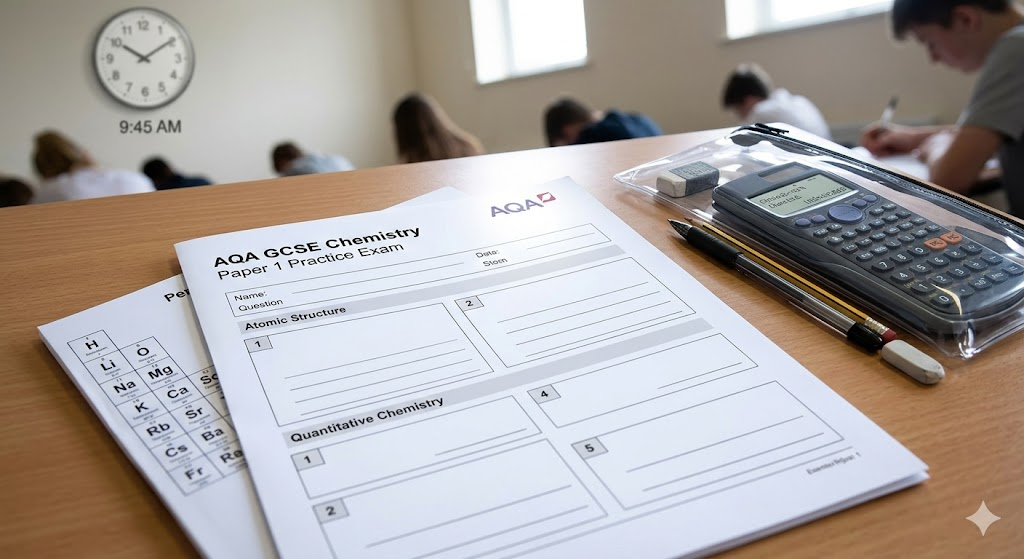
Additional Information
What the Course Entails and Exam Details
The content covered in AQA GCSE Chemistry Paper 1 encompasses foundational topics essential for understanding how the universe is built. This paper assesses knowledge related to the building blocks of matter and the chemical and energy changes that reactions undergo. Mastery of these areas is paramount for subsequent study in chemistry.
Key topics included in Paper 1 are:
Atomic Structure and the Periodic Table: Explores atoms, elements, compounds, and the history and trends of the periodic table.
Bonding, Structure, and Properties of Matter: Covers ionic, covalent, and metallic bonding, as well as the properties of giant structures and nanoparticles.
Quantitative Chemistry: Involves chemical measurements, using moles, calculations involving reacting masses, and understanding concentrations.
Chemical Changes: Assesses knowledge of the reactivity series, extraction of metals, electrolysis, and the production of salts.
Energy Changes: Focuses on exothermic and endothermic reactions, and bond energy calculations.
Additionally, this exam includes questions on the 'Required Practicals' related to these topics, such as identifying ions and investigating electrolysis.
What to Expect in the Final Exam
The actual AQA GCSE Chemistry Paper 1 exam is a written assessment that forms a fixed percentage of the overall GCSE grade. The exam is structured differently based on the student's entry tier:
For Foundation Tier students (aiming for grades 1-5):
Format: A written paper featuring a mixture of multiple choice, structured, closed short answer, and open response questions.
Marks: The paper is out of 100 marks.
Duration: The exam lasts 1 hour and 45 minutes.
Rules: Standard exam rules apply, including the use of calculators and periodic tables provided in the exam pack.
For Higher Tier students (aiming for grades 4-9):
Format: A written paper featuring a similar mixture of multiple choice, structured, closed short answer, and open response questions, but with higher complexity and demand.
Marks: This paper is also out of 100 marks.
Duration: The exam lasts 1 hour and 45 minutes.
Rules: Identical standard exam rules apply, including the use of necessary mathematical equipment.
There is no fixed 'passing score' but higher marks correspond to the GCSE grading system (9 being the highest). A grade 4 is typically considered a standard pass, with grade 5 a strong pass, which often serves as the prerequisite for proceeding to A-level Chemistry.
How to Study and Exam Centers
Studying effectively for AQA GCSE Chemistry Paper 1 requires a proactive and strategic approach. Start early and consolidate your understanding of each key topic as you learn it. Here are actionable study strategies:
Active Recall: Rather than just re-reading notes, test yourself frequently using flashcards, mind maps, and past paper questions to improve retention.
Understand Command Words: Be familiar with exam terms like 'describe', 'explain', 'calculate', and 'compare', as they tell you exactly what the question requires for full marks.
Focus on Calculations: Quantitative chemistry requires practice; memorize formulas and practise mole calculations repeatedly.
Master Required Practicals: Review the procedures, safety precautions, and expected results for all five Paper 1 required practicals, as they are guaranteed to appear.
Use Past Papers: This is the most effective tool. Complete past papers under timed conditions to improve your speed and get used to the AQA exam format and mark scheme.
You cannot register to take the AQA GCSE exams directly through online portals or specialized centers like Pearson VUE. Students must take the exam at a registered school or college that is an official AQA exam center. If you are not enrolled in a school, you must register as a private candidate through an approved center that agrees to host you for the examination. Contact local schools or colleges directly to inquire about this.
Job Opportunities from the Course
Achieving a GCSE in Chemistry is a crucial gateway and first step on various professional ladders. It demonstrates essential mathematical skills, logical thinking, and scientific literacy that are highly valued by employers and educational institutions alike. While not a vocational qualification itself, it unlocks necessary advanced study (like A-levels and degrees) leading to the following job titles and career paths:
Medical Doctor
Pharmacist
Chemical Engineer
Research Scientist (in fields like biochemistry or material science)
Forensic Scientist
Analytical Chemist
Veterinary Surgeon
Environmental Consultant
Science Teacher (Secondary)
Science Lab Technician
Software Engineer (STEM analytical skills are transferable)
Data Analyst (STEM numerical skills are transferable)
This qualification provides the solid foundation required for any future role where a robust understanding of the composition of matter and its interactions is essential.
Frequently Asked Questions
Reviews
5.0
Based on 0 reviews
Leave a Review
No reviews yet. Be the first to review!