
Assessment and Qualifications Alliance (AQA) GCSE Chemistry Paper 2 Practice Exam
$69.00
- Buy to unlock unlimited access to all Quiz questions and Answers in this Quiz.
- After purchase you can print a PDF of the whole quiz at any point. The PDF will contain the questions and the correct answers.
About this Exam
The AQA GCSE Chemistry Paper 2 Practice Exam is an essential tool for students preparing for the final portion of their GCSE Chemistry qualification. This practice exam is designed to mimic the format, style, and challenge level of the actual Assessment and Qualifications Alliance (AQA) examination. It is intended primarily for Year 11 students in the UK who are nearing the end of their secondary education and aiming to consolidate their knowledge in key chemistry topics. This practice session offers a valuable opportunity to identify knowledge gaps, manage time effectively under pressure, and build the confidence required to succeed in the official assessment. By engaging with this practice paper, students can refine their examination technique and significantly improve their chances of achieving their desired grade.
Ready to test your knowledge?
Buy Now to Access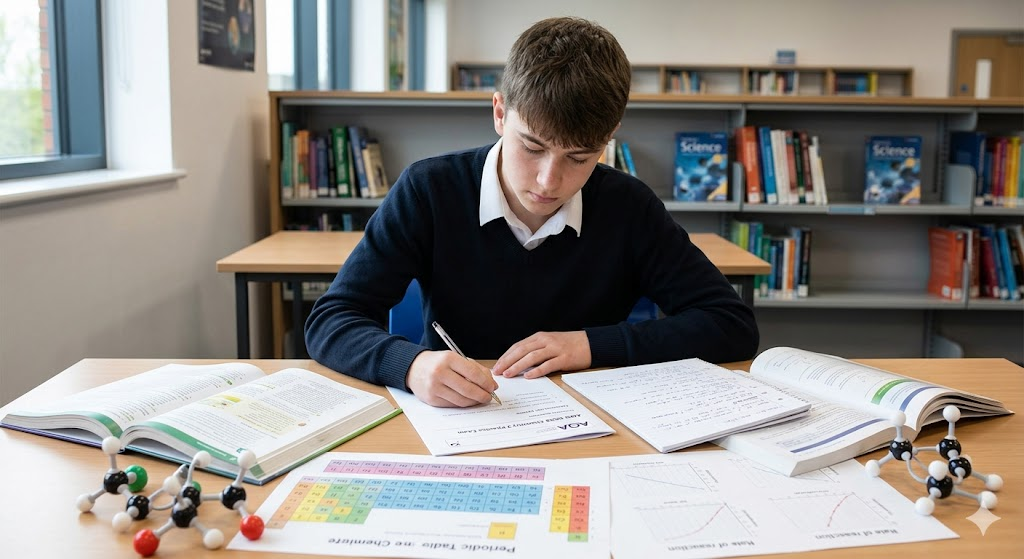
Additional Information
What the Course Entails and Exam Details
The curriculum leading up to the AQA GCSE Chemistry Paper 2 focuses on distinct areas of chemistry that build upon the foundational concepts covered in Paper 1. This half of the course explores how chemical reactions can be monitored and controlled, and delves into the analysis and utilization of resources. The syllabus includes critical topics such as the rates of chemical change, organic chemistry, chemical analysis, chemistry of the atmosphere, and using resources. Within these units, students learn about factors affecting reaction rates, the properties of hydrocarbons and polymers, various methods of identifying chemical substances, the history of Earth's atmosphere, and the importance of sustainable development and recycling. A key focus throughout the course is the integration of ‘Working Scientifically’ skills, which require students to demonstrate practical competencies, data interpretation abilities, and mathematical skills as applied to chemical contexts.
What to Expect in the Final Exam
The official AQA GCSE Chemistry Paper 2 is a written examination that assesses knowledge from the latter half of the chemistry syllabus. It is a 1-hour and 45-minute exam, contributing 50% towards the final GCSE grade (the other 50% comes from Paper 1). The exam consists of a mixture of question styles, including multiple choice, structured questions, closed short-answer questions, and open-ended, extended response questions that allow students to demonstrate the depth of their understanding. There are two tiers of entry: Foundation (targeting grades 1–5) and Higher (targeting grades 4–9). Practical-based questions account for at least 15% of the total marks, derived from the required practical activities students must complete during the course. Students are allowed a scientific calculator and the AQA periodic table data sheet for use during the exam.
How to Study and Exam Centers
A successful revision strategy should be active and variety-driven. The most effective way to prepare for this exam is by using past papers and high-quality practice exams like the one referenced here. Timing yourself while completing these papers is crucial to prepare for the pressure of the actual exam day. Focus on masterng the required practicals, as these are frequently the basis for extended-answer questions. Utilize a range of resources, including official AQA revision guides, textbooks, and online resources such as GCSEPod or Seneca Learning. Ensure you can recall key definitions, understand reaction rate graphs, and can accurately draw organic molecules. The actual AQA GCSE examinations are not taken online; they are administered in physical, authorized testing centers, typically the school or college where the student has studied. Independent students or those retaking the exam must register with an approved exam center, such as a local school or private college, well in advance of the examination dates to secure a place.
Job Opportunities from the Course
Completing the GCSE Chemistry course, alongside other core qualifications, is the crucial first step toward further education and a diverse array of rewarding career paths. Achieving a strong grade in this subject unlocks opportunities to study A-Level Chemistry, which is a required prerequisite for many university degree programs in the sciences and medicine. The skills and knowledge gained from chemistry are valuable across numerous sectors. Potential career paths include:
Chemical Engineer
Pharmacist
Analytical Chemist
Biochemist
Forensic Scientist
Geochemist
Doctor
Veterinarian
Science Teacher
Research Scientist
Toxicologist
Environmental Consultant
Science Journalist
While further study is often necessary for these roles, success in the AQA GCSE Chemistry course provides the essential foundation upon which all these careers are built.
Frequently Asked Questions
Reviews
5.0
Based on 0 reviews
Leave a Review
No reviews yet. Be the first to review!