
Assessment and Qualifications Alliance (AQA) GCSE Citizenship Practice Exam
$69.00
- Buy to unlock unlimited access to all Quiz questions and Answers in this Quiz.
- After purchase you can print a PDF of the whole quiz at any point. The PDF will contain the questions and the correct answers.
About this Exam
The AQA GCSE Citizenship Studies qualification is an engaging and essential course designed for key stage 4 students across the UK who are passionate about making a difference. It provides a foundational understanding of how British society functions, the legal systems that govern us, and the complex relationships between the UK and the wider world. This course empowers young people with the knowledge and skills to become informed, critical thinkers, and active participants in democratic life. Whether you’re interested in law, politics, or community action, this qualification is your first step toward understanding your place in a dynamic, global society.
Ready to test your knowledge?
Buy Now to Access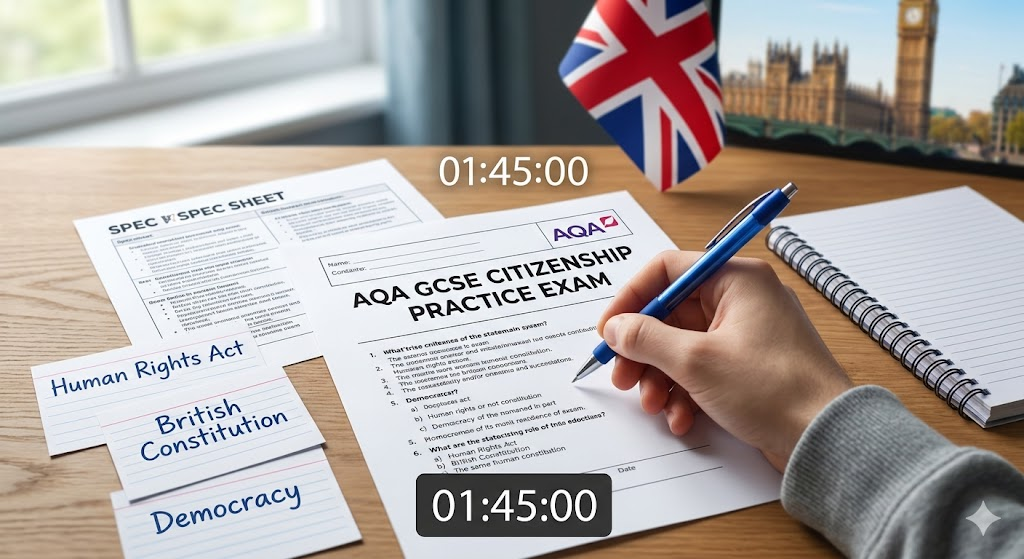
Additional Information
What the Course Entails and Exam Details
The AQA GCSE Citizenship Studies (8100) syllabus is structured around four core themes that provide a comprehensive overview of modern civic life. The curriculum is purely examination-based, with no coursework component.
Theme 1: Life in Modern Britain: Explores the makeup of diverse communities, the concept of British values, and the essential role of a free press in a democracy.
Theme 2: Rights and Responsibilities: Delves into the nature of laws, the development of human rights, the operation of the UK legal system (including criminal and civil courts), and how the law protects the citizen.
Theme 3: Politics and Participation: Examines where political power resides in the UK, the functioning of local and devolved governments, the role of political parties, and different voting systems.
Theme 4: Active Citizenship: This unique theme requires students to undertake a practical Citizenship Action investigation. While the action itself is not graded, Paper 1 directly assesses the skills you developed during this project, such as advocacy, lobbying, and collaborating to bring about change.
What to Expect in the Final Exam
To achieve your AQA GCSE Citizenship qualification, you must complete two written examinations, usually taken at the end of Year 11.
Exam Structure: The assessment consists of two papers, Paper 1 and Paper 2.
Duration: Each paper is 1 hour and 45 minutes long.
Total Marks: Each paper is worth 80 marks, making a total of 160 marks for the qualification.
Question Types: Both papers use a variety of question formats to test different skills, including multiple-choice questions (1-2 marks), short-answer questions, source-based questions where you analyze information, and extended-answer questions (8-12 marks) that require you to form a balanced argument.
Grading: Students are awarded a grade on the 9–1 scale, with 9 being the highest possible grade. A grade 4 is considered a "standard pass," while a grade 5 is a "strong pass."
How to Study and Exam Centers
Preparation is key to succeeding in any GCSE. To prepare effectively for the AQA Citizenship Studies exam, you should focus on both knowledge recall and skill application.
Master the Specification: The AQA specification is your roadmap. Ensure you understand every bullet point across all four themes.
Practise with Past Papers: Regularly completing past exam papers is the single best way to familiarise yourself with the question types, command words (e.g., 'Describe', 'Discuss', 'Evaluate'), and time management constraints.
Analyze Mark Schemes: Do not just complete questions; review the official mark schemes to understand exactly what examiners are looking for, especially in the 12-mark extended answers.
Use Flashcards for Key Terms: The course uses precise terminology, such as 'uncodified constitution,' 'alternative dispute resolution,' and 'advocacy.' Use flashcards for quick revision of definitions.
Examination Centers: GCSE Citizenship exams are standard qualifications and must be taken at an authorized examination center, typically your school or college. Independent students must register with an authorized center to sit the exams physically; they cannot be taken online.
Job Opportunities from the Course
A strong result in GCSE Citizenship Studies demonstrates valuable transferable skills, including critical analysis, effective communication, the ability to form reasoned arguments, and an understanding of legal and political systems. These are highly regarded by employers across numerous sectors. It provides an excellent foundation for further study in Law, Politics, Sociology, History, and Journalism.
Specific career paths and job roles this qualification unlocks include:
Civil Servant
Police Officer
Journalist
Paralegal / Legal Executive
Local Government Officer
Charity Fundraiser / Campaigner
Social Worker
Magistrate (Community role)
Politician / Political Researcher
Frequently Asked Questions
Reviews
5.0
Based on 0 reviews
Leave a Review
No reviews yet. Be the first to review!