
Assessment and Qualifications Alliance (AQA) GCSE Dance Practice Exam
$69.00
- Buy to unlock unlimited access to all Quiz questions and Answers in this Quiz.
- After purchase you can print a PDF of the whole quiz at any point. The PDF will contain the questions and the correct answers.
About this Exam
The AQA GCSE Dance qualification is a vibrant, academic, and practical course designed for young dancers who want to deepen their understanding of dance as an art form. This certification is specifically tailored for students typically aged 14 to 16, usually taken during Key Stage 4 in the UK.
It is ideal for anyone with a passion for movement, offering a unique blend of practical skills and theoretical study. Whether you aspire to be a professional performer, a choreographer, or simply want to develop critical thinking and communication skills, this course provides the essential foundation. The AQA GCSE Dance framework allows you to explore the creative possibilities of dance while mastering physical technical skills.
Ready to test your knowledge?
Buy Now to Access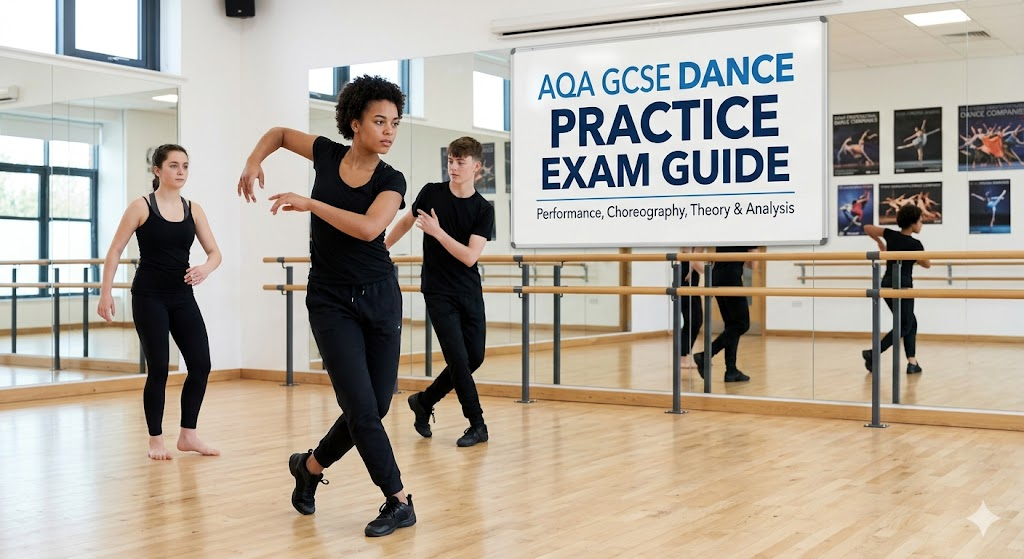
Additional Information
What the Course Entails and Exam Details
The AQA GCSE Dance specification is split into two main components: practical (which makes up 60% of the total grade) and theoretical (which makes up 40% of the total grade). The course focuses on three key assessment areas: performance, choreography, and critical appreciation.
Students are not just assessed on how well they move, but also on how they structure dances and analyze professional works. The core topics covered in the syllabus include:
Practical Performance:
Set Phrases: Students must learn and accurately perform specified dance phrases (e.g., Breathe, Shift) determined by AQA, focusing on technical precision, physical skills, and safe practice.
Duet/Trio Performance: This component assesses your ability to perform in a group, showing sensitivity, awareness, and expressive skills while interacting with other dancers.
Practical Choreography:
Solo or Group Choreography: Students must create an original dance piece based on a specific stimulus chosen from the AQA exam brief (e.g., a photograph, a piece of poetry, or a political event). This tests your ability to develop motifs, structure the dance, and select appropriate action, space, and dynamics.
Critical Appreciation (Theory):
Own Work Analysis: Reflecting upon and analyzing your own performances and choreographic choices.
Professional Anthology Study: This is a vital theoretical component where you study six professional dance works (e.g., Within Her Eyes, Emancipation of Expressionism). You must analyze these works, focusing on their constituent features: choreography, structure, sound, setting, and costume.
What to Expect in the Final Exam
While a large portion of your grade comes from coursework performances filmed throughout the year, there is a dedicated written exam paper at the end of the course. Here are the specific details you need to prepare for regarding the final AQA GCSE Dance exam:
Component 1: Performance and Choreography (Practical Assessment)
Format: This is a practical exam.
Requirement: Students are assessed on two key pieces: Performance (which includes the solo set phrases and a performance in a duet/trio, lasting 3 minutes 30 seconds to 5 minutes total) and Choreography (a 2 minute 30 second to 3 minute original piece).
Assessment: This performance and choreography component will be filmed and must show your understanding of style, technique, and artistry. It is worth 60% of your total GCSE.
Component 2: Dance Appreciation (Written Exam)
Format: This is a traditional sit-down written examination.
Time Limit: You will have 1 hour 30 minutes to complete the paper.
Exam Structure: The paper consists of three main sections:
Section A (30 marks): Short answers relating to practical knowledge and critical thinking based on your own experience of performance and choreography.
Section B (18 marks): Short and extended answers analyzing your own practical performance and choreography.
Section C (32 marks): Extended answers requiring you to analyze the six specific professional works from the AQA Anthology, comparing and contrasting their features (lighting, costume, set, choreography).
Total Marks: This component is worth 80 marks and accounts for 40% of your total grade.
How to Study and Exam Centers
Preparing for the AQA GCSE Dance exam requires a balanced approach to both practical rehearsal and theoretical study. Here are actionable strategies for success:
Practical Study Strategies (Performance and Choreography):
Repetition is Key: Film your rehearsals of the set phrases and duet/trio frequently. Watching yourself allows you to spot technical errors and refine your expressive skills. Work on improving your extensions, posture, and alignment.
Understand the Stimulus: When choreographing, spend significant time exploring the exam-set stimulus. Research your concept thoroughly. Do not just use movements that "look good"; ensure every action contributes to telling the story or communicating the theme.
Use Feedback Loops: Seek regular, constructive feedback from your teacher. Practice performing in front of peers to build confidence and refine your focus.
Understand Assessment Criteria: Study the AQA marking grids. Know exactly what examiners are looking for in terms of technique, performance, dynamic range, and focus.
Theoretical Study Strategies (Written Exam):
Master the Anthology: Create detailed flashcards or a mind map for each of the six professional works. Memorize key constituent features: What is the accompaniment for Within Her Eyes? How is the set used in Artificial Things? What are the key movements in Emancipation of Expressionism?
Compare and Contrast: Section C often asks you to compare works. Practice writing paragraphs linking two works by theme, structure, or design choice.
Timed Practice Papers: Use past exam papers available on the AQA website. It is critical to practice writing long essay questions within the 1-hour-30-minute time limit. Focus on structuring your arguments clearly.
Analyze Your Own Work: You must be able to write articulately about your own practical process. Practice describing how you used dynamics to convey a specific theme in your choreography.
Exam Centers:
You cannot simply register for AQA GCSE Dance as an independent candidate at a public testing center. GCSE exams must be taken at registered and authorized centers. For most students, this will be your secondary school, academy, or sixth-form college. The practical components must be moderated by your teachers and then verified by an external AQA moderator, who will visit your school or review the filmed material. The written exam is invigilated within your center during the official national exam window.
Job Opportunities from the Course
AQA GCSE Dance isn't just a physical subject; it builds significant transferable skills in teamwork, discipline, analysis, and creativity that are highly valued in any sector.
Achieving this qualification opens doors to numerous career paths, including:
Professional Dancer (in ballet, contemporary, commercial, or musical theater companies)
Choreographer (creating work for music videos, film, or stage)
Dance Teacher / Dance Instructor (in schools, colleges, or private dance studios)
Community Dance Artist / Arts Worker (delivering dance programs in social care or community settings)
Performing Arts Manager / Administrator (working behind the scenes for companies or venues)
Stage Manager (coordinating live dance and theater performances)
Costume / Set Designer (focusing on the visual elements of performance)
Lighting Designer for Performance (creating atmospheric designs for dance)
Physiotherapist / Dance Medicine Specialist (treating dancers—with further specialization)
Movement Psychotherapist (using movement in a therapeutic setting—with further specialization)
Visualization of Your Preparation Journey
This image captures the spirit of the comprehensive preparation you are undertaking. Good luck with your study guide and your future AQA GCSE Dance Practice Exam!
Frequently Asked Questions
Reviews
5.0
Based on 0 reviews
Leave a Review
No reviews yet. Be the first to review!