
Assessment and Qualifications Alliance (AQA) GCSE Engineering Practice Exam
$69.00
- Buy to unlock unlimited access to all Quiz questions and Answers in this Quiz.
- After purchase you can print a PDF of the whole quiz at any point. The PDF will contain the questions and the correct answers.
About this Exam
The AQA GCSE Engineering qualification is an engaging, hands-on course designed for students in the UK (typically aged 14–16) who have a passion for understanding how things work. It bridges the gap between academic theory and practical application, focusing on solving real-world problems through engineering design and manufacturing. This exam is ideal for creative, technically-minded students who enjoy mathematics, science, and practical problem-solving. By completing this qualification, students develop critical thinking and technical skills that are highly valued in modern industry.
Ready to test your knowledge?
Buy Now to Access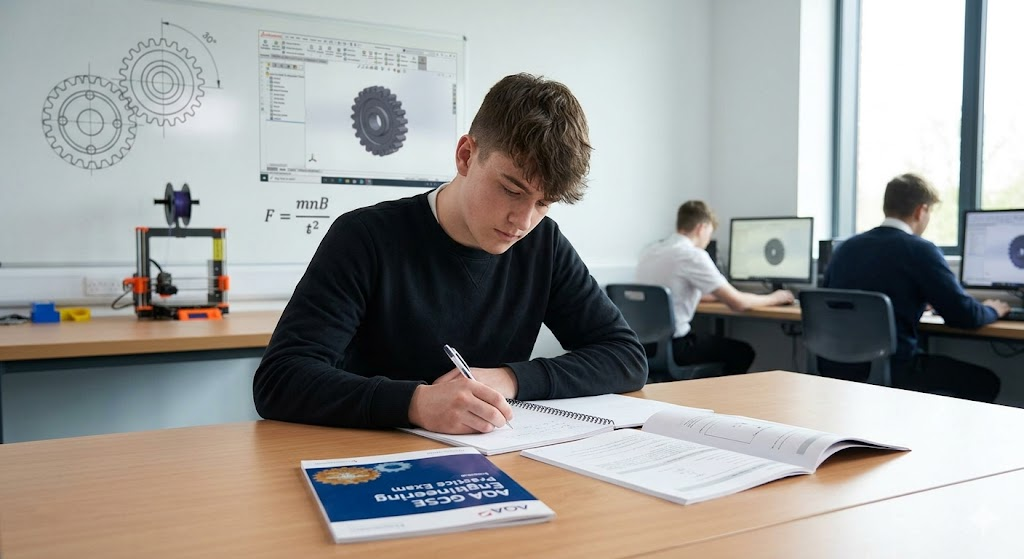
Additional Information
What the Course Entails and Exam Details
The course is structured to provide a broad understanding of various engineering disciplines. It combines theoretical knowledge with substantial practical work. Key areas of study include:
Engineering Materials: Understanding the properties, costs, and availability of metals, polymers, composites, and smart materials.
Manufacturing Processes: Learning how products are made, focusing on both traditional hand tools and modern computer-aided manufacturing (CAM).
Systems and Control: An introduction to mechanical, electrical, electronic, and pneumatic systems.
Testing and Investigation: Techniques for analyzing existing products and testing new designs.
The Impact of Engineering: Considering the ethical, environmental, and economic implications of engineering decisions.
Practical Skills: Developing competence in interpreting technical drawings, using CAD software, and safely operating workshop machinery.
What to Expect in the Final Exam
The assessment for AQA GCSE Engineering is divided into two equally weighted components, 50% written exam and 50% non-exam assessment (NEA).
Component 1: Written Examination (50% of GCSE) This is a single 2-hour written paper sat at the end of the course. The exam assesses knowledge and understanding of the core content. The paper is out of 120 marks.
The format includes:
Multiple choice questions: Testing quick recall of facts.
Short answer questions: Requiring brief explanations or definitions.
Extended response questions: These are 6- or 12-mark questions focusing on broader topics, such as manufacturing processes or the environmental impact of engineering. Students must demonstrate detailed knowledge and coherent arguments.
Calculations: Mathematical applications relevant to engineering (e.g., calculating gear ratios or material costs).
Component 2: Non-Exam Assessment (NEA) (50% of GCSE) This is a substantial practical project completed during class time (approximately 40–50 hours). AQA releases a 'brief' (a specific problem or context) that students must respond to. Students must produce a dynamic 'portfolio' and a 'prototype' that solves the problem presented. The assessment covers:
Problem solving.
Design and communication (using CAD and technical drawing).
Production planning and manufacturing.
Evaluation of the final prototype.
How to Study and Exam Centers
How to Study Success in AQA GCSE Engineering requires balanced preparation. Start early and revise consistently:
Use the Specification: Download the official AQA specification. This is your definitive checklist for what can appear in the written exam.
Practice with Past Papers: Complete as many previous exam papers and specimen papers as possible. This is the most effective way to understand the question structure and the depth of response required for extended answers.
Master Mathematical Skills: A small but significant portion of the written paper is math-based. Practice calculations related to mechanics, material properties, and electronics.
Focus on the NEA: Manage your NEA time strictly. Start prototyping early to allow time for testing and iterative improvement, which gains high marks. Use your portfolio to explain why you made decisions, not just what you did.
Understand Command Words: Know exactly what the question wants when it says "Describe," "Explain," "Analyze," or "Evaluate." This differentiates between a 2-mark and a 4-mark response.
Exam Centers GCSEs, including AQA Engineering, are exclusively taken within registered exam centers, which are almost always schools, sixth-form colleges, or further education colleges.
Independent or home-schooled students must arrange to register as a 'private candidate' at an approved center that is willing to host them. It is important to note that the physical practical work for the NEA must be completed under the direct supervision of a qualified teacher, so finding a center that will facilitate the practical component as well as the written exam is essential for private candidates. Candidates cannot take GCSE engineering exams online.
Job Opportunities from the Course
AQA GCSE Engineering provides a vital foundation for numerous career pathways. Successful students typically progress to A-Levels in Physics, Mathematics, or Design Technology, or pursue Level 3 technical qualifications such as BTECs.
This qualification is highly regarded by employers seeking apprentices or technical staff. Specific job titles that this pathway unlocks, often after further specific technical training or an apprenticeship, include:
Civil Engineering Technician
CAD Technician (Computer-Aided Design)
Mechanical Engineering Apprentice
Aerospace Manufacturing Technician
CNC Machinist / Operator
Electrical or Electronic Engineering Technician
Maintenance Engineer
Renewable Energy Technician
Robotics and Automation Technician
Materials Testing Technician
This GCSE is your first step toward a dynamic and rewarding career shaping the world around us. Best of luck with your studies!
Frequently Asked Questions
Reviews
5.0
Based on 0 reviews
Leave a Review
No reviews yet. Be the first to review!