
Assessment and Qualifications Alliance (AQA) GCSE Physics Paper 2 Practice Exam
$69.00
- Buy to unlock unlimited access to all Quiz questions and Answers in this Quiz.
- After purchase you can print a PDF of the whole quiz at any point. The PDF will contain the questions and the correct answers.
About this Exam
The AQA GCSE Physics Paper 2 Practice Exam is a crucial stepping stone for students aiming for success in their final General Certificate of Secondary Education (GCSE) in Physics. It is specifically designed to simulate the format, rigor, and topic coverage of the actual second paper of the assessment. This practice exam targets Year 11 students in England, Wales, and Northern Ireland who are studying the AQA Physics specification, whether as a separate science or as part of a Trilogy/Combined Science course. It provides an essential benchmark for measuring progress, identifying knowledge gaps, and building necessary exam stamina and confidence.
Ready to test your knowledge?
Buy Now to Access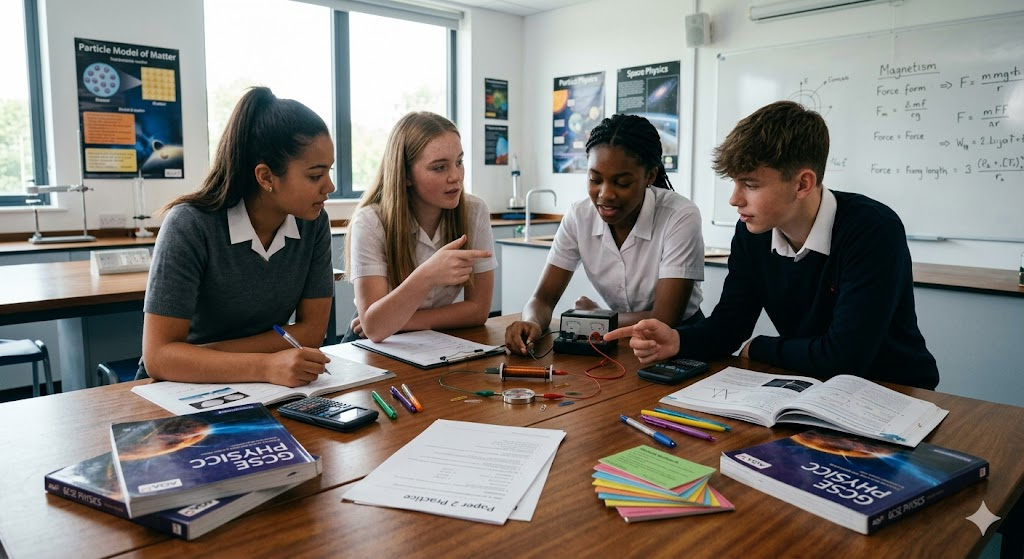
Additional Information
What the Course Entails and Exam Details
The AQA GCSE Physics course develops a fundamental understanding of the physical world, exploring the nature and properties of matter and energy. The curriculum for Paper 2 specifically focuses on several core topics. These major areas include 'Forces', which covers key concepts like Newton’s Laws, motion, and momentum. Students are also tested on 'Waves', encompassing properties, electromagnetic waves, and sound. The important topic of 'Magnetism and Electromagnetism' is covered, alongside 'Space Physics', which is specific to the separate Physics qualification. This course and its practice exam require students to apply mathematical skills, analyze data, and demonstrate a solid grasp of practical working methods.
What to Expect in the Final Exam
The final AQA GCSE Physics Paper 2 is a written examination. The paper is available in two tiers: Foundation (grades 1-5) and Higher (grades 4-9). The time limit for this exam is 1 hour and 45 minutes for separate physics and 1 hour and 15 minutes for combined science. The total mark count varies accordingly, usually 100 marks for the separate paper. The paper features a mix of question styles, including multiple choice, structured questions, closed short-answer responses, and open-ended, extended-response questions that are worth 6 marks. Specific practical knowledge is also assessed through questions based on 'Required Practicals' encountered during the course. A scientific calculator and a physics equation sheet are required tools for this test.
How to Study and Exam Centers
To study effectively for the AQA GCSE Physics Paper 2, focus on active revision methods. Create clear, concise mind maps for major topics like 'Forces' and 'Waves' and use flashcards to memorize essential equations and definitions. The most effective strategy is to practice with past exam papers; this identifies common question patterns and hones your time management. Analyze the official mark schemes to understand exactly what examiners look for. AQA GCSE Physics exams cannot be taken online; they are administered through authorized physical testing centers, which are almost always a student’s registered school or college. Private candidates must also register with an approved exam center, like a local school, to sit the written papers.
Job Opportunities from the Course
Achieving a strong grade in GCSE Physics opens diverse and exciting educational and career pathways. It is often a prerequisite for studying 'A-Level' Physics, Engineering, or Mathematics. This qualification serves as a valuable foundation for numerous technical roles and modern apprenticeships.
Specific job opportunities that value a strong foundation in Physics include:
Laboratory Technician
Apprentice Engineer (Civil, Mechanical, Electrical)
Electrician
Renewable Energy Technician
Data Analyst
Telecommunications Trainee
Aviation Trainee (e.g., Pilot, Air Traffic Control)
Frequently Asked Questions
Reviews
5.0
Based on 0 reviews
Leave a Review
No reviews yet. Be the first to review!