
Assisting With Wound Care Practice Exam
$69.00
- Buy to unlock unlimited access to all Quiz questions and Answers in this Quiz.
- After purchase you can print a PDF of the whole quiz at any point. The PDF will contain the questions and the correct answers.
About this Exam
The Assisting With Wound Care certification is a vital credential for healthcare providers dedicated to managing skin integrity and optimizing patient healing. This specialized exam assesses your readiness to support registered nurses, physicians, and other clinicians in providing specialized treatments for chronic, acute, and complex wounds. It is designed primarily for Certified Nursing Assistants (CNAs), Licensed Practical Nurses (LPNs/LVNs), Medical Assistants, and rehabilitation technicians who want to validate their clinical competency. Obtaining this certification demonstrates your commitment to patient safety, advanced sterile techniques, and evidence-based healing practices. This comprehensive practice exam is the ultimate tool to test your current knowledge, build your confidence, and identify critical knowledge gaps before sitting for the official final assessment.
Ready to test your knowledge?
Buy Now to Access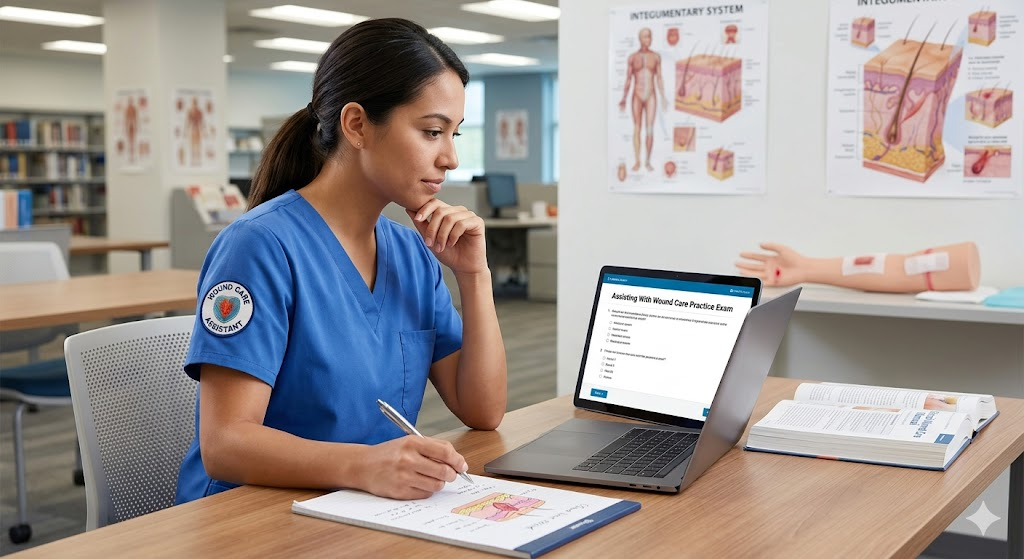
Additional Information
What the Course Entails and Exam Details
The core curriculum for wound care assisting focuses heavily on practical, hands-on knowledge balanced with essential biological concepts. You must possess a strong understanding of the anatomy of the integumentary system and the physiological phases of normal wound healing. The exam will test your ability to differentiate between various types of wounds, including pressure injuries, diabetic foot ulcers, arterial ulcers, and venous stasis ulcers. A major portion of the syllabus is dedicated to maintaining sterile fields, performing proper aseptic dressing changes, and utilizing appropriate personal protective equipment (PPE). Students are expected to know how to accurately measure wounds, document progression, identify signs of localized or systemic infection, and understand the nutritional factors that support tissue repair. You must also be familiar with the indications and contraindications for common dressing types, such as hydrogels, foams, alginates, and transparent films.
What to Expect in the Final Exam
The final certification exam typically utilizes a computerized testing format consisting of 100 to 120 multiple-choice questions. Depending on the certifying organization (such as NAWCO or ABWM), you should expect a testing window of approximately two hours to complete the assessment. In addition to the cognitive exam, many certifications also require students to pass a hands-on practical skills component supervised by an approved preceptor. This practical section might require you to demonstrate sterile technique while performing a dressing change or accurately staging a mock pressure injury. A passing score is usually predetermined based on a scaled grading system, often requiring you to achieve a score equivalent to 70% or higher. It is crucial to be prepared for scenario-based questions that test your ability to apply your knowledge to real-world patient care situations rather than just recalling facts.
How to Study and Exam Centers
To ensure success, create a structured study schedule focusing heavily on visual identification of wound types and the appropriate clinical response for each stage. We highly recommend utilizing specialized flashcards to memorize the specific characteristics of pressure injury stages, dressing categories, and medical terminology. Utilizing this specific practice exam repeatedly is the most effective way to familiarize yourself with the question format, improve your time management skills, and identify weak areas for targeted review. official exams are administered at physical testing centers, commonly through recognized providers like Pearson VUE or Prometric, which have locations nationwide. Depending on your specific certifying body, you may also have the option to take the test through a live remote proctoring portal from your own home, provided you meet the necessary technology and environment requirements.
Job Opportunities from the Course
Upon successful completion of your wound care certification, a variety of specialized and high-demand career paths will open to you within the healthcare sector.
Wound Care Nurse Assistant
Specialized CNA in Skilled Nursing Facilities
Home Health Aide with Wound Care Focus
Hyperbaric Technologist (with additional training)
Rehabilitation Assistant in Burn Centers
Wound Care Technician in specialized clinics
Clinical Medical Assistant in Dermatology or Podiatry offices
Frequently Asked Questions
Reviews
5.0
Based on 0 reviews
Leave a Review
No reviews yet. Be the first to review!