
Asthma Educator Certification Practice Test
$69.00
- Buy to unlock unlimited access to all Quiz questions and Answers in this Quiz.
- After purchase you can print a PDF of the whole quiz at any point. The PDF will contain the questions and the correct answers.
About this Exam
The Asthma Educator Certification, often leading to the credential of Certified Asthma Educator (AE-C), is a vital validation for healthcare professionals dedicated to improving the lives of individuals living with asthma. This certification signifies advanced knowledge in asthma management, education, and counseling. It is designed for diverse licensed or credentialed healthcare providers, including Registered Nurses, Respiratory Therapists, Pharmacists, Physician Assistants, and Nurse Practitioners, who wish to specialize their practice and demonstrate expertise in this chronic respiratory condition.
Ready to test your knowledge?
Buy Now to Access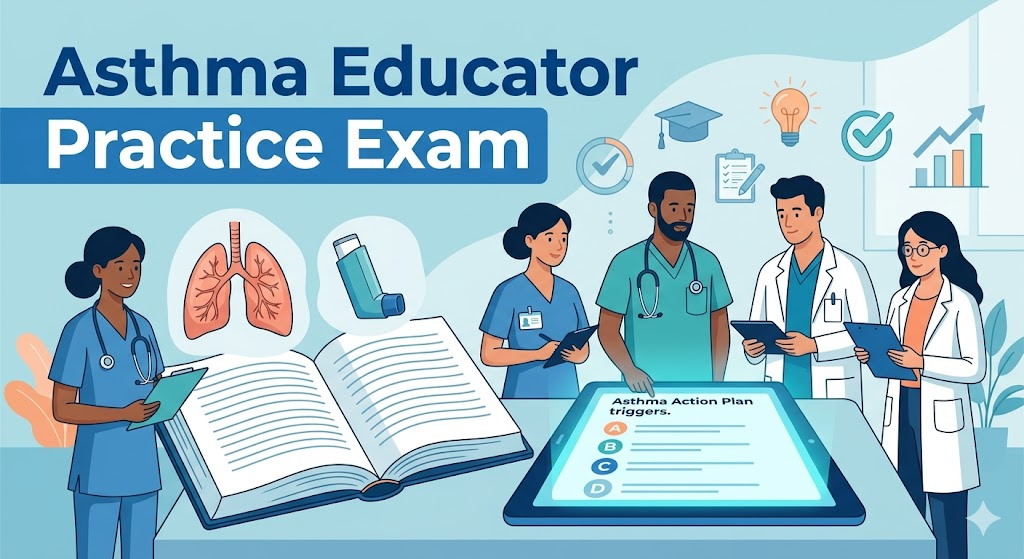
Additional Information
What the Course Entails and Exam Details
To become a Certified Asthma Educator, candidates must master a comprehensive body of knowledge centered on evidence-based asthma care. The core curriculum generally covers five major domains:
The Disease Process: Deep knowledge of anatomy, physiology, pathophysiology of asthma, and the factors contributing to airway inflammation.
Integrative Management: Understanding pharmacological therapies (controllers and quick-relief medications), delivery devices (inhalers, nebulizers), and non-pharmacological interventions.
Patient Education and Behavioral Change: Strategies for teaching self-management skills, developing Asthma Action Plans, and motivational interviewing to enhance adherence.
Environmental Factors: Identifying and managing asthma triggers, including allergens, irritants, and occupational exposures.
Program Management and Professional Issues: Implementing asthma education programs, public health implications, and ethical considerations in care.
What to Expect in the Final Exam
The actual AE-C certification exam, administered by the National Board for Respiratory Care (NBRC) in the United States, is a rigorous assessment. Candidates should expect the following format:
Exam Structure: The exam consists of multiple-choice questions designed to test recall, application, and analysis of clinical situations. There are typically 175 questions in total (150 scored items and 25 unscored pretest items).
Time Limit: Candidates are allowed a maximum of 3 hours to complete the examination.
Passing Score: The NBRC uses a scaled score system. A scaled score of 75 is required to pass.
Delivery Method: The exam is computer-based and administered in a secure, proctored environment.
How to Study and Exam Centers
Preparation is key to succeeding on the AE-C exam. Here are actionable strategies and information on where to test:
How to Study:
Leverage Official Resources: Begin with the NBRC’s official Candidate Handbook and content outline. The Association of Asthma Educators (AAE) often provides recommended review courses and study materials.
Use Practice Exams: Take multiple [Asthma Educator Certification Practice Tests] to familiarize yourself with the question style and manage your pacing. Review both correct and incorrect answers thoroughly.
Focus on the Guidelines: The exam heavily aligns with national guidelines, such as the National Asthma Education and Prevention Program (NAEPP) EPR-3 and GINA reports. Study these meticulously.
Join Study Groups: Collaborate with peers to discuss complex clinical scenarios and reinforce your understanding.
Exam Centers:
The AE-C exam is administered by the NBRC through Applied Measurement Professionals (AMP) test centers. These centers are located globally, often in professional testing facilities like H&R Block offices or dedicated Pearson VUE centers (check the NBRC website for current partners). You must register through the NBRC, and you will then be authorized to schedule your appointment at a convenient local center.
Job Opportunities from the Course
Obtaining the AE-C credential unlocks specialized career paths and can increase your marketability in various healthcare settings. This certification demonstrates to employers a dedicated expertise that is valuable in clinical and community health environments.
Career paths and job titles unlocked or enhanced by this certification include:
Certified Asthma Educator (AE-C)
Asthma Program Coordinator
Clinical Nurse Specialist (Asthma/Allergy focus)
Respiratory Therapist (with specialized outpatient caseloads)
Inpatient Asthma Educator
Community Health Educator
Case Manager for Chronic Diseases
Medical Science Liaison (Pharmaceutical industry)
Frequently Asked Questions
Reviews
5.0
Based on 0 reviews
Leave a Review
No reviews yet. Be the first to review!