
Astronomy Science Olympiad Master Practice Test
$69.00
- Buy to unlock unlimited access to all Quiz questions and Answers in this Quiz.
- After purchase you can print a PDF of the whole quiz at any point. The PDF will contain the questions and the correct answers.
About this Exam
The Science Olympiad Astronomy event is a challenging knowledge-based competition designed for middle school (Division B) and high school (Division C) students across the United States.
It is tailored for students with a profound interest in space, astrophysics, and observational astronomy.
Participants demonstrate their expertise in understanding complex astronomical concepts, interpreting real data, and solving intricate problems about the universe.
This competition goes beyond standard classroom curriculum, requiring dedicated preparation and a genuine passion for the subject.
Ready to test your knowledge?
Buy Now to Access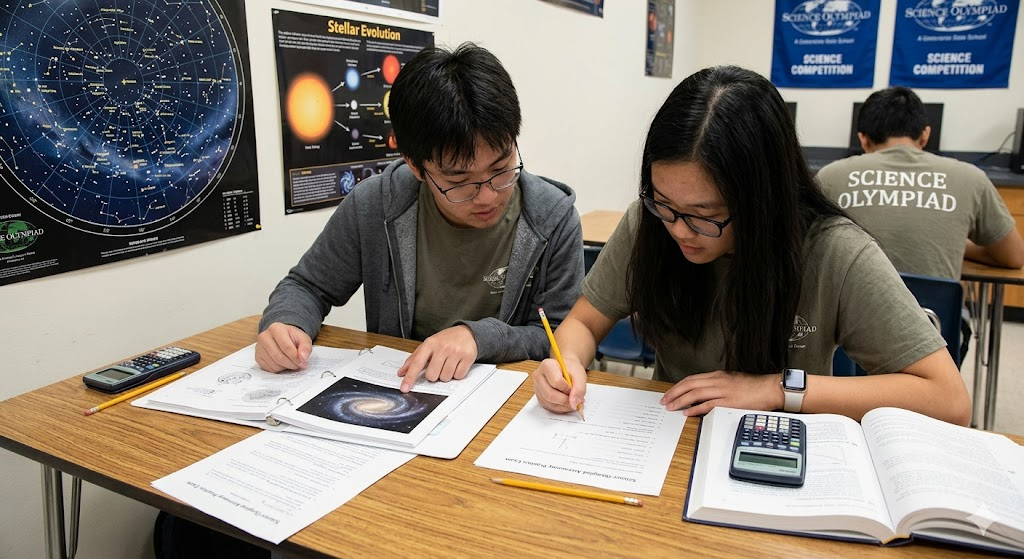
Additional Information
What the Course Entails and Exam Details
The syllabus for the Science Olympiad Astronomy event is rigorous and changes annually to include new focus topics and specific deep-sky objects.
Students must gain a deep understanding of stellar evolution, including the life cycles of stars, stellar classification using the Hertzsprung-Russell (H-R) diagram, and the formation of various celestial structures.
Core topics typically include:
Observational Astronomy: Identification and understanding of specific deep-sky objects (nebulae, star clusters, galaxies, variable stars) relevant to the current year's rules.
Astrophysical Concepts: Stellar properties, electromagnetic radiation, spectroscopy, and basic orbital mechanics.
Cosmology and Galaxies: Structure of the Milky Way, galactic evolution, and cosmological distance scales.
The "Master Practice Test" is designed to comprehensively cover these areas, mirroring the depth and difficulty of an actual regional or state-level competition.
What to Expect in the Final Exam
The official Science Olympiad Astronomy competition is a written test, typically taken by a team of two students.
The exam format is diverse, incorporating multiple-choice questions, matching, identification of objects from images or charts, and complex calculation problems that require applying mathematical formulas (such as Kepler's Laws or distance modulus).
Participants are allowed to bring specific resources, such as a dedicated binder of notes or a laptop (depending on the specific year's rules and division), making resource organization a critical part of preparation.
The standard time limit for the competition is 50 minutes.
Success is determined by the highest score, and tie-breakers are often incorporated based on pre-selected difficult questions.
How to Study and Exam Centers
Effective preparation for this event requires more than just passive reading.
Students should:
Utilize Official Resources: Always start with the official Science Olympiad rules and the sanctioned test packet for the current year.
Master the Deep-Sky Objects: Create flashcards and study guides for the specific list of objects designated for the current season, focusing on their characteristics, location, and significance.
Practice with Data: Learn to interpret real astronomical data, including light curves of variable stars, H-R diagrams, and stellar spectra.
Build a Comprehensive Binder: Organize reference materials efficiently, ensuring quick access to formulas, charts, and object summaries during the timed exam.
Take Timed Practice Tests: Regularly simulate competition conditions using practice exams to improve speed and accuracy.
Science Olympiad competitions do not take place at standard professional testing centers.
Instead, they are held at various host locations, including middle schools, high schools, and universities, organized at the regional, state, and national levels.
Students must be part of a registered school team to participate in these official tournaments.
Job Opportunities from the Course
While participating in the Science Olympiad Astronomy event does not directly lead to immediate employment, the skills and knowledge acquired are foundational for numerous STEM career paths.
This competition fosters critical thinking, complex problem-solving, teamwork, and data analysis—skills highly valued in scientific fields.
Students who excel in this event often pursue higher education and careers in:
Astrophysics
Planetary Science
Data Science and Analysis
Aerospace Engineering
Science Education and Communication
Good luck with your preparation for the Science Olympiad Astronomy event!
Frequently Asked Questions
Reviews
5.0
Based on 0 reviews
Leave a Review
No reviews yet. Be the first to review!