
Athletic Training Education Competency Practice Test
$69.00
- Buy to unlock unlimited access to all Quiz questions and Answers in this Quiz.
- After purchase you can print a PDF of the whole quiz at any point. The PDF will contain the questions and the correct answers.
About this Exam
Welcome to your essential guide for the Athletic Training Education Competency Practice Test. This crucial assessment is a pivotal stepping stone designed for students enrolled in accredited athletic training programs who are preparing to transition from classroom knowledge to clinical proficiency. The exam acts as a comprehensive check, ensuring you have mastered the foundational concepts and practical skills required to safely and effectively practice as an entry-level athletic trainer. It is an indispensable tool to gauge your readiness for the rigors of the final Board of Certification (BOC) exam and your future career. Think of it not just as a test, but as a roadmap to professional confidence.
Ready to test your knowledge?
Buy Now to Access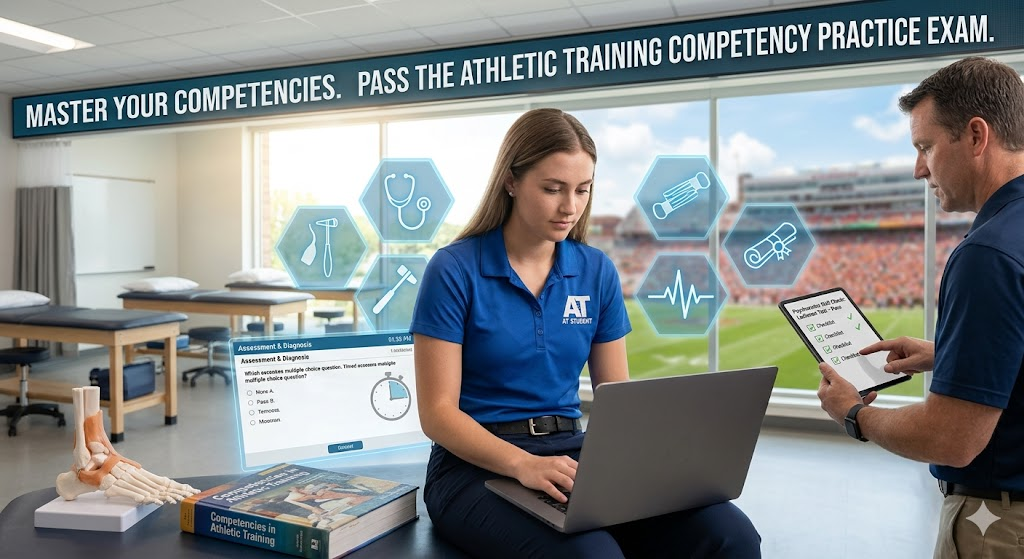
Additional Information
What the Course Entails and Exam Details
This examination is based on the rigid standards established by the Commission on Accreditation of Athletic Training Education (CAATE). It evaluates a wide spectrum of cognitive knowledge and psychomotor skills. Candidates must demonstrate competence in the five primary domains of athletic training.
These domains include:
Risk Reduction, Wellness, and Health Literacy: Focusing on injury prevention strategies, protective equipment, and wellness education.
Assessment, Evaluation, and Diagnosis: Testing your ability to perform clinical evaluations and accurately diagnose musculoskeletal injuries and medical conditions.
Critical Incident Management: Assessing immediate care skills for acute injuries and emergency situations, including spine boarding and CPR.
Therapeutic Intervention: Evaluating your knowledge of rehabilitation techniques, therapeutic modalities, and pharmacology.
Healthcare Administration and Professional Responsibility: Covering documentation, facility management, legal standards, and ethical practice.
What to Expect in the Final Exam
While the exact structure can vary depending on whether your specific test is institutional or a standardized mock exam, you should anticipate a challenging, hybrid format. Most modern competency practice tests mimic the BOC exam, featuring approximately 125 to 175 items.
The format generally includes:
Standalone Multiple-Choice Questions: Assessing core knowledge and recall.
Multi-Select Items: Requiring you to choose all correct answers in a complex scenario.
Focused Testlets: Presenting a clinical case scenario followed by a series of five distinct questions derived from it.
Drag-and-Drop/Hot Spot: Evaluating practical skill application and anatomical knowledge.
You will typically be given a time limit of three to four hours to complete the computerized portion. Institutional competency assessments often also include a separate practical (psychomotor) component where you must demonstrate skills like taping, evaluation, or manual therapy to a preceptor. A passing score usually ranges from 70% to 80%, depending on the specific program or testing body's standards. It is crucial to check the specific rules of your program regarding the use of scratch paper, calculators, and scheduled breaks.
How to Study and Exam Centers
Effective preparation for this competency exam requires a dynamic, multi-faceted approach. You cannot rely on passive reading; you must actively apply your knowledge.
Actionable Study Strategies:
Utilize Practice Testing Early and Often: Take timed practice exams to simulate the pressure and identify your weakest domains. Review every explanation, understanding why the correct answer is correct and why the others are not.
Master the Basics: Revisit your fundamental anatomy and physiology. A deep understanding of these subjects is the backbone of accurate assessment and effective rehabilitation.
Integrate Your Clinical Experience: The strongest students bridge the gap between classroom and clinic. Visualize your past clinical rotations when answering scenario-based questions. Ask your preceptors mock questions during downtime.
Focus on Domain Mastery: Do not treat all subjects equally. If you struggle with Therapeutic Intervention, dedicate more study time to modalities and rehabilitation progressions.
Where to Take the Exam: As this is often an educational requirement or a practice tool, you will typically access the Athletic Training Education Competency Practice Test through one of two primary pathways:
Online Educational Portals: Many accredited programs subscribe to third-party services like ACES (Athletic Training Competency Assessment System) or specialized test prep platforms. You will log in and take the exam remotely or in a supervised computer lab.
On-Campus Testing: Institutional competency exams are administered directly by your program faculty within physical classrooms or clinical simulation labs on your university’s campus. Your program director will provide specific details on scheduling and location.
Job Opportunities from the Course
Successfully navigating your educational competencies is the mandatory key that unlocks the door to your ultimate goal: the BOC certification and the ATC credential. Once certified and licensed, you are qualified for diverse and rewarding career paths.
Some of the job opportunities available to you include:
Secondary School Athletic Trainer: Providing healthcare to high school athletes.
Collegiate/University Athletic Trainer: Working with NCAA, NAIA, or junior college sports teams.
Professional Sports Athletic Trainer: Employed by teams in leagues like the NFL, NBA, MLB, MLS, or NHL.
Clinic-Based Athletic Trainer: Working alongside physicians in sports medicine or orthopedic clinics.
Industrial/Occupational Athletic Trainer: Managing injury prevention and rehabilitation in corporate or manufacturing settings.
Military/Tactical Athletic Trainer: Providing healthcare to armed forces personnel or first responders.
Performing Arts Athletic Trainer: Supporting dancers, musicians, and other performers.
Frequently Asked Questions
Reviews
5.0
Based on 0 reviews
Leave a Review
No reviews yet. Be the first to review!