
Atlanta Fire Rescue Instructor 1 Practice Test
$69.00
- Buy to unlock unlimited access to all Quiz questions and Answers in this Quiz.
- After purchase you can print a PDF of the whole quiz at any point. The PDF will contain the questions and the correct answers.
About this Exam
The Atlanta Fire Rescue Instructor 1 certification is a foundational milestone for dedicated fire service personnel within the Atlanta metropolitan area who are ready to transition from a responsive role to an educative one.
This certification, which aligns with the National Fire Protection Association (NFPA) 1041 Standard for Fire Service Instructor Professional Qualifications, is designed specifically for firefighters, apparatus operators, and junior officers who possess a strong desire to train, mentor, and shape the next generation of public safety professionals.
By obtaining this level of certification, you demonstrate to the Atlanta Fire Rescue Department (AFRD) and the Georgia Firefighter Standards and Training Council (GFSTC) that you have mastered the essential teaching concepts, safety protocols, and presentation skills required to deliver authorized training curricula within your department.
It is an ideal path for those seeking career advancement and a lasting impact on departmental efficiency and safety.
Ready to test your knowledge?
Buy Now to Access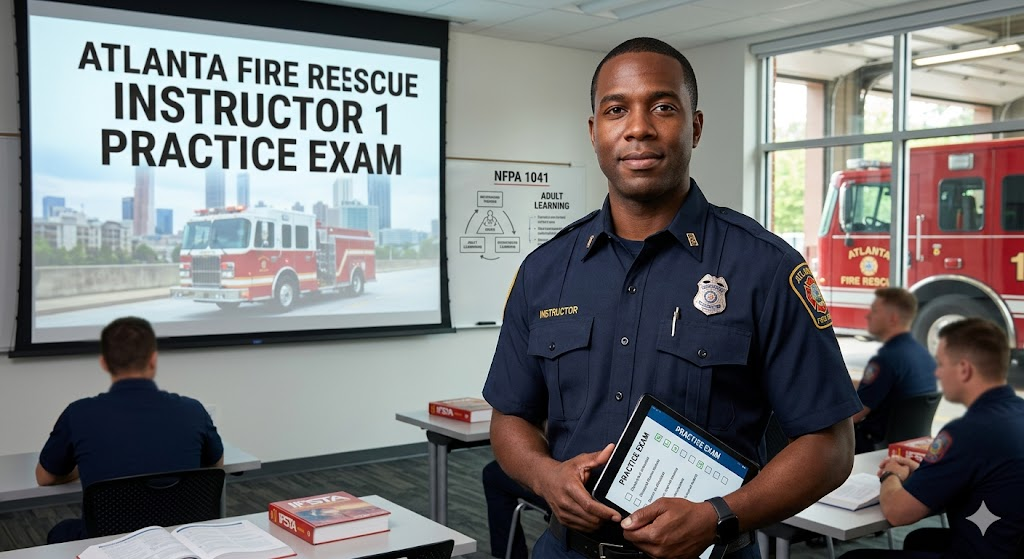
Additional Information
What the Course Entails and Exam Details
The path to becoming a certified Instructor 1 involves both a comprehensive training course and a rigorous final examination. The curriculum focuses heavily on pedagogical skills tailored to the high-stakes environment of emergency services.
Key topics and cognitive skills covered in the course and evaluated on the exam include:
Foundations of Learning: Understanding different adult learning styles and how to adapt your teaching methods to ensure all students succeed.
Instructional Planning: Mastering the art of reviewing lesson plans, assembling necessary instructional materials, and organizing the learning environment for maximum efficiency and safety.
Delivery Methods: Learning to utilize varied teaching techniques, including lectures, practical demonstrations, and the effective integration of audiovisual technology and simulated training aids.
Testing and Evaluation: Acquiring the skills to administer oral, written, and practical examinations fairly and accurately, as well as providing constructive feedback to learners.
Legal and Safety Responsibilities: Deeply understanding instructor liability, standard operating procedures (SOPs), and NFPA safety standards to ensure all training is conducted without incident.
What to Expect in the Final Exam
The final certification process consists of two primary components designed to measure both your knowledge and your ability to apply it. You must succeed in both areas to receive your Instructor 1 certification.
The Written Examination:
The cognitive portion of the exam is typically presented as a multiple-choice examination. This test assesses your comprehension of NFPA 1041 standards, adult learning theories, and safety protocols. Students are usually given a strict time limit (often two to three hours) to complete the test.
Passing Score Requirement:
In accordance with GFSTC standards, a minimum passing score of 70% to 80% is typically required on the written examination.
Practical Skills Evaluation:
Because teaching is an applied skill, you will also undergo a practical evaluation. Candidates are required to prepare and deliver a formal presentation on a fire service topic before a panel of evaluators. You will be graded on your lesson plan organization, your clarity of speech, your use of instructional aids, and your adherence to safety guidelines during demonstrations.
How to Study and Exam Centers
Preparation is paramount for this exam. Moving beyond passive reading to active practice is the key to success.
Actionable Study Strategies:
We highly recommend utilizing a combination of standard fire service texts (such as IFSTA or Jones & Bartlett) and dedicated Atlanta Fire Rescue Instructor 1 practice tests. Practicing with sample questions will help you familiarize yourself with the phrasing of the exam and identify weak areas in your knowledge base.
Furthermore, you should practice your presentation skills. Record yourself teaching a 15-minute topic and critique your delivery. Ensure you can manage instructional aids smoothly and address potential student questions confidently.
Exam Centers and How to Register:
The written and practical examinations are administered under the authority of the Georgia Firefighter Standards and Training Council (GFSTC).
Typically, the testing takes place at authorized regional training centers or specific academy locations, such as the Atlanta Fire Rescue Department Training Academy. You must register for the exam through your department’s training officer or the GFSTC portal. While some written components might be offered via online portals, the practical evaluations almost always require physical presence at an authorized testing center.
Job Opportunities from the Course
Obtaining your Instructor 1 certification is an essential career accelerator. It is often a prerequisite for promotion within the AFRD and unlocks specialized roles.
By successfully completing this course and exam, you unlock career paths and job titles such as:
Company Officer (Lieutenant/Captain): In many departments, Instructor 1 certification is required to promote to an officer level, as officers are responsible for the daily training of their crews.
Departmental Training Officer: This allows you to serve within the dedicated training division, planning and delivering department-wide training programs.
Fire Academy Instructor: You may become eligible to instruct recruit classes at the Atlanta Fire Rescue Training Academy or other regional academies.
Adjunct Fire Science Instructor: This certification can open opportunities to teach part-time at local colleges or technical schools offering Fire Science degrees.
Specialized Subject Matter Expert (SME): This is the foundational step toward becoming an instructor in specialized fields like Hazardous Materials, Technical Rescue, or Live Fire Training.
Frequently Asked Questions
Reviews
5.0
Based on 0 reviews
Leave a Review
No reviews yet. Be the first to review!